Categories
Exam Questions Harvard

Harvard. Modern Schools of Economic Thought, Midyear Exam. Schumpeter, 1927-1928.


I just returned from a recent trip that included 5.5 working days in the Harvard University Archives. Among the images of treasures for transcription that I have brought back are the mid-year examinations for several decades of Harvard’s year-long economics courses. My first order of business now  is to add the corresponding mid-year examinations to material already posted for Harvard courses here at Economics in the Rear-view Mirror.

We begin with a course taught by the ever popular and ultimate click-bait, Joseph Schumpeter. The final examination questions for his 1927-28 course, Modern Schools of Economic Thought, have been posted earlier. Now we know something about what was covered in the first semester of that course.

________________________

1927-28
HARVARD UNIVERSITY
ECONOMICS 15

Mid-Year Examination

  1. Write as fully as possible on either one or the other of the following subjects:
    1. What is the distinctive characteristic of Capitalism and how does the view we have about it influence our capital concept?
    2. The evolution and basic function of the Entrepreneur.
  2. Answer shortly two out of the four following questions:
    1. The substitution of capital for labor means the substitution of labor assisted by much waiting for labor assisted by little waiting. (Marshall) Criticize.
    2. What is meant by the ‘superior bargaining power’ of the entrepreneur and how much does what is meant by it amount to in explaining entrepreneur’s gains?
    3. According to the theory of marginal utility, prices are proportional to marginal utility. According to the Ricardian theory of value prices are—fundamentally—proportional to quantities of labor necessary for the production of commodities. Prove that the second proposition, upon the introduction of suitable assumptions, turns out to be a special case of the first.
    4. A rise in any element of expenses of production is generally held to raise the prices of products. Interest is an element of expenses of production. The rate of discount is obviously a rate of interest. Yet it is held that raising the rate of discount will depress prices. Explain and criticize.


Source: Harvard University Archives. Examination Papers, Mid-Years, 1927-28 (HUC 7000.55), Papers Printed for Mid-Year Examinations. History, History of Religions,… , Economics,… , Military Science, Naval Science. January-February, 1928.

Image source: Joseph A. Schumpeter at table with books, photograph, ca. 1930. Detail from image posted at Harvard University Archives. Joseph Schumpeter Papers. HUGBS 276.90p (38).

Categories
Curriculum Fields Harvard

Harvard. Mathematical Economics Recognized as Subfield of Theory. E.B. Wilson, Crum, and Schumpeter, 1933


What I find particularly striking in the following report of the Committee on Instruction in Mathematical Economics at Harvard (note the  first named of the trio is E. B. Wilson) is the forecast that economics graduate students will need to acquire tools of mathematical economics and statistics already in the mid 1930s because they will need them later, 1953-63, when they will be “at the height of their activity” and by which time (implicitly) the “rapidly increasing importance of theoretical and statistical work involving higher mathematics” will have caught up with them. I have appended the course names for the statistics and mathematics courses referred to by number in the report.

Related postings: 

_____________________

Meeting of the Committee (Wilson, Crum, Schumpeter) on
Instruction in the Mathematical Economics
Tuesday, May 9 [1933]

In view of the rapidly increasing importance of theoretical and statistical work involving higher mathematics, and of the possibility that a considerable number of economists may have to be adequately familiar with both mathematical theory and statistical procedure twenty to thirty years from now, that is, when many of our present students will be at the height of their activity, the Committee (Wilson, Crum, Schumpeter) agreed on the following recommendations to be submitted to the Department which they believe to be both necessary and sufficient in order to provide facilities for events to work in mathematical theory as applied to economics:

(1) Any student who may wish to do so should be allowed to offer mathematical economics as his special field within the requirements for the Ph.D. This would involve but a slight alteration of existing practice which permits students to choose some branch of economic theory as a special field. The committee’s suggestion is merely that mathematical economics should be added to the other special subjects in economic theory which a student may select.

It seems desirable, moreover, to permit that any such student may select mathematics or rather some branch of pure or applied mathematics in place of one of the two remaining fields he has to offer.

(2) Advanced work in mathematical economics should conform to modern tendencies by stressing equally the mathematical side of economic theory and mathematical statistics. No student who elects mathematical economics as his special field should be allowed to do the one without the other. Especially courses 31a and 32b should be required also from students mainly interested in pure theory.

(3) Work in the Department of Mathematics through Math 5 should be considered as the minimum requirement as to mathematical training. Credit should be given only for Math 5, but not for any of the still more elementary course preparatory to it, which most of the students taking up mathematical economics will have had anyhow in their undergraduate period.

(4) No further steps should be taken at present. It seems best to see what the response will be before attempting to organize a special graduate course. The mathematical aspect of our subject is being dealt with in some courses already, and any Ph.D. candidates who may present themselves in case the rules be altered as recommended could easily be taken care of individually.

*  *  *  *  *  *  *  *

Copy of Letter from Harold H. Burbank to Joseph Schumpeter

October 3, 1933

Dear Joe,

I have read and approved without qualification the report of the Committee on Instruction in Mathematical Economics.

I think this report should be brought before the Department on the evening of Tuesday, October 10.

Very sincerely yours,

Prof. J. A. Schumpeter
2 Scott Street

HHB:VS

*  *  *  *  *  *  *  *

Graduate Instruction in the Mathematical Economics
Department Vote, October 10, 1933

In view of the rapidly increasing importance of theoretical and statistical work involving higher mathematics, and of the possibility that a considerable number of economists may have to be adequately familiar with both mathematical theory and statistical procedure twenty to thirty years from now, that is, when many of our present students will be at the height of their activity, the Committee (Wilson, Crum, Schumpeter) agreed on the following recommendations to be submitted to the Department which they believe to be both necessary and sufficient in order to provide facilities for events to work in mathematical theory as applied to economics.

The Department voted to accept the recommendations stated as follows:

(1) Any student who may wish to do so should be allowed to offer mathematical economics as his special field within the requirements for the Ph.D. This would involve no alteration of existing practice, which permits students to choose some branch of economic theory as a special field. The committee’s suggestion is that mathematical economics should be admissible.

(2) Any students using mathematical economics as his special field should be allowed to offer some branch of pure or applied mathematics as an allied field.

Work in the Department of Mathematics through Math 5, or the equivalent, should be considered as the minimum requirement as to mathematical training. Credit should be given only for Math 5, but not for any more elementary course preparatory to it.

(3) Advanced work in mathematical economics should conform to modern tendencies by stressing equally the mathematical side of economic theory and mathematical statistics. Therefore courses 31a and 32b should be required of anyone in electing mathematical theory as his special field.

(4) No further steps need be taken at present. It seems best to see what the response will be before attempting to organize a special graduate course. Any individual cases calling for special attention can be dealt with, under the proposed regulation, as our courses now stand.

Source:  Harvard University Archives. Department of Economics, Correspondence and papers 1930-1961. (UAV349.11), Box 13.

_____________________

Statistics Courses offered in the Department of Economics
at Harvard, 1934-35

Economics 31a 1hf (formerly Economics 41a). Theory of Economic Statistics, I

Half-course (first half-year). Mon., Wed., Fri., at 9. Professor Crum and Asst. Professor Frickey.
Economics 1a, or its equivalent, is a prerequisite for this course.

Economics 31b 2hf (formerly Economics 41b). Theory of Economic Statistics, II

Half-course (second half-year). Mon., Wed., Fri., at 9. Professor Crum and Asst. Professor Frickey.
Economics 1a, or its equivalent, is a prerequisite for this course.

Economics 32b 2hf (formerly Economics 42). Foundations of Statistical Theory

Half-course (second half-year). Tu., Th., 3 to 4.30. Professor E. B. Wilson.
Economics 31and one year of Calculus are prerequisites for this course.

Source: Announcement of the Courses of Instruction offered by the Faculty of Arts and Sciences, 1933-34(second edition), Official Register of Harvard University, Vol. XXX, No. 39 (September 20, 1933), p. 128.

_____________________

Undergraduate Mathematics Courses
at Harvard, 1934-35

Mostly Freshmen

[Mathematics] A. Professors J. L Coolidge et al. — Analytic Geometry; Introduction to the Calculus.

Mostly Sophomores

[Mathematics] 2. Professors Graustein et al. — Differential and Integral Calculus; Analytic Geometry.

Mostly Juniors

[Mathematics] 5a1hf. Professor Morse. — Differential and Integral Calculus (advanced course), Part I

[Mathematics] 5a2hf. Professor Morse. — Differential and Integral Calculus (advanced course), Part II


Source: Harvard University. Report of the President of Harvard College, 1934-35, p. 86.


Images:  Left to right: William Leonard Crum, Joseph A. Schumpeter, Edwin Bidwell Wilson. From the 1934 (Crum) and 1939 (Schumpeter and Wilson) Harvard Class Albums.


Categories
Exam Questions Harvard

Harvard. Core graduate economic theory exams. Schumpeter, 1938


This post provides three examinations found for the year-long graduate economic theory course taught by Joseph Schumpeter. Reading lists as well as the examinations for the immediately preceding two years have been posted earlier (see links below).

_________________

Related posts for core graduate economic theory
Reading lists, examinations

1935-36 Schumpeter
1936-37 Schumpeter

_________________

Course Enrollment

[Economics] 101 (formerly 11). Professor Schumpeter.—Economic Theory.

Total 36: 25 Graduates, 4 Seniors, 3 School of Public Administration, 3 Radcliffe, 1 Other.

Source: Harvard University. Report of the President of Harvard College, 1937-38, p. 85.

_________________

Mid-year Examination, 1938.

1937-38
HARVARD UNIVERSITY
ECONOMICS 101

Answer FIVE questions

  1. The Marshallian law of demand states that falling price is associated with increasing quantity demanded. But we often find that, on the contrary, quantity sold increases and decreases with price. How would you explain such cases?
  2. In what sense are decreasing average unit costs incompatible with perfect competition?
  3. What is meant by elasticity of expenditure, and how is this concept related to the ordinary elasticity of demand?
  4. Do you think that monopoly price should be more “rigid” than competitive price? Explain your answer.
  5. To what extent is it true that conditions deviating from perfect competition tend to produce excess capacity?
  6. Is it correct to say that there is one and only one price to every oligopolistic situation because the only rational course for oligopolists to adopt is to combine and thus to set up a simple monopoly?
  7. How are prices determined in the case of a discriminating monopolist selling in two separate markets? In general would you expect output to be larger or smaller under discriminating monopoly than under simple monopoly?

Source: Duke University. David M. Rubenstein Rare Book and Manuscript Library. Economists’ Papers Archive. Papers of Llloyd Appleton Metzler, Box 7, “H. C. S. Easy Clasp File”.

_________________

ECONOMICS 101
Make-up Examination, March 1938

(Answer FIVE questions)

  1. What is the difference between the Marshallian supply curve and the particular expenses curve?
  2. What do we mean by saying that under conditions of perfect competition firms produce “up to the optimal point” while under conditions of the imperfect competition they do not?
  3. Given the indifference map of an individual, how can a demand curve be deduced therefrom? Is this a Marshallian demand curve?
  4. Define bilateral monopoly and indicate conditions under which price is, and conditions under which price is not, determinate.
  5. What is the difference between monopolistic competition and oligopoly?
  6. Discuss the relation between cost curves and supply curves.
  7. Discuss the relation between the elasticity of demand and the elasticity of substitution.

Source:Harvard University Archives. Papers of Joseph Schumpeter. Lecture Notes, Box 10, Folder “Ec 101”.

_________________

Final Examination, 1938.

1937-38
HARVARD UNIVERSITY
ECONOMICS 101

Answer FIVE questions

  1. If the elasticity of substitution of a factor is greater than the elasticity of demand for the product, then the elasticity of demand for that factor will be smaller, the greater is the proportion of that factor to the others. Prove, assuming that there are only two factors.
  2. It has been held that in a socialist society income should consist of two parts: a wage fixed much as it would be under perfectly competitive capitalism, and a “dividend” out of the surplus of the total national product over the sum total of wages. It has also been held that the size of dividends should be proportional to wages received. Do you think that such a policy would secure optimal allocation of resources, assuming free choice of occupations?
  3. Profits have sometimes been defined as a “rent of ability.” Do you think this satisfactory? Why or why not?
  4. “The extent and direction in which the amount of the factor employed in any use differs from the ideal amount varies directly with the divergence between the fraction

\frac{\text{marginal revenue to the individual firm}}{\text{price}}

in the particular use and in the alternative use from which the factor has to be drawn .… The magnitude of the elasticity of demand is an inverse measure of the degree of imperfection of competition. We may conclude that it is socially desirable to expand those industries in which competition is more imperfect than the industry with which they compete for their factors of production and to contract those in which the opposite condition prevails.” Explain.

  1. What would you expect the effective technological change (“invention”) on the rate of interest to be?
  2. How would you measure the loss inflicted on consumers by the imposition of an import duty? Must there necessarily be a loss? Would your conclusions be affected if the commodity were controlled in the exporting country by a monopolist?
  3. “The Marxist’s claim to superiority for his economics is that ‘bourgeois’ economics has utterly failed to explain the fundamental tendencies of the development of the capitalist system.” Do you think this claim is justified in so far as it concerns “bourgeois” economics? How does the Marxist attempt to provide a theoretical explanation of the “fundamental tendencies of the development of the capitalist system?”


Source: Duke University. David M. Rubenstein Rare Book and Manuscript Library. Economists’ Papers Archive. Papers of Llloyd Appleton Metzler, Box 7, “H. C. S. Easy Clasp File”.

Image Source: Joseph A. Schumpeter in Harvard Class Album, 1939.


Categories
Exam Questions Harvard Leontief Undergraduate

Harvard. Undergraduate mathematical economics. Schumpeter, Leontief, Goodwin. 1933-1950


Joseph Schumpeter introduced a one semester undergraduate course “Introduction to the Mathematical Treatment of Economic Theory” in the first semester of the 1933-34 academic year at Harvard. Schumpeter taught the course three times and it was taught from 1935-36 through 1947-48 by Wassily Leontief. The course was then continued by Richard Goodwin in 1949-50. This post presents a grab-bag of information that includes early and a late course description, annual enrollment data, a course outline from 1945-46 and five exams. Links to all earlier posts for the course available at Economics in the Rear-view Mirror have been included as well.

Some of the backstory to this course is included in this earlier post (memo by Crum of 4 April 1933 and a list of topics to be covered).

_______________

Course Announcement, 1933-34

Economics 8a 1hfIntroduction to the Mathematical Treatment of Economic Theory

Half-course (first half-year). Mon., 4 to 6, and a third hour at the pleasure of the instructor. Professor Schumpeter, and other members of the Department.

Economics 8a is open to those who have passed Economics A, and Mathematics A, or its equivalent. The aim of this course is to acquaint such students as may wish it with the elements of the mathematical technique necessary to understand the simpler contributions to the mathematical theory of economics.

Source:  Announcement of the Courses of Instruction offered by the Faculty of Arts and Sciences 1933-34 (Second edition) in Official Register of Harvard University, Vol. XXX, No. 39 (September 20, 1933), p. 126.

*  *  *  *  *  *  *

Course Enrollment, 1933-34

[Economics] 8a 1hf. Professor Schumpeter. — Introduction to the Mathematical Treatment of Economic Theory.

15 Graduates, 3 Seniors, 5 Others. Total 23.

Source: Harvard University. Report of the President of Harvard College and Reports of Departments for 1933-1934, p. 85.

*  *  *  *  *  *  *

Exam not found for Economics 8a, 1933-34

_______________

Course Enrollment, 1934-35

[Economics] 8a 1hf. Professor Schumpeter. — Introduction to the Mathematical Treatment of Economic Theory.

2 Seniors, 1 Junior, 1 Sophomore. Total 4.

Source: Harvard University. Report of the President of Harvard College and Reports of Departments for 1934-1935, p. 81.

*  *  *  *  *  *  *

 1935 final exam questions.

_______________

Course Enrollment, 1935-36

[Economics] 8a 2hf. Asst. Professor Leontief. — Introduction to the Mathematical Treatment of Economic Theory.

4 Juniors, 2 Sophomores. Total 6.

Source: Harvard University. Report of the President of Harvard College and Reports of Departments for 1935-1936, p. 82.

*  *  *  *  *  *  *

Implicit course outline and course readings with the 1936 exam questions.

_______________

Course Enrollment, 1936-37

[Economics] 4a 2hf. Asst. Professor Leontief. — Introduction to the Mathematical Treatment of Economic Theory.

1 Graduate, 2 Seniors, 3 Juniors, 2 Sophomores, 1 Other. Total 9.

Source: Harvard University. Report of the President of Harvard College and Reports of Departments for 1936-1937, p. 92.

*  *  *  *  *  *  *

Final Examination, 1936-37
HARVARD UNIVERSITY
ECONOMICS 4a

Answer at least THREE questions: one in each group

Group I

  1. Discuss the relation between the production function of an enterprise and its cost curve.


Group II

  1. Given a cost of a single plant:
    C=\frac{1}{A+X}+BX
    where indicates the total cost, the total output, and the magnitudes of the two constants are such
    that A< 0 and B> 1/A.
    Derive the total cost curve of an enterprise which consists of two identical plants of this kind.
  2. A monopolist sells in two markets a commodity produced without costs. The total revenue, R1, obtained from the sale of qunits of this commodity in the first market is given by:
    {{R}_{1}}=A{{q}_{1}}+Bq_{1}^{2}\text{ }\left( A>0,\text{ }B<\text{ }0 \right)
    The sale of qunits in the second market nets:
    {{R}_{2}}=K{{q}_{2}}+Lq_{2}^{2}\text{ }\left( K>0,\text{ }L<\text{ }0 \right)
    Compute the prices which this monopolist would charge (a) with discrimination between the two markets; (b) without discrimination.


Group III

  1. Prove that marginal costs are increasing in the point of minimum average costs.
  2. Prove that a tax on profits cannot affect the output of an enterprise unless it induces it to suspend its operations.


Source: Harvard University Archives. Examination Papers. Finals 1937. (HUC 7000.28) Vol. 79. Faculty of Arts and Sciences. Papers Printed for Final Examinations. History, History of Religions, …, Economics, …, Military Science, Naval Science. January-June, 1937.

_______________

Course Enrollment, 1937-38

[Economics] 4a 2hf. Asst. Professor Leontief. — Introduction to the Mathematical Treatment of Economic Theory.

2 Graduates, 2 Seniors, 6 Juniors, 1 Sophomore. Total 11.

Source: Harvard University. Report of the President of Harvard College and Reports of Departments for 1937-1938, p. 85.

*  *  *  *  *  *  *

Final Examination, 1937-38
HARVARD UNIVERSITY
ECONOMICS 4a2

Answer THREE questions including question 1. Devote to discussion of question 1 about one hour and a half.

  1. Discuss fully the relation between the production function and the cost curve of an enterprise.
  2. Given:
    1. The cost curve of a monopolist:
      C= A+ BQ+ CQ2
      C indicates the total cost, the total output, A, B, C,are given constants.
    2. The demand function for his product in Market I.
      q1= a1b1p1
      qis the quantity consumed for his product in Market I at the price p1.
      a1and bare given constants
    3. The demand function for his product in Market II.
      q2= a2b2p2
      q2is the quantity taken in at the price p2;
      aand bare given constants.
      The monopolist is able to discriminate between the two markets provided the difference between the two prices is not larger than K
      Find (and express in terms of the given constants) that the value of Kwhich would maximize the sales qin the first market.
  3. Given:
    1. A, monopolist’s cost curve:
      C = A+ BQ+ CQ
    2. The demand curve for his product:
      p= a bQ
      stands for total costs, Q for total output, for the market price, A, B, C, d, and are constants.
      A subsidy at dollars is paid to the monopolist per unit of output.
      Find how large the subsidy must be in order to induce him to produce and sell twice as much as he would without the subsidy.
  4. Is it possible that the average costs of an enterprise are increasing with the output while the marginal costs are decreasing at the same time?
    Give and answer and demonstrate that it is correct.


Source: Harvard University Archives. Harvard University Final Examinations, 1853-2001. (HUC 7000.28) Box 4. Faculty of Arts and Sciences. Papers Printed for Final Examinations. History, History of Religions, …, Economics, …, Military Science, Naval Science. January-June, 1938.

_______________

Course Enrollment, 1938-39

[Economics] 4a 2hf. Asst. Professor Leontief. — Introduction to the Mathematical Treatment of Economic Theory.

2 Graduates, 2 Seniors, 2 Juniors, 1 Sophomore. Total 7.

Source: Harvard University. Report of the President of Harvard College and Reports of Departments for 1938-1939, pp. 97-98.

*  *  *  *  *  *  *

Exam not found for Economics 4a, 1938-39

_______________

Course Enrollment, 1939-40

[Economics] 4a 2hf. Associate Professor Leontief. — Introduction to the Mathematical Treatment of Economic Theory.

1 Graduate, 1 Sophomore. Total 5.

Source: Harvard University. Report of the President of Harvard College and Reports of Departments for 1939-1940, p. 98.

*  *  *  *  *  *  *

Final Examination, 1939-40
HARVARD UNIVERSITY
ECONOMICS 4a2

Answer four questions including question 1.

  1. Discuss the relation between the marginal costs of an enterprise and the marginal productivities of the factors used in production.
  2. An enterprise manufactures two commodities X and Y, using two factors of production, V and W. The production function is x(yb– 1) = vnwm.
    Given the prices px, py, pvand pwwrite down the equations which determine the most profitable outputs of X and Y and the corresponding inputs of V and W.
  3. Given:
    1. The total cost curve of a monopolist
      C = A + Kxand
    2. the market demand curve for his product
      p = B – Lx,
      p is the price and x the quantity of the commodity produced and sold. A, K, B and L are positive constants.
      An excise tax of z dollars per unit of output is being levied.
      What magnitude of z (expressed in terms of the given constants) would maximize the total tax receipts?
  4. Prove that the price of labor will exceed its marginal value productivity if
    1. labor is the only factor of production used in manufacture of a given commodity,
    2. the producer of this commodity sells his output on a purely competitive market, but is the only (“monopsonistic”) buyer of the particular kind of labor used in his plant,
    3. The supply curve of labor is negatively inclined.
  5. Discuss the problem of price discrimination by a monopolist.


Source: Harvard University Archives. Harvard University Final Examinations, 1853-2001. (HUC 7000.28) Box 5. Faculty of Arts and Sciences. Papers Printed for Final Examinations. History, History of Religions, …, Economics, …, Military Science, Naval Science. June, 1940.

_______________

Economics 4a not offered in 1940-41

_______________

Course Enrollment, 1941-42

[Economics] 4a 2hf. Associate Professor Leontief. — Introduction to the Mathematical Treatment of Economic Theory.

1 Graduate, 5 Seniors, 8 Juniors, 3 Sophomores, 1 Freshman. Total 18.

Source: Harvard University. Report of the President of Harvard College and Reports of Departments for 1941-1942, p. 62.

*  *  *  *  *  *  *

Course Outline Economics 4a 1941-42 (and 1942-43)

https://www.irwincollier.com/harvard-intro-to-mathematical-economics-schumpeter-leontief-1935-42/

*  *  *  *  *  *  *

Final Examination, 1941-42
HARVARD UNIVERSITY
ECONOMICS 4a

Answer one question in each of the following three groups:

(a) 1 or 2
(b) 3 or 4
(c) 5 or 6

  1. Describe in detail the relation between a production function and the corresponding cost function.
  2. Show that the slope of a supply curve of a single enterprise is positive.
  3. Show that a total cost curve can be of such a shape that the marginal costs are increasing but the average costs decreasing throughout its whole length. Give example.
  4. The cost curve of an enterprise is
    C = A + x + Bx2+ Kx3
    (C are the total costs, x – the output, A, B, and K – constants).
    What is the lowest competitive price at which the owner will find it profitable to operate the plant rather than to cease production entirely?
  5. An enterprise consists of two identical plants. Each has a following cost curve:
    C = A + Bx2+ x3
    (C are the total costs, x – the output, A and B are constants).
    Compute the combined cost curve of the whole enterprise.
  6. Given a production function y = f(x,z)
    (y is the amount of product, p– its price, x and z inputs of two factors, pand p– their respective prices.)
    The producer maximizes his profits under conditions of pure competition. Show that an increase of the price pof factor x will reduce the amount (x) of this factor used in the process of production.


Source: Harvard University Archives. Harvard University Final Examinations, 1853-2001. (HUC 7000.28) Box 6. Faculty of Arts and Sciences. Papers Printed for Final Examinations. History, History of Religions, …, Economics, …, Military Science, Naval Science. June, 1942.

_______________

Course Description, 1942-43

Economics 4a 1hfIntroduction to the Mathematical Treatment of Economic Theory. Half-course (first half-year). Mon.4 to 6. Associate Professor Leontief.

Economics A and Mathematics A, or their equivalents, are prerequisites for this course.
The course is intended to instruct beginners in economic theory (having had elementary mathematical training) in the application of elementary mathematical methods in economics and at the same time to enable them to understand some of the major contributions to economic theory made by such writers as Marshall, Cournot, Walras, and Edgeworth.

Source:  Official Register of Harvard University, Vol. XXXIX, No. 45 (June 30, 1942). Division of History, Government, and Economics Containing an Announcement for 1942-43. 

*  *  *  *  *  *  *

Course Enrollment, 1942-43

[Economics] 4a 1hf. Associate Professor Leontief. — Introduction to the Mathematical Treatment of Economic Theory.

1 Graduate, 2 Seniors, 4 Juniors, 2 Sophomores, 1 Public Administration. Total 10.

Source: Harvard University. Report of the President of Harvard College and Reports of Departments for 1942-1943, p. 46.

*  *  *  *  *  *  *

Exam not found for Economics 4a, 1942-43

_______________

Course Enrollment, 1943-44

[Economics] 4a. (winter term) Associate Professor Leontief. — Introduction to the Mathematical Treatment of Economic Theory.

2 Juniors in ROTC, 1 Radcliffe, 3 Seniors, 4 Navy (V-12). Total 10.

Source: Harvard University. Report of the President of Harvard College and Reports of Departments for 1943-1944, p. 56.

*  *  *  *  *  *  *

Exam not found for Economics 4a, 1943-44

_______________

Economics 4a not offered in 1944-45

_______________

Course Enrollment, 1945-46

[Economics] 4a. (fall term) Associate Professor Leontief. — Introduction to the Mathematical Treatment of Economic Theory.

1 Senior, 2 Juniors, 3 Sophomores, 2 Radcliffe. Total 8.

Source: Harvard University. Report of the President of Harvard College and Reports of Departments for 1945-1946, p. 58.

*  *  *  *  *  *  *

Course Outline, 1945-46

INTRODUCTION TO THE MATHEMATICAL TREATMENT OF ECONOMIC THEORY
Economics 4a
1945-46, Fall Term

  1. Introductory remarks.
    Profit function.
    Maximizing profits.
  2. Cost functions: Total costs, fixed costs, variable costs, average costs, marginal costs, increasing and decreasing marginal costs.
    Minimizing average total and average variable costs.
  3. Revenue function.
    Price and marginal revenue.
    Demand function
    Elasticity and flexibility.
  4. Maximizing the net revenue (profits).
    Monopolistic maximum.
    Competitive maximum.
    Supply function.
  5. Joint costs and accounting methods of cost imputation.
    Multiple plants.
    Price discrimination.
  6. Production function.
    Marginal productivity.
    Increasing and decreasing productivity.
    Homogeneous and non-homogeneous production functions.
  7. Maximizing net revenue, second method.
    Minimizing costs for a fixed output.
    Marginal costs and marginal productivity.
  8. Introduction into the theory of consumers’ behavior.
    Indifference curves and the utility function.
  9. Introduction to the theory of the market.
    Concept of market equilibrium.
    Duopoly, bilateral monopoly.
    Pure competition.
    Monopoly.
  10. Time lag and time sequences.
  11. Introduction into the theory of general equilibrium.


Reading: R. G. D. Allen, Mathematical Analysis for Economists.

Evans, Introduction into Mathematical Economics.

Antoine Cournot, Researches into the Mathematical Principles of the Theory of Wealth.

Jacob L. Mosak, General Equilibrium Theory in International Trade.

Weekly problems.

Source: Harvard University Archives. Syllabi, course outlines and reading lists in Economics, 1895-2003. HUC 8522.2.1, Box 3, Folders “1945-1946 (1 of 2)”.

*  *  *  *  *  *  *

Final Examination, 1945-46
1945-46
HARVARD UNIVERSITY
ECONOMICS 4a
Introduction to Mathematical Economics

Answer any three questions.

  1. Show the relationship between the total cost curve and the supply curve of an enterprise.
  2. Show that, at the point of optimum output, the marginal costs of an enterprise are equal to the price of any cost factor divided by its marginal productivity.
  3. A consumer has an income of qdollars in the first and of ydollars in the second year. Although the combined expenditures in the two years equal y1+ y2he can spend more than yin the first year, and correspondingly less in the second year or vice versa. In both years, he purchases one kind of consumers’ goods, its price being pdollars in the first and pdollars per unit in the second year. The utility function which the consumer maximizes is u= f(x1, x2) where is the utility level, xand xthe quantities consumed in the first and second year respectively.
    1. Derive the equations which determine the optimum magnitudes of xand x2.
    2. Show that an increase of the price p1, with p2, y1,yremaining constant, might increase x1.
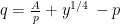
  4. The demand, q, for the product of a monopolist depends upon the price, p, of his produce and the amount of money, y, which he spends on advertising. The total production cost, c, depends upon the quantity of output, q. Given the demand function: q=\frac{A}{p}+{{y}^{{1}/{4}\;}}-p
    and the total (production) cost function = q
    where is a positive constant;
    Determine the output, the price, and the advertising outlay which would maximize the profits (total revenue minus total outlay) of this enterprise.
  5. The well-being, u, of a worker depends upon the amount, x, of consumers’ goods which he can buy with his daily wage, and the number of hours of leisure, y, which remain to him after he finishes his daily work:
    u= f(x, y)

    1. Derive the equations determining the number of hours (call it l) of daily work which he will be willing to do at the wage of dollars per hour, if the price of the consumers’ good is dollars per unit.
    2. Show that an increase of the hourly wage rate might reduce the number of hours which the worker will choose to work.


Source: Harvard University Archives. Harvard University Final Examinations, 1853-2001. (HUC 7000.28) Box 11. Faculty of Arts and Sciences. Papers Printed for Final Examinations. History, History of Religions, …, Economics, …, Military Science, Naval Science. January, 1946.

_______________

Economics 4a not offered in 1946-47

_______________

Course Enrollment, 1947-48

[Economics] 4a. Professor Leontief. — Introduction to the Mathematical Treatment of Economic Theory (Sp).

2 Graduates, 6 Seniors, 8 Juniors, 1 Sophomore, 2 Public Administration, 1 Radcliffe. Total 20.

Source: Harvard University. Report of the President of Harvard College and Reports of Departments for 1947-1948, p. 89.

*  *  *  *  *  *  *

Reading list and midterm and final examination question, 1947-48

_______________

Economics 4a not offered in 1948-49

_______________

Course Enrollment, 1949-50

[Economics] 104 (formerly Economics 4a). Assistant Professor Goodwin. — Introduction to the Mathematical Treatment of Economic Theory (Sp).

3 Graduates, 6 Seniors, 1 Junior, 2 Sophomores, 1 Public Administration, 1 Radcliffe. Total 14.

Source: Harvard University. Report of the President of Harvard College and Reports of Departments for 1949-1950, p.72.

*  *  *  *  *  *  *

Course Texts on Library Reserve, 1945-46

R.G.D. Allen. Mathematical analysis for economists

W.L. Crum. Rudimentary mathematics for economists and statisticians

P.A. Samuelson. Foundations of economic analysis.

Source: Harvard University Archives. Syllabi, course outlines and reading lists in Economics, 1895-2003. HUC 8522.2.1, Box 4, Folders “1949-1950 (1 of 3)”.

_______________

Image Sources: Schumpeter and Leontief from Harvard Class Album 1950, Goodwin from Harvard Class Album 1951.

Categories
Harvard Suggested Reading Syllabus

Harvard. Advanced Economic Theory, Second Term. Schumpeter, 1948


In 1947-48 the advanced economic theory sequence of two semester courses featured the pairing of Gottfried Haberler and Joseph Schumpeter in the Winter and Spring terms, respectively. In this post you will find course enrollment data along with the course outline and assigned readings for the Spring term taught by Schumpeter. Alas I could not find the final examination questions for this course in the otherwise fairly complete collection of course examinations in the Harvard Archives.

Materials from the Winter Term course 1947-48 taught by Gottfried Haberler.

__________________

Course Enrollment

[Economics] 103b. Professor Schumpeter.—Advanced Economic Theory (Sp).

Total 10:  8 Graduates, 1 Public Administration, 1 Radcliffe.

Source: Harvard University. Report of the President of Harvard College, 1947-48, p. 90.

__________________

Advanced Economic Theory
Joseph Schumpeter

Economics 103b
Spring Term 1947-48

Plan of Course and Suggestions for Reading

The plan of the course is to start from and to build upon Professor Haberler’s lectures in the Fall Term (103a). We shall start from the statics of equilibrium and then discuss at some lengths the use and limitations of the method of Comparative Statics. After this, we shall survey various Dynamic Models. These models will be made the starting points of excursions into relevant fields of pure and applied theory.

Professor Haberler’s reading list remains in force. Wicksell’s Lectures I being particularly recommended. In addition, perusal of the following items will prove helpful. The more important ones are marked by an asterisk. The list is intended to cover also suggestions for the reading period.

J. Tinbergen*, Suggestions on Quantitative Business Cycle Theory, Econometrica, July 1935.

F. Modigliani*, Liquidity Preference, Interest, and Money, Econometrica, January 1944.

N. Kaldor*, Stability and Full Employment, Economic Journal, December 1938

F. Lavington, Approach to a Theory of Business Risks, Economic Journal, June 1925

L. Metzler, Factors Governing the Length of Inventory Cycles, Review of Economic Statistics, February 1947

M. V. Jones, Secular and Cyclical Saving Propensities, Journal of Business of the University of Chicago, January 1944

L. M. Lachmann, Uncertainty and Liquidity Preference, Economica, August 1937

M. Kalecki, A Theorem on Technical Progress, Review of Economic Studies, June 1941

P. A. Samuelson*, Foundations of Economic Analysis, 1947


Source: Harvard University Archives. Syllabi, course outlines and reading lists in economics, 1895-2003. Box 4. Folder “Economics, 1947-48 (2 of 2)”.

Image Source: Joseph Schumpeter in Harvard Class Album 1946.


Categories
Exam Questions Harvard Socialism Suggested Reading Syllabus

Harvard. Economics of socialism. Outline, readings, final exam. Schumpeter, 1943-44


Earlier Economics in the Rear-view Mirror posted the course outline and final examination for Joseph Schumpeter’s course on the economics of socialism that was given in the second semester of 1945-46. None of the final examination questions were shared between these two years, so together the exams provide a better idea of what was actually covered than either alone.

______________________

Course Announcement

Economics 11b. Economics of Socialism

Half-course (winter term). Mon., Wed., and (at the pleasure of the instructor) Fri., at  10. Professor Schumpeter.


Source: Announcement of the Courses of Instruction Offered by the Faculty of Arts and Sciences During 1943-44. Official Register of Harvard University, Vol. 40, No. 21 (September 29, 1943), p. 33.

______________________

Course Enrollment

[Economics] 11b (winter term) Professor Schumpeter. –Economics of Socialism.

Total 26:  3 Graduates, 5 Seniors, 2 Juniors, 1 Sophomore, 13 Navy.


Source: Harvard University. Report of the President of Harvard College and Reports of Departments for 1943-44, p. 56.

______________________

ECONOMICS 11b
1943-44
OUTLINE AND ASSIGNMENTS

  1. FIRST TWO WEEKS: The Socialist Issue.

Socialist ideas and socialist parties. Socialism and the labor movement. Laborite and intellectualist socialism. The Definition of Socialism.

H. W. Laidler*, History of Socialist Thought, 1927.
T.M. Sogge, “Industrial Classes in the U. S.  in 1930,” Journal of the American Statistical Association, vol. 28 (1933), pp. 199-203.
Encyclopaedia of the Social Sciences, article on Socialist and Labor Parties.

  1. THIRD TO FIFTH WEEK: The Theory of Centralist Socialism.

O. Lange and F. M. Taylor*, The Economic Theory of Socialism.
H. D. Dickinson, Economics of Socialism, 1939.

  1. SIXTH TO NINTH WEEK: The Economic Interpretation of History. The Class Struggle, and the Marxist Theory of Capitalism.

Karl Marx, Capital, Volume I, chs. I, IV, V, VI.
Marx and Engels, The Communist Manifesto
Paul M. Sweezy*, The Theory of Capitalist Development, 1942, chs. I-VI (pp. 1-108).

  1. TENTH TO TWELFTH WEEK: The Socialist Theory of the State and of the Proletarian Revolution, Imperialism, National Socialism.

V.I. Lenin, State and Revolution.
V. I. Lenin, Imperialism.
M. Dobb, Political Economy and Capitalism, ch. VII.
Paul M. Sweezy*, The Theory of Capitalist Development, Chs. XIII-XIX.

READING PERIOD ASSIGNMENT

Read E. Bernstein, Evolutionary Socialism, especially pp. 18-95, and survey again the items in the reading list marked *.


Source:Harvard University Archives. Syllabi, course outlines and reading lists in economics, 1895-2003 (HUC 8522.2.1). Box 3, Folder “Economics, 1943-1944 (2 of 2)”.

______________________

1943-44
HARVARD UNIVERSITY
ECONOMICS 11b
[Final. February, 1944]

One question may be omitted. Arrange your answers in the order of the questions.

  1. Describe briefly the emergence of either the English Independent Labour Party or the German Social Democratic Party.
  2. In the Second International, opinion was divided on the question whether socialists should or should not participate in bourgeois governments. What were the arguments that were adduced for and against? Which groups expressed the one and which the other view? Which view prevailed eventually within the Second International?
  3. What are the rules of rational allocation of productive resources in a socialist society, and how do they differ from the corresponding rules in a capitalist society (a) under conditions of perfect competition and (b) under conditions of monopolistic competition?
  4. State and criticize the Marxian proposition known as the Theory of Increasing Misery (“immiseration”).
  5. Most socialist writers recognize that the transition from the capitalist to the socialist form of life will raise a number of problems that are distinct from the problem of how to run a socialist society when established. What are those “transitional problems” and what methods have been suggested for dealing with them?
  6. What is meant by Reformism? By Revisionism? By Laborism?


Source:  Harvard University Archives. Harvard University. Final Examinations, 1853-2001. Box 8, Folder “Final examinations, Winter term, 1943-44”.

Image Source:  Harvard Class Album 1942.

Categories
Exam Questions Harvard

Harvard. Exams for History and Literature of Economics. Schumpeter, 1942-48.


Joseph Schumpeter offered his graduate course “History and Literature of Economics since 1776” nine times during the period 1940-1949. The core readings were basically unchanged. In an earlier post I provided the reading list  for 1939-40 along with examinations from the 1939-40 and 1940-41 academic years. The reading list, complete with links to every item, for 1948-49 has also been transcribed and posted.

In this post you will find transcriptions of final examination questions for five of the remaining seven years in the series.

_____________

Final Examination, 1941-42
HARVARD UNIVERSITY
ECONOMICS 113b2

One question may be omitted. Arrange your answers in the order of the questions.

  1. Economists of the most varied types have claimed Adam Smith as patron-saint. How would you describe his general method as revealed in the five books of the Wealth of nations?
  2. If you felt called upon to defend Ricardo’s theory of value, how would you do it?
  3. Marx predicted the breakdown of the capitalist system. What was his main line of argument? Do you think that the course of events in the last decade has verified his theory?
  4. Explain the meaning and use of the theorem usually referred to as Say’s Law.
  5. Senior defined cost of production as the sum of labor and abstinence necessary for production. Do you think this satisfactory?
  6. Does Marshall’s work seem to you to close or to begin a period in the history of economic thought?


Source:Harvard University Archives. Final Examinations, 1853-2001 (HUC 7000.28) Box 6, Papers Printed for Final Examinations—History, History of Religions, …, Economics, …, Military Science, Naval Science. June 1942.

_____________

Final Examination, 1942-43
HARVARD UNIVERSITY
ECONOMICS 113b2

Answer any four out of the following five questions.

  1. With the possible exception of Darwin’s Origin of Species, no scientific book has ever equaled the success of the Wealth of Nations. How do you account for this success?
  2. Discuss the Malthusian theory of population and describe its role in the classical system of economic theory.
  3. What do you think of the so-called Ricardian theory of rent?
  4. Criticize the following statement made by Adam Smith: “The price of monopoly is upon every occasion the highest which can be got. The natural price, or the price of free competition, on the contrary, is the lowest which can be taken…for any considerable time.”
  5. The founders of the marginal-utility school evidently believed that they had revolutionized economic theory. What warrant was there for this belief? What do you think their contribution consisted in?


Source:Harvard University Archives. Final Examinations, 1853-2001 (HUC 7000.28) Box 7, Papers Printed for Final Examinations—History, History of Religions, …, Economics, …, Military Science, Naval Science. May 1943.

_____________

Final Examination, 1943-44
[not (yet) located]

Course not offered 1944-45

_____________

Final Examination, 1945-46
HARVARD UNIVERSITY
ECONOMICS 113b

Two questions may be omitted. Arrange your answers in the order of the questions.

  1. Explain the meaning and use of “Say’s Law.”
  2. Sketch the history and discuss the merits and demerits of the wage-fund theory.
  3. How did Ricardo explain “profits?”
  4. Choose any economist between 1776 and 1890 with whose work you are familiar, and describe the nature, method, and value of his contribution.
  5. Smith no doubt sponsored what Lord Keynes described as the Fallacy of Cheapness and Plenty. What do you think of the proposition involved?
  6. What relation do you conceive to exist between economists’ theoretical explanations of facts and (a) their political preferences in general and (b) the interests of the social classes to which they belong in particular?


Source:Harvard University Archives. Final Examinations, 1853-2001 (HUC 7000.28) Box 11, Papers Printed for Final Examinations—History, Government, Economics, …, Military Science, Naval Science. May 1946.

_____________

Final Examination, 1946-47
HARVARD UNIVERSITY
ECONOMICS 113b

One question may be omitted. Arrange your answers in the order of the questions.

  1. Characterize briefly the nature, and the historical roots, of Adam Smith’s performance.
  2. What was the contribution of Ricardo to economics? And what of it may be said to have survived until today?
  3. State and criticize the various explanations that the English classics offered for what they took to be an indubitable tendency in the rate of profits to fall?
  4. Appraise the role, in the history of economic theory, of Malthus’s Law of Population?
  5. Discuss the validity and the importance of the marginal-utility theory of value.
  6. What do you mean by, and what do you think of, Institutionalism?


Source:Harvard University Archives. Final Examinations, 1853-2001 (HUC 7000.28) Box 14, Papers Printed for Final Examinations—History, History of Religions, …, Economics, …, Military Science, Naval Science. May 1947.

_____________

Final Examination, 1947-48
HARVARD UNIVERSITY
ECONOMICS 113b

One question may be omitted. Arrange your answers in the order of the questions.

  1. Discuss the nature and importance of Ricardo’s contributions to economic theory.
  2. Discuss the nature and importance of Senior’s contributions to economic theory.
  3. “Demand for commodities is not demand for labor.” Explain and criticize.
  4. State and analyze the Ricardian theory of Rent.
  5. State and analyze Say’s “Law of Markets.”
  6. Most English classics were votaries of Laissez-faire. What qualifications did they admit, particularly with reference to the labor contract?


Source:Harvard University Archives. Final Examinations, 1853-2001 (HUC 7000.28) Box 15, Papers Printed for Final Examinations—History, History of Religions, …, Economics, …, Military Science, Naval Science. May 1948.

_____________

Final Examination, 1948-49
[not (yet) located]

_____________

Image Source: Selection from “Joseph A. Schumpeter and other at dinner table, ca. 1945”, Harvard University Archives HUGBS 276.90p (4).


Categories
Economists Harvard Radcliffe Swarthmore

Harvard. Wolfgang Stolper describes his training in letter to Hobart College, 1941


This post provides Wolfgang Stolper‘s own description of his academic training, teaching and research interests as of early 1941 in a letter to the President of Hobart College regarding his application for an assistant professorship. Stolper’s Harvard coursework for 1934-37 was transcribed for an earlier post. He was on the job market for the 1941-42 academic year after having taught a wide range of courses at Harvard since completing his Ph.D. in 1938. 

Hobart’s offer ended up being only 73% of the offer he was to receive from  Swarthmore (and which he accepted). From the April 29, 1941 letter from President’s office at Swarthmore:  “I realize that the salary which we are offering you [$3300] is considerably under what you have been receiving this year. It is, however, the equivalent of your combined Harvard and Radcliffe salaries for the past two years…” A follow-up letter from the President of Swarthmore College dated May 7, 1941 confirmed the approval of Stolper’s appointment as Assistant Professor of Economics at Swarthmore for 1941-42 at a salary of $3300 ($900 higher than the Hobart offer).

Also of some interest is the rather casual/modest mention of what ultimately was to become Wolfgang Stolper’s greatest hit: “Right now I am finishing another article on Protection and Real Wages.”

________________

Carbon copy of Wolfgang Stolper’s letter
to President of Hobart College

Wolfgang F. Stolper

19 Ware Street
March 18, 1941

Mr. Brooks Otis
Hobart College
Geneva, N.Y.


Dear Mr. Otis,

I am writing this letter to you about my background and training, as you suggested at our meeting on March 17. If you think it desirable either you or I can ask the Harvard appointment office to send you all the documents concerning me.

First about my background. I was born in Vienna in May 1912. There I went to elementary school and through the first three years of high school. We then moved to Berlin where I finished high school (humanistisches Gymnasium) in 1930, and where I also studied law for three semesters. I then went to Bonn, where I studied law and economics in about the same proportions. My economics teachers were Professors Spiethoff, who is now retired, H. v. Beckerath, who is now at Chapel Hill, and Schumpeter who is now in Harvard. From Bonn I went to to Zürich where I wrote a thesis under Professor Eugen Grossmann on the reasons, economic and otherwise, which lead the various nations to defend different economic policies during the World Economic Conference in London in 1933.

In August 1934 I came to Harvard as a Holtzer fellow, and I held a University fellowship during the next year 1935/36. Since 1936 I have been teaching. I took somewhat more than the required eight courses, my main interests within the field of economics being: Theory, Money and Banking, Business Cycles, International Economic Relations, and Building.

In May, 1935 I took my M.A., and in May, 1938 I got my Ph.D.. My thesis was on the British housing boom from 1931-36, and its connection with monetary policy in the widest sense.

My teaching experience has been quite extensive, more so, I believe, than that of most of my colleagues. Besides the usual complement of tutees and the principles course I have been giving half of the lectures in the course on International Economic Relations [Econ 43a,  Report of the President of Harvard College 1938-39, p. 98;  Report of the President of Harvard College 1939-40, p. 99;  Report of the President of Harvard College 1940-41, p. 58,], and I am this year assisting Professors Haberler and Hansen in the course on Business Cycles [Econ 45a, Report of the President of Harvard College 1940-41, p. 58]. In Radcliffe College I am also giving a section of the course on principles, half of the course on International Economic Relations, and also half of the course on Business Cycles [Radcliffe College. Courses of Instruction 1940-41, pp. 43, 45.]. This year I was also asked to give a University Extension course on International Economic Relations [Report of the President of Harvard College 1940-41, p. 347].

The list of my publications does not look too impressive. I have published a number of short book reviews in the American Economic Review, a short theoretical article in the Quarterly Journal. My thesis which I have revised and brought up to date will be published by the Harvard University Press. I also just signed a contract with Blakiston Co. to write a text on International Trade together with my friend, Dr. H.K. Heuser who is Professor at the Fletcher School of Law and Diplomacy. Right now I am finishing another article on Protection and Real Wages.

Perhaps I should add that I am married and have a ten-year old son.

I hope that this information is what you wanted. My teachers and senior colleagues will of course be glad to give you any information about me which you might want. I need hardly add that I am very interested in the position, and that I, therefore, hope very much to hear from you again in the not too distant future.

Yours very sincerely,

________________

Job Offer to Wolfgang Stolper from Hobart College

HOBART COLLEGE
Geneva, New York

April 29, 1941

The President


Mr. Wolfgang F. Stolper
19 Ware Street
Cambridge, Massachusetts


Dear Mr. Stolper:

I regret to think that more than a month has passed since I talked with you at Cambridge. Doubtless you have gathered that we had entirely lost interest in you in the interim. That is, however, by no means the case. Since we have to appoint three men at this time, a sociologist, a political scientist and an economist we have, necessarily, had to proceed rather slowly. Our major preoccupation so far has not been Economics simply because we have had to concentrate on one thing at a time. We have now, however, reached a point where the Economics appointment is directly concerning us.

I am writing this letter to you to find out more definitely what your expectations would be. The plain fact is that we find that we cannot offer the salary that we should like to. The best thing that we can do for next year in Economics is an Assistant Professorship at twenty-four hundred dollars ($2400.00). I might also add, as I think I said to you personally, that anyone appointed to this position would have considerable freedom in the choice of courses and in the teaching, and a considerable opportunity to influence the operation and planning of the whole Social Science curriculum here in cooperation with his colleagues in Sociology and Political Science,–that is, of course, if he cared to do so.

If it is not too much trouble, would you drop me a line stating whether you would still be interested in the job as outlined above?

Very truly yours,
[signed]
Brooks Otis

BO/bg

________________

Carbon copy of Stolper letter
declining Hobart offer

Wolfgang F. Stolper

19 Ware Street
May 2, 1941

Mr. Brooks Otis
Hobart College
Geneva, N.Y.


Dear Mr. Otis,

Thank you very much for your letter of April 29. I regret very much that I have to reject your offer to come to Hobart next year since I have just accepted a position as Assistant Professor at Swarthmore College.

I was very glad to have had a chance of meeting you, and I hope very much that this letter will not be the end of our relationship.

Very truly yours,


Source:Duke University. David M. Rubenstein Rare Book & Manuscript Library. Economists’ Papers Archive. Wolfgang F. Stolper Papers, Box 23, Folder “[illegibly marked]”

Image Source: Wolfgang F. Stolper from  John Simon Guggenheim Memorial Foundation (Fellow, 1947).

Categories
Exam Questions Harvard

Harvard. Year-end exams. Money, Banking, Commercial Crises. Young, 1921-27


Today’s artifacts come from the roaring ’20s. Besides his courses in economic theory, Allyn A. Young taught a year long course at Harvard, “Money, Banking and Commercial Crises”. Before presenting enrollment figures and the exams for Young’s Economics 3, I have assembled a chronology that identifies the course instructors over the entire period 1911-1946. Links are provided to the related artifacts that have been transcribed here at Economics in the Rear-view Mirror. 

The chronology is followed by Young’s course description for 1924-25. Presumably there was a mid-year exam for the course, but these were not included in the printed collection of final course examinations. It is possible that the questions have been limited to the second-semester’s course content. This is something that definitely deserves checking.

___________________

Chronology of the Harvard economics course
“Money, Banking and Commercial Crises”

This two semester course was the product of merging the one semester course “Commercial Crises and Cycles of Trade” (Economics 12) with the two semester sequence “Money” and “Banking and Foreign Exchange” (Economics 8a and 8b, respectively).

The new course “Money, Banking, and Commercial Crises” (Economics 8, then 3, and later 41) was a staple of economics course offerings for the next 35 years.

Economics 8

1911-12 taught by E.E. Day

Economics 3

1912-13, 1913-14 taught by E.E. Day.

Money, Banking, and Commercial Crises (1914-15) taught by Benjamin M. Anderson.

1915-16 taught by Norman John Silberling

Money, Banking, and Commercial Crises (1917-18) taught by Benjamin M. Anderson.

1918-19, 1919-20 taught by A. E. Monroe.

1920-21 through 1926-27 taught by Allyn A. Young. Year-end exams transcribed below.

1927-28 through 1931-32 taught by John H. Williams

1932-33 taught by John H. Williams, Joseph Schumpeter and Lauchlin Currie.

1933-34 [course title: Money, Banking, and Cycles] Seymour Harris

1934-35, 1935-36 taught by John H. Williams and Seymour Harris

Economics 41

1936-37  taught by John H. Williams and Seymour Harris

Money, Banking, and Commercial Crises (1937-38) John H. Williams and Richard V. Gilbert.

1938-39 to 1941-42 taught by John H. Williams and Seymour Harris

1942-43, 1943-44 taught by Alvin Hansen and John H. Williams

1944-45 first semester taught by Schumpeter, second semester by Hansen and Williams

1945-46 Economics 41 morphed back into a two semester course “Money and Banking” taught by John H. Williams with a new one term course “Business Cycles” taught by Alvin Hansen.

________________________

Course Description, 1924-25

[Economics] 3. Money, Banking, and Commercial Crises. Mon., Wed., Fri., at 2. Professor Young.

In this course money and credit will be studied with special reference to the part they play in the present economic system. The principal problems of public policy with respect to the control of money and banking will be discussed. Foreign exchange, organized speculation in its relation to the money market, and the characteristic phenomena of commercial crises will be considered in some detail. The course will be conducted by means of lectures, discussions, frequent short reports or exercises on assigned topics, and (in the second half-year) a thesis based on work in the library. Certain subjects, such as the monetary and banking history of the United States, will be covered almost wholly by assigned reading, tested by written papers.

Source:  Division of History, Government and Economics 1924-25 published in Official Register of Harvard University, Vol. 21, No. 22 (April 30, 1924), p. 67.

_______________________

Enrollment, 1920-21

[Economics] 3. Professor Young —Money, Banking, and Commercial Crises.

Total 148: 6 Graduates, 34 Seniors, 67 Juniors, 26 Sophomores, 3 Freshmen, 30 Others.

Source:  Harvard University. Report of the President of Harvard College 1920-21, p. 19.


Year-end examination, 1920-21
HARVARD UNIVERSITY
ECONOMICS 3

  1. What is a dollar?
  2. In what manner and why were bank reserves inelastic under the national banking system? What were the consequences?
  3. Discuss the relation of overproduction to crises, distinguishing carefully different types of overproduction.
  4. Outline the sequence of events in a typical business cycle.
  5. Define: federal reserve bank note, gold-exchange standard, “value of money.”
  6. In what different ways may federal reserve notes be issued?
  7. Explain and discuss the “equation of exchange.”
  8. Describe and explain the dominating position the London money market held before the war.


Source:  Harvard University Archives. Examination Papers 1921 (HUC 7000.28, No. 63), Papers Set for Final Examinations [in] History, Church History,…,Economics,…, Fine Arts, Music. June, 1921, p. 56.

________________________

Course announcement, 1921-22

[Economics] 3. Money, Banking, and Commercial Crises

Mon., Wed., Fri., at 1.30. Professor Young.

Source:  Harvard University, Announcement of the Courses of Instruction Offered by the Faculty of Arts and Sciences for the Academic Year, 1921-22 (Third Edition),p. 109.


Year-end examination, 1921-22
HARVARD UNIVERSITY
ECONOMICS 3

  1. Draw up a statement showing the condition of a national bank. Explain the meaning of the various items.
  2. Under what conditions is a large surplus an indication of a bank’s strength? How may it be an indication of weakness?
  3. To what classes of persons are rising prices advantageous? To what classes are they disadvantageous?
  4. Define: gold exchange standard, banker’s acceptance, finance bill, bimetallism, index number.
  5. What do you take to have been the causes of the fall of prices between 1874 and 1896?
  6. Why were “surplus reserves” under the national banking system normally exceedingly small?
  7. State and explain the Ricardian theory of gold movements. Are the recent movements of gold from Europe to the United States explainable by the Ricardian principle?
  8. What relation was there between the Bank Act of 1844 and the controversies of the restriction period?
  9. If the weight of the gold dollar were reduced by half would prices be doubled? Explain your reasoning.
  10. “The bulk of the acceptance business arising out of the foreign trade of the entire world has for many years been conducted in London.” Explain what this statement means and why it is true.

Final. 1922


Source:  Harvard University Archives. Examination Papers 1922 (HUC 7000.28, No. 64), Papers Set for Final Examinations[in] History, Church History,…,Economics,…, Social Ethics, Education. June, 1922.

________________________

Enrollment, 1922-23

[Economics] 3. Professor Young—Money, Banking, and Commercial Crises.

Total 129: 6 Graduates, 33 Seniors, 75 Juniors, 11 Sophomores, 1 Freshman, 3 Others.

Source:  Harvard University. Report of the President of Harvard College 1922-23, p. 92.


Year-end examination, 1922-23
HARVARD UNIVERSITY
ECONOMICS 3

  1. Define: money of account, standard of deferred payments, inflation, gold-exchange standard, discounting.
  2. Give an account of the life-history of a typical commercial long bill of exchange, as used in international trade.
  3. Discuss the nature and significance of the par of exchange between two countries when one has a gold standard and the other has (a) a gold standard, (b) a silver standard, (c) inconvertible paper.
  4. Is New York City likely to become the center of the world’s foreign exchange markets? Discuss.
  5. In what ways are federal reserve notes and clearing-house loan certificates alike? In what ways are they unlike?
  6. Professor W. C. Mitchell holds that prosperity breeds a crisis because of (a) the gradual increase in the costs of doing business, and (b) the accumulating tension of the investment and money markets. Explain and discuss.
  7. Was the federal reserve system responsible for the rise of prices between 1917 and 1920 and for the subsequent drop? Discuss.
  8. In what ways do the federal reserve banks effect (a) regional and (b) national clearings?
  9. On what grounds is it generally held that a larger use of bank acceptances in this country is desirable?

Final. 1923.


Source:  Harvard University Archives. Examination Papers 1923 (HUC 7000.28, No. 65), Papers Printed for Final Examinations [in] History, History of Religions,…,Economics,…, Social Ethics, Anthropology. June, 1923.

________________________

Enrollment, 1923-24

[Economics] 3. Professor Young—Money, Banking, and Commercial Crises.

Total 119: 2 Graduates, 25 Seniors, 81 Juniors, 5 Sophomores, 1 Freshman, 5 Others.

Source:  Harvard University. Report of the President of Harvard College 1923-24, p. 106.


Year-end examination, 1923-24
HARVARD UNIVERSITY
ECONOMICS 3

Answer nine questions.

  1. Explain the first and either the second or the third of these theories of the business cycle: (1) the “banking theory”; (2) Hobson’s theory of over-saving; (3) Fisher’s theory of the lagging adjustment of interest.
  2. “It thus appears that the Bank of England’s official rate is often through long periods a mere empty symbol, leaving no actual relation to the real price of money in London; and only becomes effective, and a factor in the monetary position when…” When?
  3. Draw up a statement showing the principal items which enter into the balance of payments.
  4. What conditions must be fulfilled if New York is to become the center of the world’s foreign exchange markets?
  5. State and discuss the doctrine of purchasing-power parity.
  6. Discuss the open-market operations of the federal reserve banks, with special reference to (a) the provisions of the law, (b) the purposes of such operations, (c) their relation to possible changes in prevalent types of commercial paper.
  7. Why did national bank notes constitute an inelastic currency? in just what manner do federal reserve notes constitute an elastic currency?
  8. Discuss the effect of organized speculation on prices, taking account of the fact that different types of price variations cover different periods of time.
  9. G. Moulton lists as “fallacies,” (1) the notion that a nation’s capacity to pay a foreign debt (such as reparations) is measured by the excess of its annual production over its annual consumption, and (2) the notion that a country can pay such a debt by selling securities to other countries. Do you agree? Explain.
  10. “In the main, banks do not lend their deposits, but rather, by their own extensions of credit, create the deposits.” Explain.

Final. 1924.


Source:  Harvard University Archives. Examination Papers 1924 (HUC 7000.28, No. 66), Papers Printed for Final Examinations [in] History, History of Religions,…, Economics,…, Psychology, Social Ethics. June, 1924.

________________________

Enrollment, 1924-25

[Economics] 3. Professor Young—Money, Banking, and Commercial Crises.

Total 111: 1 Graduate, 22 Seniors, 72 Juniors, 12 Sophomores, 1 Freshman, 3 Others.

Source:  Harvard University. Report of the President of Harvard College 1924-25, p. 75.


Year-end examination, 1924-25
HARVARD UNIVERSITY
ECONOMICS 3

Answer eight questions.

  1. Some writers hold that business cycles are caused by the expansion and contraction of bank credit. Why and how, in their view, does bank credit expand and contract?
  2. “A country can pay a foreign debt only by exporting more than it imports.” Explain and discuss critically.
  3. What was the major defect of the old national banking system?
  4. Define: rediscount, trust company, par collections, gold standard, purchasing power parity.
  5. “The Bank of England has power to exert a decisive influence over the magnitude of the gold movements to and from England.”—Furniss.
  6. What are the distinguishing characteristics (economic or legal, not physical characteristics) of the following types of money: silver dollars, United States notes, national bank notes, federal reserve notes?
  7. What are the prerequisites to the stabilizing of a depreciated paper currency?
  8. In what measure was the federal reserve system responsible for the rapid rise of prices in 1919 and 1920 and for the subsequent collapse?
  9. The federal reserve banks hold nearly $3,000,000,000 in gold, amounting to about 75 per cent of their liability on account of deposits and note issues combined, and constituting a large idle investment. Under what conditions would a considerable part of this gold be exported to other countries?

Final. 1925.


Source:  Harvard University Archives. Examination Papers 1925 (HUC 7000.28, No. 67), Papers Printed for Final Examinations [in] History of Science, History, …, Economics,…, Anthropology, Military Science. June, 1925.

________________________

Enrollment, 1925-26

[Economics] 3. Professor Young—Money, Banking, and Commercial Crises.

Total 110: 31 Seniors, 64 Juniors, 8 Sophomores, 1 Freshman, 6 Others.

Source:  Harvard University. Report of the President of Harvard College 1925-26, p. 77.


Year-end examination, 1925-26
HARVARD UNIVERSITY
ECONOMICS 3

Answer eight questions.

  1. Define deposits, discount, monetary standard, bimetallism.
  2. Formulate the “quantity theory” in any way that you prefer, and discuss it critically.
  3. A Brazilian firm draws a 90-day bill upon a London banker on account of a shipment of coffee to Boston.

(1) Why should the London bill be preferred to a bill upon New York or Boston?
(2) What is done with the bill after it reaches London?
(3) How is the bill finally settled?

  1. Some writers hold that when a government issues inconvertible paper money it obtains what is virtually a “forced loan.” Others hold that such an issue is more like taxation. What is your opinion, and why?
  2. Give an account of one of the following:

The socialist theory of crises.
Hobson’s theory of over-saving.
The “banking theory” of crises.

  1. Explain briefly the meaning of any two of the following phrases:

Par-collections controversy.
Open market policy.
Gold settlement fund.
Rediscounting

  1. Compare the Bank of England and either the Bank of France or the Reichsbank with respect to

(a) restrictions on note issue;
(b) discount policy.

  1. Was the federal reserve system responsible for the inflation of 1919-20 and the ensuing collapse? Explain.
  2. Just why, in your opinion, did the mark (or the franc, or the greenback) depreciate?

Final. 1926.


Source:  Harvard University Archives. Examination Papers 1926 (HUC 7000.28, No. 68), Papers Printed for Final Examinations [in] History, History of Religions, …, Economics,…, Social Ethics, Military Science. June, 1926.

________________________

Enrollment, 1926-27

[Economics] 3. Professor Young and Mr. Marget.—Money, Banking, and Commercial Crises.

Total 125: 2 Graduates, 27 Seniors, 74 Juniors, 14 Sophomores, 2 Freshmen, 6 Others.

Source:  Harvard University. Report of the President of Harvard College 1926-27, p. 74.


Year-end examination, 1926-27
HARVARD UNIVERSITY
ECONOMICS 3

Answer eight questions.

  1. Explain and discuss critically some form of the “banking” or “credit” theory of business cycles.
  2. “If prices are rising” Hawtrey observes, “the mere holding of commodities in stock yields an additional profit over and above the usual dealer’s percentage on the turn-over. If traders are to be deterred from borrowing money to buy commodities, the rate of discount must be high enough to offset the additional profit. But, it may be asked, how is this possible when prices are rising at the rate of 30 per cent per annum?” Hawtrey’s answer? Your own?
  3. Discuss critically either (a) Fisher’s proposals for stabilizing the price level, or (b) proposals for attaining the same end by controlling the supply of bank credit.
  4. Select two of the following and discuss their significance as “causes” of the depreciation of inconvertible paper money: (1) excessive quantity; (2) ultimate redemption uncertain; (3) unbalanced budget; (4) adverse balance of foreign payments; (5) speculation.
  5. Define: rediscounts, purchasing-power parity, invisible exports, monetary standard, par collections.
  6. Compare the note-issue system of the Bank of England (as established by the Act of 1844) with the note-issue system of the federal reserve banks, with particular reference to (a) separation of “banking” and “issue” departments, and (b) the type of assets by which the notes are “covered.”
  7. In what way or ways do purchases and sales of government securities in the New York money market by the federal reserve banks affect the state of that market?
  8. If you were Dictator of France, and took account of considerations of justice as well as of expediency, would you plan to stabilize the franc at its present (gold) value? Or would you plan for a gradual recovery of its pre-war value? Why?
  9. Discuss the relation of international gold movements to changes of (a) relative price levels, (b) relative discount rates.

Final. 1927.


Source:  Harvard University Archives. Examination Papers 1927 (HUC 7000.28, No. 69), Papers Printed for Final Examinations [in] History, History of Religions, …, Economics,…, Social Ethics, Military Science. June, 1927.

Image Source: Allyn Young in Harvard Classbook 1925.


Categories
Cambridge Chicago Columbia Economic History Economists Germany Harvard NBER Stanford

Chicago. Friedman memo regarding Karl Bode and Moses Abramovitz, 1947


In the following 1947 memo from Milton Friedman to T.W. Schultz we can read two talent-scouting reports on potential appointments for the University of Chicago economics department. One candidate, Karl Bode had been vouched for by Allen Wallis, a trusted friend and colleague of Milton Friedman, but we can easily read Friedman’s own less than enthusiastic report on the meager published work examined, certainly compared to Friedman’s glowing report for his friend from Columbia student days, Moses Abramovitz. But comparing the publications listed in the memo, I certainly wouldn’t fault Friedman’s revealed preference for Abramovitz.

Abramovitz went on to have a long and distinguished career at Stanford and Bode left Stanford for government service with his last occupation according to his death certificate “Planning Director, Agency for International Development (A.I.D.)”

Since Karl Bode turned out to have cast a relatively short academic shadow, I have appended some biographical information about him at the end of this post. But for now just the vital dates: Karl Ernst Franz Bode was born November 24, 1912 in Boennien, Germany and he died March 18, 1981 in Arlington, VA.

__________________

Milton Friedman on Bode and Abramovitz

January 10, 1947

[To:] Mr. Schultz, Economics
[From:] Mr. Friedman, Economics
[Re:] Staff appointments

In connection with staff appointments, I thought it might be helpful if I put down on paper for you the information I have on two persons whose names I have casually mentioned: Karl Bode and Moses Abramovitz.

  1. Karl Bode (Assoc. Prof. of Economics, Stanford)

I know about Bode primarily from Allen Wallis. Allen considers him absolutely first-rate in all respects and recommends him very highly.

Bode, who is now in his early thirties, was born in Germany and, though Catholic of Aryan descent, and the holder of a highly-prized governmental fellowship, left Germany almost immediately after Hitler’s accession. He went first to Austria, then to Switzerland, where he took his Ph.D., in 1935, then to England, where he studied at Cambridge and at the London School. Bernard Haley met him while at Cambridge, was highly impressed with him, and induced him to come to Stanford, where he has been since 1937. He has been on leave of absence since early 1945, first with the Tactical Bombing Survey, then with the Allied Military Government in Berlin. He is expected back sometime this summer.

At Stanford, Bode is responsible for American and European Economic History, and, in addition, has taught advanced courses in Economic Theory. His original interest was in International Trade. He has a contract to write a text on Economic History, but I do not know whether on American or European Economic History.

I have obtained a list of his publications, most of which are fragments or reviews. Three of more general interest are:

(a) A. W. Stonier: “A New Approach to the Methodology of the Social Sciences”, Economica, Vol. 4, p. 406-424, Nov., 1937.

(b) “Plan Analysis and process analysis: AER, 33-348-54, June 1943.

(c) “A Note on the Mathematical Coincidence of the instantaneous and the serial multiplier”, Review of Economic Statistics, 26: 221-222, Nov. 1944.

I have read these. They are too slight to permit a reliable and comprehensive judgment about his capacities; but they are sufficient to demonstrate a clear, logical mind.

Allen tells me that Schumpeter, Haberler, Howard Ellis, and of course, the Stanford people all know him and could provide evidence about his abilities.


  1. Moses Abramovitz (member of research staff in charge of business cycle unit, National Bureau of Economic Research.)

Abramovitz got his bachelor’s at Harvard, his Ph.D. at Columbia. He has done some part-time teaching of Theory at Columbia. During the war he was with the Office of Strategic Services, where he worked on foreign economic conditions. He was a member of the reparations commission staff at both the Moscow and Paris Conferences.

Abramovitz and I were fellow graduate students at Columbia, and I have known him rather well ever since. I think him extremely capable, with an excellent mind, broad interests, and an extraordinary capacity for forming a sound judgment from conflicting evidence.

His academic and private research background is mostly in Economic Theory and Business Cycles; but the war years gave him a considerable background, and generated a real interest, in foreign economic relations.

Some of his writings are:

Selected Publications:

An Approach to a Price Theory for a Changing Economy, Columbia University Press, 1939.

Monopolistic Selling in a Changing Economy, Q.J.E., Feb., 1938.

Saving vs Investment: Profits vs Prosperity?Supplement on papers relating to the TNEC, Am. Econ. Rev., June, 1942.

Book on Cyclical behavior of inventories completed and scheduled to be published shortly by Nat’l Bureau of Economic Research.

M.F.

ab

* * * * *

PUBLICATIONS OF KARL BODE

A new approach to the methodology of the social sciences. (With A.W. Stonier): Economica, vol. 4, pp. 406-424, November, 1937.

Prosperität und Depression: Zeitschrift für Nationalökonomie, vol. 8, pp. 597-614, December, 1937.

Review of: Plotnik, M.J. Werner Sombart and his type of economics. 1937. American Economic Review, 28: 522-523, September, 1938.

Review of: Sombart, Werner. Weltanschauung, Wissenschaft und Wirtschaft. 1938. Ibid., 28: 766, December, 1938.

The acceptance of defeat in Germany: Journal of abnormal and social psychology, 38: 193-198, April, 1943.

Plan analysis and process analysis: American Economic Review, 33: 348-354, June, 1943.

Review of: Day, C. Economic Development in Europe. 1942:Journal of economic History, 2: 225-227, November, 1942.

Catholics in the postwar world: America, 71: 347-348, July, 1944

Economic aspects of morale in Nazi Germany: Pacific Coast Economic Association: Papers, 1942. pp. 29-34, 1943.

Reflections on a reasonable peace: Thought, 19: 41-48, March, 1944

Review of: Dempsey, B.W. Interest and usury. 1943: Ibid., 18: 756-758, December, 1943.

German reparations and a democratic peace: Thought, 19: 594-606, December, 1944

A note on the mathematical coincidence of the instantaneous and the serial multiplier: Review of Economic Statistics, 26: 221-222, November, 1944.


Source:Hoover Institution Archives. Papers of Milton Friedman, Box 79, Folder 1 “University of Chicago, Minutes. Economics Department 1946-1949”.

__________________

Karl F. Bode
AEA 1969 Directory of Members, p. 41.

Bode, Karl F., government; b. Germany, 1912; student, U. Bonn-Germany, 1931-33, U. Vienna-Austria, 1933-34; Ph.D., U. Bern-Switzerland, 1935; Cambridge-England, 1935-37. DOC.DIS. The Concept of Neutral Money, 1935. FIELDS 2abc, 1c, 4a. Chief, Regional Organization & Program Staff, Intl. Cooperation Adm., 1955-60, asst. dep. dir. for planning, 1960-62; chief, Planning Assistance & Research Div., Agy. for Intl. Dev., 1962-67; dir., Research, Evaluation & Information Retrieval, Agy. for Internat. Dev. since 1967. ADDRESS Vietnam Bur., Agy. for Internat. Dev., Dept. State, Washington, DC 20523.

__________________

 Haberler Report of Mises’s Private Seminar

Regular participants of the seminar were several members of the Mont Pelerin Society – notably Hayek, Machlup, the late Alfred Schutz and in the very early days, John V. Van Sickle. Visiting scholars regarded it a great honor to be invited to the seminar – among them Howard S. Ellis (University of California), Ragnar Nurkse (late Professor of Economics in Columbia University, New York) whose untimely death occurred three years ago, Karl Bode (later in Stanford University and now in Washington), Alfred Stonier (now University College in London), and many others. There was Oskar Morgenstern (now Princeton University), the late Karl Schlesinger and Richard Strigl, two of the most brilliant economists of their time…the unforgettable Felix Kaufmann, philosopher of the Social Sciences in the broadest sense including the law and economics – he also wrote a much debated book on the logical foundation of mathematics – who after his emigration in 1938 joined the Faculty of the New School for Social Research in New York where he taught with great success until his premature death twelve years ago.

Source: Mises’s Private Seminar: Reminiscences by Gottfried Haberler. Reprint from The Mont Pelerin Quarterly, Volume III, October 1961, No. 3, page 20f. Posted at the Mises Institute website.

__________________

 From the Preface of Felix Kaufman’s 1936 book

For the critical editing of the manuscript and of the galleys, I wish to thank most heartily a number of friends in various countries, expecially Dr. Karl Bode, presently of St. John’s College, Cambridge and Dr. Alfred Schütz of Vienna. Dr. Bode has also taken upon himself the great labor of preparing both indexes.

Source: Felix Kaufmann. Theory and Method in the Social Sciences. [English translation of Methodenlehre der Sozialwissenschaften. Wien: Julius Springer, 1936.] from Felix Kaufmann’s Theory and Method in the Social Sciences, Robert S. Cohen and Ingeborg K. Helling (eds.). Boston Studies in the Philosophy and  History of Science, 303. Springer: 2014.

__________________

 Reports from The Stanford Daily

The Stanford Daily, Volume 93, Issue 47, 29 April 1938

Several distinguished scholars from other universities will join the Stanford faculty next year…Dr. Karl Franz Bode, formerly on the faculty of St. John’s College, Cambridge University, England, was appointed assistant professor of economics to succeed Dr. Donald M. Erb who was appointed president of the University of Oregon….


The Stanford Daily, Volume 100, Issue 02, 23 September 1941, p. 1.

Econ Department Changes Classes… History of Currency Problems, 118, will he given in fall quarter rather than in the spring quarter. It is a five-unit course, taught MTWThF at 11 a.m. in Room 200Q by Karl F. Bode. Economics 1 and 2 are prerequisites….


The Stanford Daily, Volume 103, Issue 86, 28 May 1943, p. 1.

Wilbur Names New Faculty Promotions. Promotions and appointments of faculty members for the academic year 1943-1944 were announced yesterday by Chancellor Ray Lyman Wilbur. … Those promoted from assistant professor to associate professor are … Dr. Karl F. Bode, economics….


The Stanford Daily, Volume 111, Issue 20, 7 March 1947, p. 3

President Donald B. Tresidder yesterday announced 37 faculty promotions. The promotions include 11 faculty members to full professorships, six to associate professorships, and two to assistant professorships, together with promotion of 18 members of the clinical faculty at the Stanford School of Medicine in San Francisco….

To professorships … Karl F. Bode, in economics…


The Stanford Daily, Vol 119, Issue 7, 13 February 1951, p. 1.

Dr. Karl F. Bode, Stanford economics professor on leave for government duty in Germany, has been appointed deputy economic adviser, Office of Economic Affairs, it has been announced by the office of the U.S. High Commissioner for Germany. Dr. Bode will be stationed in Bonn, Germany. He has been acting chief of the program division in the Office of Economic Affairs.


Image Source: Karl Bode from the 1939 Standford Quad.