Categories
Economists Suggested Reading Yale

Yale. Suggested readings in social sciences from Arthur T. Hadley, 1901

President of Yale and former Professor of Political Economy, Arthur T. Hadley provides guidance to reading in the social sciences in the literature survey of this posting. It was published as one of six papers in a volume “based upon lectures arranged by the American Society for the Extension of University Teaching, and delivered in Philadelphia in the winter of 1898-99. The impulse to read good books that has grown out of the work of the Society in Philadelphia seemed to demand the suggestions that it was the purpose of these lectures to offer to those who desire to read wisely.”

Economics is discussed between pages 155 and 162 in the text following the book references, but visitors are encouraged to read the entire essay to appreciate the place of economics in Hadley’s scheme of the social sciences.

________________________

SOCIOLOGY, ECONOMICS, AND POLITICS
BY ARTHUR T. HADLEY

REFERENCES

“History of the Science of Politics,” by Sir Frederick Pollock, London, 1890.
[First edition 1890; New and Revised Edition 1911; Reprint 1930.]

“Commentaries on the Laws of England,” by Blackstone, London, 1765-69.
[John Adams’ copies:  Book I; Book II;  Book III; Book IV]

“Fragment on Government,” by Jeremy Bentham, London, 1776.

“Ancient Law,” by Sir Henry Sumner Maine, London, 1861.

“Wealth of Nations,” by Adam Smith, 1776. Edition with notes by Thorold Rogers, Oxford, 1880. Abridgment by Ashley, London, 1895.  [Vol I.; Vol II.]

“Principles of Political Economy, with some of their Applications to Social Philosophy,” by John Stuart Mill, London, 1848.
[1871: Seventh edition:   Vol. I; Vol. II.]

“Contemporary Socialism,” by John Rae. Second edition, London, 1891.
[1884: First edition; 1891: Second edition;  1901: Third edition]

“Burke,” by John Morley, London, 1888.

“Social Evolution,” by Benjamin Kidd, London, 1894.

“Physics and Politics,” by Walter Bagehot, London and New York, 1872. [1873: First Edition; 1881: Sixth Edition]


[p. 139]

SOCIOLOGY, ECONOMICS, AND POLITICS

It is the work of the biographer or the historian to gather the events which group themselves about some man or body of men, and trace the subtle sequences of causation by which they are connected. The task of the student of political theory, whether he call himself economist, jurist, or sociologist, is a more ambitious and a more perilous one. His explanations of political events must be general instead of specific. It is not enough for him to correlate the occurrences of a particular life or a particular period. He must frame laws which will enable his followers to correlate the events of any life or any period with which they may have to deal, and to sum up in a single generalization the lesson of many such lives and periods.

This is the kind of result at which the sociologist must aim, if he has the right to call himself a sociologist at all. His manner of [140] reaching it will depend upon his individual character. It may be in flashes of genius like that of Burke. It may be by the strict observance of logical processes like those of John Stuart Mill. It may be — and this is the most common method of all — by a painstaking study of history like that of Aristotle or Adam Smith. Such a study of history the sociologist is at some stage of his progress practically compelled to make. The most brilliant genius must verify his theories by comparing them with the facts. The most astute logician must test the correctness of his processes by applying his conclusions to practical life. In default of such study we have not a work of science but a work of the imagination. This is the character of books like Plato’s “Republic,” like More’s “Utopia,” like Bellamy’s “Equality.” It is to a less degree the character of books like Rousseau’s “Contrat Social” or George’s “Progress and Poverty.” Each of these is a work of genius; but in Plato or Bellamy there is no historical verification at all, and in Rousseau or George there is not enough of it. A work of this kind is sure to be unscientific; and what is worse, it is [141] almost equally sure to be pernicious in its practical influence.

We are sometimes told that these imaginative works of sociology bear the same relation to politics that the historical novel does to history. This may be true if we look at them solely from the standpoint of literary art. But if we judge from their moral effect upon the reader the parallel fails. Reader and author both know that the historical novel is not true. It does not pretend to be true. No one is in danger of mistaking “Quentin Durward”or “Henry Esmond” for actual histories of the time with which they deal. With the writings of political theorists it is far otherwise. The line between the picture of an actual state and the picture of a possible state is not a very clear one. The reader of Rousseau or George hardly knows when he passes from a description of real evils and abuses to a description of imaginary remedies. The greater the ability with which such a work is written the greater is the danger of confusion. The author as well as the reader is excited by the exercise of imaginative power. Bellamy is said to have written “Looking Backward” as a work of fiction [142] pure and simple; but when his readers began to regard him in the light of a prophet, there was an irresistible temptation for the author to regard himself in the same way.

If a man can write literature at all, the construction of a work of political imagination gives him a fatally easy chance to act as a leader of men’s thoughts, Plato’s “Republic” was a far easier work to construct than Aristotle’s “Politics.” The one required only concentrated thought, the other involved in addition a painstaking use of material. There is the same advantage in facility of construction in the works of Rousseau as compared with those of Turgot. The easily written work is also the one which enjoys more readers and which has more influence, at least during the writer’s lifetime. George’s “Progress and Poverty” was not based on an investigation into the history of land tenure. He was therefore able in good faith to promise his readers the millennium if certain schemes of social reform were adopted; and readers anxious for the millennium were enthusiastic over the book. Wagner, in his “Foundations of Political Economy,” unfortunately not translated into English, made a [143] scrupulous investigation of those historical points which George had overlooked, and he was therefore unable to promise his readers the millennium. The consequence is that where Wagner counts one disciple George counts a thousand. Of the ultimate disappointment and evil which result when we trust ourselves to unhistorical theories of politics it is hardly necessary to speak. The work of political imagination may have the same artistic character as the historical novel, but it has a baneful practical influence which makes it, from the moralist’s standpoint, an illegitimate use of artistic resources.

It is not in his choice of subject matter, but in the form of his conclusions, that the work of the sociologist differs from that of the writer of history. The man who aims at specific explanations, however widespread, is an historian; the man who is occupied with verifying generalizations, however narrow, is a sociologist. Bryce’s “American Commonwealth” is essentially a work of history. That he deals with a set of contemporary events instead of successive ones is an accident of his subject. He has taken a cross section of history, instead of a longitudinal [144] section, because American political events are better understood by looking at them in the former way than in the latter. On the other hand, Bagehot’s “English Constitution,” though very similar to Bryce’s “American Commonwealth” in its subject and in its external arrangement, is predominantly a sociological work; and the same thing may be said yet more unreservedly of Burke’s “Reflections on the Revolution in France.” To Bagehot and to Burke, the understanding of English or French politics was not an end; it was rather an incident in the discovery and application of those profounder laws which regulate the politics of every nation.

The use of the name “sociology” to designate investigations of this kind dates from Auguste Comte; its widespread popular acceptance, which makes it necessary for us to use it whether we like it or not, results chiefly from the influence of Herbert Spencer. Many students of political theory regard the term as an unfortunate one; and I am inclined to think that we shall understand the real scope of our subject better if we use the word sociology only under protest. This is not because it is bad Latin, — though it is very bad [145] Latin indeed, — but because it has prevented the use of a much better term, ethics, the science of customs and morals. The effect of calling our subject sociology instead of ethics has been bad, both on the students of morals and on the students of society. It has caused the students of morals to follow old methods and to make their science predominantly a deductive rather than an empirical one. Instead of availing themselves of the results of history and making a social study of those laws of conduct which are essentially social phenomena, they have continued, like their fathers, to make it a branch of psychology. Meantime it has caused the professed students of sociology to go too far in the other direction; to neglect the help which they can get from wide-awake psychologists like Mark Baldwin, whose “Social and Ethical Interpretations in Mental Development” is really a profound contribution to political study, and to occupy themselves far more with classifying things which they see from the outside, than with explaining those which they get from the inside. Among people who have but a slight knowledge of the methods and purposes of political science, [146] there is a tendency to apply the name “sociology” to every description of the actions of men in society, whether scientific or not. The story of a public bath-house, the collection of a few wage statistics, or the scheme for a new method of measuring criminals are all described as studies in sociology; and the observer, who has perhaps collected a little material for the future historian, is deluded by the high-sounding name into the belief that he has done more truly scientific work than Gibbon or Mill, Nor do the really scientific sociologists wholly escape the baleful influence of a name which tends to separate their field so widely from that of the moralists. It leads them to make their science a branch of anthropology; to deal with men chiefly in masses; to give disproportionate importance to the study of prehistoric races just because they are so readily looked at in this way. Even if, like Bastian or Giddings, we give just importance to the development of mental processes, as distinct from physical ones, we are prone to begin at a point so remote from our own that we are unable to test the correctness of our descriptions.

Thus it has come to pass that there is in [147] the popular mind not only a separation but an antithesis between ethics, which deals with the profounder instincts derived from our consciousness, and the various branches of sociology, — law, economics, politics, — whose study and whose precepts are empirical. This way of looking at things is fundamentally wrong. All good sociological work has a profoundly ethical character. Aristotle, Hobbes, Rousseau, Blackstone, Adam Smith, not to mention a score of scarcely less distinguished writers, obtained their hold upon the public by the light which they threw upon ethical difficulties and moral problems. Their sociological work has sometimes been based on good ethics and sometimes on bad ethics; in fact, its ethics has generally been good or bad according to the greater or less completeness of the historical study which has preceded it. But some powerful ethical reasoning it has contained and must contain in order to secure a hold on mankind. It must explain men’s mental and moral attitude toward each other. Sociology is ethics, and ethics is sociology. The apparent opposition between the two is the result of deductive scientific methods on one side or the other.

[148] We have now defined the limits of our subject. We are seeking to gain a general view of that literature which is based upon history, expresses its conclusions in general laws, and seeks to explain men’s moral conduct as members of society. The successful investigations in this field fall under three groups: law, economics, and politics. The first seeks to explain, criticise, and justify the judicial relations of mankind as determined by the necessities of public security; the second their commercial relations as determined by the necessities of business; while the third, as yet in its infancy, attempts to consider their political and moral relations as members of a civil society in whose government they have a share.

The principles of law were of course formulated at a very early period. First we have codes of procedure, like the Twelve Tables of Rome; then we have formal rules of conduct which will be enforced by the civil authority; still later we have judicial decisions and legal text-books indicating the methods in which these traditional rules are applied to new cases. But none of these is literature. Legal literature, in the broader [149] sense, may be said to begin when we endeavor to explain the relations between the rules of law and the principles of natural justice accepted by the conscience of the community. The two greatest modern works of law, Blackstone’s “Commentaries” in England and Savigny’s “System of the Roman Law of To-day” in Germany, both owe their power to this underlying idea. Not that it is obtruded upon the reader, but that it is held in reserve as a vivifying force. Blackstone is distinguished from “Coke upon Littleton,” not in being a greater legal authority, — for, technically speaking, “Coke upon Littleton” is legal authority while Blackstone is not, — but because Blackstone wrote a work for the public and not for the lawyers; a work which put all English-speaking gentlemen in touch with the common law, and made it, not an instrument of professional success, but a part of the reader’s life. The ethical character manifest in Blackstone’s writings is from the necessity of the case even more saliently developed in the works of the international lawyers, and most of all in their great leader Grotius. For international law rests not [150] upon the authority of a superior who has the physical force to make his commands respected, but on the common sense and common consent of the parties in interest. A treatise on international law is therefore in the highest sense a treatise on ethics, — ethics put to the test of practice, and verified or rejected by history.

But profound as is the harmony between law and justice in civilized nations, the occasional dissonance is on that ground all the more marked. These dissonances have therefore occupied a large attention among those who studied the relations between law and ethics. What gives authority to certain principles which we call law, more or less independent of those other principles which we call justice? It was Hobbes who, in his “Leviathan,” first undertook a systematic answer to this question, and developed the theory of the social compact which, for good or ill, has formed the subject of so many political controversies. According to Hobbes, a state of nature is for mankind a state of anarchy. To avoid the intolerable evils of this condition, governments have been established for the purpose of giving [151] security. As long as a government does, in fact, give such security, it performs its part of the compact under which it was established; and its subjects, as representatives of the other party to such a compact, are bound to obey its ordinances. The evils of anarchy were, in Hobbes’s view, so great that no approximation to the enforcement of justice could be obtained except under such a surrender of personal rights and opinions as was implied in his fiction of the social compact.

In the hands of Hobbes this doctrine was a conservative force. It justified men in keeping quiet under evils against which their moral sense would otherwise have led them to revolt. But in the century following Hobbes, Locke and Rousseau made a use of the social compact theory of which its author never dreamed, — a use which made it not a conservative but a revolutionary power, — a use which reintroduced into politics and into law those discussions of natural justice which it had been Hobbes’s aim to exclude. For Rousseau denied emphatically that the government had fulfilled its part of the contract with the people when it simply [152] maintained a state of public security. It was not enough to govern, it must govern well; it must not merely repress positive disorder, but promote that justice and that happiness which the collective public opinion of the community demanded. The government, as Rousseau regarded it, was a trustee for the people, pledged and required to pursue popular happiness, and forfeiting its trust the moment it used it for any other purpose. It was on these views of Locke and Rousseau that the authors of the Declaration of Independence based their political doctrines. It was on these views that the French Revolution was founded, and in the exaggeration of these views that its excesses were committed.

But just at the time when this idea of the social compact was most widely influential in practice, it received its deathblow as a theory. With marvelously acute analysis, Bentham, in his “Fragment on Government,” proved that there was neither historically nor logically any such thing as a social compact. Government, according to Bentham, derives its authority, not from an ancient promise to give public security, nor from [153] a long standing trusteeship in behalf of the people, but from the habitual obedience of its subjects. Where such habitual obedience exists, there is government. The accredited acts of such a government are lawful, whether they conform to the ideas of natural justice in any individual case or not. If these acts are habitually contrary to the people’s sense of justice, discontent will culminate in revolution, and then the government will be changed so that another authority and another set of laws will come into being. But the second government, like the first, derives its authority from the fact of being able to exercise its power. Any rights which Hobbes might deduce from a supposed agreement by which it was brought into being, or any limitations on its authority which Rousseau might deduce from a similar hypothesis, are both alike fictitious.

Such was the ground taken by Bentham; and he has been followed by almost all English and American writers who deal with law from a professional standpoint. But there has very recently been a tendency to react from this extreme view and to take a middle ground between the position of [154] Bentham and Hobbes. For while it is undoubtedly true that people habitually obey a government, and that its authority is in fact based on this habitual obedience, it is also true that they obey cheerfully only within certain limits set by public opinion, and that beyond those limits they defeat the governmental authority, not by a revolution, but by the quieter process of nullification. The same habit which establishes the government establishes bounds within which it regards the authority of that government as salutary, and beyond which it will not encourage or even allow the government to go. This view was foreshadowed by Burke in some of the noblest of his political orations. It was applied historically by Sir Henry Maine in his studies of Indian village communities. It has received vigorous support from Herbert Spencer in his brilliant collection of essays, “The Man versus the State.” In America, where the extreme views of Bentham have never enjoyed the unquestioned authority which they possessed in England, even professional lawyers like Abbott Lawrence Lowell have developed theories of law and government based on this [155] view. It only remains for some man of genius to summarize the conclusions of these scattered works, and to develop a theory of the relations between law and justice which shall do for the students of our day what Aristotle did for those of two thousand years ago.

The study of economics, or principles of commerce, began much later than the study of law. The recognition of the ethical character of governments antedated by at least two thousand years the recognition of the ethical character of commerce. Those who look at business operations from the outside, as most of the early writers did, regard them as presumably immoral; as bearing the same relations to the principles of justice which the thief bears to the policeman. Aristotle, Cicero, Aquinas, are all actuated by this idea. It was reserved for Adam Smith to develop a philosophy of business which was in the highest and best sense of the word a moral philosophy. There have been a good many needless inquiries as to the reasons which make the “Wealth of Nations” superior in merit and influence to the many other acute economic [156] writings in the latter part of the last century. The answer to these inquiries is a simple one. It was because Smith presented clearly to the reader the essentially moral character of business under modern conditions. His predecessors had generally thought of trade as a bargain, as a contest between buyer and seller, where the more skillful and more unscrupulous party gained the advantage over the other. Smith showed how under free competition the self-interest of the several parties, intelligently pursued, conduced to the highest advantage of the community. Did high prices prevail? It was a symptom of scarcity. If we forbade the seller to take advantage of that scarcity, we perpetuated the evil. If, on the other hand, we invited other sellers to compete with him, we directed the industrial forces of the community to the point where they are most needed; we relieved the scarcity of which the high price is but a symptom, and at comparatively small expense to society effected a lasting cure. There is not time to develop this theory of Smith’s in all its varied applications, or to show how, under the marvelous adjustments of modern business, price tends [157] to adjust itself to cost, and cost to be reduced to such a degree as to give the various members of the community the maximum of utility with the minimum of sacrifice. That Smith saw this truth, was his fundamental merit. That he was the first to see it in anything like its full scope, that he had the power to verify it, the candor to recognize its limits, the vigorous English in which to communicate his ideas to others, are facts which give the “Wealth of Nations” the place it deservedly holds in science and in literature. Not in economic science only, but in the whole field of morals have we learned from Adam Smith to expect a harmony of interests between the enlightened self-interest of the individual and the public needs of the community. The fact that the completeness of this harmony has been exaggerated by subsequent writers does not detract from the merit of its discoverer, but rather is a testimony to his power.

Of course Smith’s economic principles were widely called in question and vigorously debated. Some rejected his views altogether. Out of this rejection came the socialist controversy. Others held that his [158] principles of commerce were true as between individuals, but not as between nations; that in the latter case we necessarily had a bargain and a contest rather than a competition, a conflict of interests rather than a harmony. Out of this grew the protectionist controversy. The whole problem of protection is so interwoven with difficult points in the theory of taxation that the best discussion of the subject is often highly technical, and scarcely belongs to the domain of literature. But it would be wrong, in the city of Philadelphia, to give a review of economic writing which should pass over in silence the honored name of Henry C. Carey, who alone, perhaps, among protectionist writers meets the points of Adam Smith with a moral purpose not less profound than that of his opponent.

The socialist controversy belongs in far larger degree to the domain of literature. For half a century succeeding Adam Smith the benefits of increased competition were so great that all classes joined in demanding the removal of barriers against trade. But by the middle of the nineteenth century it had become quite evident that universal [159] happiness was not to be obtained in this way. Under the influence of Malthus many of the professed economists said that it was useless to strive in that direction; that with an increase of population misery must be the lot of the larger part of mankind. Such views aroused a reaction against commercialism. The literature of this reaction falls into two groups, — that of the Christian or conservative socialists, represented in English by Carlyle, Kingsley, and Ruskin, and that of the social democracy, whose great leaders in literature as well as in politics were Lassalle and Marx. The work of the Christian socialists has given us some charming examples of literary art. For the most part, however, the history of this school illustrates the danger of attempts to write on sociology without the necessary historical study. When it came to practical questions the Christian socialists as a body were found on the side of the slaveholder and the tyrant. Actual progress in emancipation came from the cautious and somewhat pessimistic student like Mill or Bright, who saw the difficulties in the way of reform, rather than from the man to whom impatience [160] seemed a virtue and idealism a substitute for history.

Lassalle and Marx deserve far more attention. Lassalle’s works have not been translated into English, and those of Marx are too voluminous and too abstruse for the general reader; but a good account of their character and influence can be found in Rae’s “Contemporary Socialism.” Lassalle was primarily a student of history, Marx a critic of actual business conditions. Lassalle thought that he discovered a law of historical evolution by which the control of business was moving farther and farther down among the masses of the people. Adam Smith’s work represented to him a period of transition from a narrower to a broader economy. It had the merit of taking business out of the hands of the privileged classes. It had the demerit of incompleteness, in that it left it in the hands of the property-owners. The evils of this incomplete work were accentuated — and over-accentuated — by Lassalle and Marx and their followers. Starting from the Aristotelian dogma that value is based on labor, Marx showed that the laborer did not get at present [161] all the product, but only a part of it; and he held that the other part, kept back from the laborer, represented legalized robbery.

Of the great ability of these writers and of their importance in the world’s literature there can be no doubt. In intellectual brilliancy they were probably superior to their greatest contemporary among the defenders of the existing order, — John Stuart Mill. Their failure was the result of a faulty method. Instead of starting from historical facts and working out towards explanations, they started with a principle of deductive ethics, that labor was necessarily the source of value. It was not in intellectual acuteness that they failed by comparison with Adam Smith, but in the intrinsic weakness of purely deductive methods for dealing with social phenomena. And it was just by knowing when to abandon these methods that John Stuart Mill succeeded. It is the fashion nowadays to criticise Mill’s economic writings unsparingly, to say that he carried nothing out to its logical conclusion, that he used neither the relentless logic of the last century nor the Darwinian methods [162] of the present. Yet Mill was greater than his critics. He had a profound conception of the importance of his subject in its moral aspects. He had a wide knowledge of facts. He had infinite industry in testing those facts. The very incompleteness of his conclusions, which has been made a subject of complaint against him, was the result of that candor which would not allow him to deal unscrupulously with facts that interfered with his theories. Great in the sense of Adam Smith he probably was not, at any rate as an economist, for he developed no new truths of wide-reaching importance. His work was not a work of seedtime, but a work of harvest. It was his to gather and store for use the fruit which Adam Smith had sown.

But the middle of the nineteenth century witnessed the beginnings of a political science wider than the study of law or the study of economics. Men’s minds were no longer satisfied with analyzing the relations between law and justice or between commerce and justice. They demanded to know what was that justice itself, and who made it. The Catholic theory that it was made by the [163] Church, and the Protestant theory that each man made it for himself, were found to be equally inadequate for explaining historical events. We needed a broader science of politics, which should explain the social structure and the public opinion which held it together, — the political entity, of which law was but one manifestation and business another.

The problem was not a new one. Men had tried to solve it in all ages; and at least four attempts had been made which possessed great merit, whether viewed from the standpoint of scientific care, of literary form, or of practical influence. These were the “Politics” of Aristotle, at the culmination of Greek thought; the “Republic” of Jean Bodin, at the close of the Middle Ages; the “Spirit of the Laws” of Montesquieu, in the literary movement which preceded the French Revolution, and the “Philosophy of History and Law” of Hegel. It was the method of analysis which was new. The Darwinian theory, with its doctrine of survival and elimination, gave us a means of explaining political evolution which our ancestors had not possessed. Crude as were the first efforts in [164] its application, and incomplete as are the results even now attained, it represents a new power in political and moral study. In one sense it was not really new; for orators like Burke and Webster and Lincoln were applying to the problems of practical statesmanship those conceptions of evolution and struggle and survival which we associate with the name of Darwin. But the growth of the modern science of biology has had a profound influence on the science and literature of politics; and those ideas which a century or even a half century ago were but the occasional inspirations of our men of genius, are now being systematized and developed in all directions. They form the background of books like Kidd’s “Social Evolution” or Fiske’s “Destiny of Man;” they are reflected in almost every page of the political essays of John Morley; they are made the basis of scientific studies as diverse as those of Spencer, Giddings, and — best of all — Bagehot, whose “Physics and Politics” perhaps represent the high-water mark of constructive attainment in this field of literary and scientific activity. Not that Bagehot’s work is in any sense final; the great book [165] to which future generations shall refer as marking an epoch in this progress remains yet to be written.

But though we cannot yet point to any such culminating achievement, we can indicate with much precision the fundamental ideas which modern political science is following, — the lines of development —

“Where thought on thought is piled till some vast mass
Shall loosen, and the nations echo round.”

The first of these fundamental ideas is that of race character. Each social group — horde, tribe, or nation — has its type of personal development. The habits of the race limit the activity of the individual. Institutions, religions, philosophies of life and conduct, are but the expressions of this race type. This is what is really meant by saying that society is an organism. The men who first made this expression popular, like Spencer, tended to carry too far this analogy to a biological organism, and to study the processes of social nutrition rather than those of social psychology. But this error is largely a thing of the past. The success of a book like Kidd’s “Social Evolution,” in spite of the vagueness or crudeness of many [166] of its parts, shows how eagerly people are looking for a science which shall lay stress on explaining their beliefs and moral characteristics rather than their visible organization.

A second fundamental idea is that this race character is but the record of the past history of the people; embodying itself in habits of action which are a second nature to the individuals that compose it. “In every man,” says Morley, “the substantial foundations of action consist of the accumulated layers, which various generations of ancestors have placed for him. The greater part of our sentiments act most effectively when they act most mechanically.” Or to quote the noble passage in Burke which suggested this utterance of Morley: “We are afraid to put men to live and trade each on his own private stock of reason, because we suspect that this stock in each man is small, and that the individuals would do better to avail themselves of the general bank and capital of nations and of ages. Many of our men of speculation, instead of exploding general prejudices, employ their sagacity to discover the latent wisdom which prevails in them. [167] If they find what they seek, and they seldom fail, they think it more wise to continue the prejudice with the reason involved, than to cast away the coat of prejudice, and to leave nothing but the naked reason: because prejudice with its reason has a motive to give action to that reason, and an affection which will give it permanence. . . . Prejudice renders a man’s virtue his habit, and not a series of unconnected acts.”

A third idea following closely upon the second is that these habits of mind have been given their shape in a struggle for existence between different races, no less severe than that which prevails among the lower animals; only this human struggle is chiefly a conflict between ethical types rather than physiological ones, and stamps its verdict of fitness or unfitness upon moral characteristics rather than physical structures. This is where the work of Darwin has given the modern investigator his greatest advantage. There were writers prior to Darwin who, like Hegel, were just as completely possessed of the idea of evolution as Spencer or Bagehot; but Hegel and every other political writer who preceded Darwin found it [168] hard to get, outside of his own consciousness, either a test of fitness or a compelling force which should make for progress. To the Darwinian this is easy. Here are two tribes, with different standards of morality. One standard preserves the race which holds it, and is therefore self-perpetuating; the other has the reverse effect, and is therefore self-destructive. The process of elimination by natural selection does its work and registers its verdict.

But the race characteristics which contributed to success in one age or state of civilization may not be equally successful in a later age or more advanced state. The race which would be permanently successful must have the means of adapting itself to new conditions. A really permanent system of morals must provide for progress as well as discipline, for flexibility to meet future conditions as well as firmness to deal with present ones. How is the combination to be secured ? The answer to this question gives us the modern doctrine of liberty, as developed by Mill and his followers. This represents the fourth and greatest of the ideas of modern social philosophy, which can be [169] applied to almost every department of human activity — commercial freedom, religious toleration, or constitutional government. We cannot better close our survey of political literature than by availing ourself of John Morley’s unrivaled powers of statement in summarizing this great principle.

“We may best estimate the worth and the significance of the doctrine of Liberty by considering the line of thought and observation which led to it. To begin with, it is in Mr. Mill’s hands something quite different from the same doctrine as preached by the French revolutionary school; indeed, one might even call it reactionary, in respect of the French theory of a hundred years back. It reposes on no principle of abstract right, but, like the rest of its author’s opinions, on principles of utility and experience.

“There are many people who believe that if you only make the ruling body big enough, it is sure to be either very wise itself, or very eager to choose wise leaders. Mr. Mill, as any one who is familiar with his writings is well aware, did not hold this opinion. He had no more partiality for mob rule than De Maistre or Goethe or Mr. Carlyle. [170] He saw its evils more clearly than any of these eminent men, because he had a more scientific eye, and because he had had the invaluable training of a political administrator on a large scale, and in a very responsible post. But he did not content himself with seeing these evils, and he wasted no energy in passionate denunciation of them, which he knew must prove futile. . . . Mr. Carlyle, and one or two rhetorical imitators, poured malediction on the many-headed populace, and with a rather pitiful impatience insisted that the only hope for men lay in their finding and obeying a strong man, a king, a hero, a dictator. How he was to be found, neither the master nor his still angrier and more impatient mimics could ever tell us.

“Now Mr. Mill’s doctrine laid down the main condition of finding your hero; namely, that all ways should be left open to him, because no man, nor the majority of men, could possibly tell by which of these ways their deliverers were from time to time destined to present themselves. Wits have caricatured all this, by asking us whether by encouraging the tares to grow, you give the [171] wheat a better chance. This is as misleading as such metaphors usually are. The doctrine of liberty rests on a faith drawn from the observation of human progress, that though we know wheat to be serviceable and tares to be worthless, yet there are in the great seed-plot of human nature a thousand rudimentary germs, not wheat and not tares, of whose properties we have not had a fair opportunity of assuring ourselves. If you are too eager to pluck up the tares, you are very likely to pluck up with them these untried possibilities of human excellence, and you are, moreover, very likely to injure the growing wheat as well. The demonstration of this lies in the recorded experience of mankind.”


Source: H. Morse Stephens et al. Counsel upon the Reading of Books, Boston and New York: Houghton, Mifflin and Company. The Riverside Press, Cambridge, 1901.

Image Source: Wikipedia, Arthur Twining Hadley.

Categories
Economists Yale

Yale. Arthur Twining Hadley. Biographical Sketch, 1899

HADLEY, Arthur Twining, 1856-

Born in New Haven, Conn, 1856; fitted for College at Hopkins Grammar School; A.B. Yale, 1876; studied political science for a year at Yale, and history and political science at the University of Berlin, 1877-79; Tutor at Yale, principally in German, 1879-83: University Lecturer on Railroad Administration, 1883-86; Professor of Political Science in the Graduate Department, 1886-99, and also during the absence of Professor Sumner, in the Academic Department, 1891-93; has also lectured at Harvard, at the Mass. Institute of Technology and elsewhere; Associate Editor of Railroad Gazette, 1887-89; author of numerous articles and monographs, and of several books, among them: Railway Transportation: Its History and its Laws; and Economics: An Account of the Relation between Private Property and Public Welfare. In 1899, on the retirement of Prof. Timothy Dwight, he was elected by the Corporation Thirteenth President of Yale, being the first layman to hold that office; LL.D. from several institutions, 1899.


ARTHUR TWINING HADLEY, LL.D., thirteenth President of Yale, was born in New Haven, Connecticut, April 23, 1856. He comes of an academic family. His grandfather, James Hadley, was a Professor of Chemistry in Fairfield Medical College in Herkimer county, New York. His father, James Hadley, is one of the most notable of Yale’s long line of notable instructors. His memory is treasured with feelings of woe by thousands of students throughout the country who have struggled through his (Greek Grammar; though as a teacher his memory is honored to-day by all of the large number of Yale students who came under his instruction. Arthur Twining Hadley fitted for College at the Hopkins Grammar School of New Haven and entered Yale in 1872. He graduated from Yale in 1876, being the Valedictorian of his class. He was one of the youngest men in his class, but Yale, and continued there in that capacity until 1883, teaching various branches, but mainly German. During the ensuing three years he was University Lecturer on Railroad Administration, contributing during this period a series of articles on transportation to Lalor’s Cyclopaedia of Political Science, and part of the article on Railways in the Encyclopaedia Britannica. In 1885 appeared his Railway Transportation: Its History and Its Laws, which is one of his best known works and has gone through translations into French and Russian. In 1886 Professor Hadley was elected by the Corporation to the Professorship of Political Science which he held until his election to the Presidency. Governor Harrison, in 1885, appointed him Commissioner [563] of Labor Statistics of the State of Connecticut, and his two reports in this capacity are marvels of research into the details of his work. It is impossible to more than summarize Professor Hadley’s writings. He has contributed numerous articles to the principal magazines of the country, and an article in Harper’s Magazine for April 1894 in which he laid stress upon the value of Yale Democracy, the importance of a high standard of scholarship and strict adherence to it, and the utility of athletics as a factor in University life. His greatest work. Economics: An Account on the Relation between Private Property and Public Welfare, appeared in 1896, and is in use as a text-book in a number of colleges. He was associated with Colonel H. G. Prout in the editorship of the Railroad Gazette from 1887 to 1889. In 1898 Professor Timothy Dwight resigned the Presidency of Yale, and the problem which confronted the Corporation in finding his successor was no small one. There was a general feeling that it would perhaps be well to break away from some of the established precedents into somewhat broader methods. After months of careful consideration the choice devolved upon Professor Hadley, who was elected Thirteenth President of the University in 1899. The very fact that he was chosen marks considerable of a departure from Yale’s traditions and shows the ability of the man, for he was the first President in all of Yale’s two hundred years of history who was not entitled to prefix Reverend to his name. He assumed office at Commencement in 1899, and began his duties with the well wishes of thousands of Yale Alumni all over the country. Professor Hadley married, June 3, 1891, Helen Harrison, daughter of former Governor Luzon B. Morris. They have three children: Morris, Hamilton and Laura Hadley.


Source: University and their Sons. History, Influence and Characteristics of American Universities with Biographical Sketches and Portraits of Alumni and Recipients of Honorary Degrees. Editor-in-chief, General Joshua L. Chamberlain, LL.D. Vol. II, pp. 562-563.


Categories
Economists Funny Business M.I.T.

MIT. Franco Modigliani as Santa Claus. 1975

On the left, the future blogmeister of Economics in the Rear-view Mirror. On the right, the future Nobel laureate in economics…Franco Modigliani. MIT, E52, December 1975.

Categories
Yale

Yale. History of graduate education up to 1898.

The following sketch of the history of Yale’s graduate school was published in 1898. What would become the graduate “seminaries” of the respective disciplines were organized as extracurricular “clubs”. The introduction of graduate fellowships and scholarships is of interest as in the early openness Yale showed with respect to graduate admission for women. Arthur Twining Hadley enters the Yale scene as professor of political science and later of political economy as well as serving as the Graduate Dean.

_______________________________

[343]

CHAPTER VI
The Graduate School

GRADUATE instruction, apart from that leading to one of the three “learned professions,” [i.e. clergy, law and medicine] was probably not thought of at Yale before the present century. Its beginnings can perhaps be traced in the comprehensive plans of President Dwight, who, as one of the founders of the Connecticut Academy of Arts and Sciences in 1799, showed his desire to encourage independent research, and the acquisition of knowledge in other fields than those which had hitherto been almost exclusively cultivated. “Resident Graduates” came here for study during his term of office, but it is not known to what extent their studies were other than theological. The catalogue of 1814, contains the names of seventeen, the first official record of their presence, and the list is continued in succeeding catalogues, rising in one year to thirty-one, until 1824, when it suddenly disappears. But in that year, “Theological Students” are entered for the first time, and the presumption is that they are simply the “Resident Graduates” appearing now under their proper descriptive title. In1826, appear the names of four Resident Graduates, and as the students of the three professional Schools are all separately entered, we doubtless have here the first reliable list of non-professional graduate students. Three of these were Bachelors of Arts from Amherst College, one being Charles U. Shephard, afterward for many years a Professor at Amherst, and well known for his mineralogical collections. For the next twenty years, with a few exceptions, lists of graduate students appear in the Catalogue, the largest number for anyone year being seven. Among these were Robert McEwen and Gordon Hall, afterward prominent clergymen; B. G. Northrup, the well-known Superintendent of Education in Connecticut; Noah Porter, James D. Dana and Denison Olmsted, Professors at Yale; and William L. Kingsley, for many years Editor of the “New Englander.” The instruction of this class of students is known to have appealed especially to the scholarly enthusiasm of President Woolsey during the years of his Professorship, and their claims always received his special attention. Professor Thacher also, with his usual forethought, expressed at an early date his desire that provision might be made for them.

In 1841, an important step was taken in the appointment of Edward E. Salisbury as Professor of Arabic and Sanskrit. This was the first provision made for the instruction of graduate students by other than College Professors whose attention was mainly given to undergraduates. It was also the first recognition in this country (if the importance of Sanskrit in the study of language, and, so far as demand for instruction went, was in advance of the time. For eight years no student presented himself; then two came. They were William D. Whitney and James Hadley. The former had taken his first degree at Williams College, and came to Yale for graduate study, attracted by Professor Salisbury, who was the only Professor of Sanskrit in the country. He studied here one year, in 1849-50, then went to Germany for three years. He returned to Yale in 1854, and took the Chair of Sanskrit which had been vacated for him by Professor Salisbury, who retained the Chair of Arabic two years longer.

Professor Whitney’s appointment came at a time when the Graduate School was beginning to emerge clearly to view as a distinct section of the new Department of Philosophy [344] and the Arts. This, as is elsewhere stated, commenced in 1847, and was opened to “graduates and others.” That year there were eleven students, five of whom were undergraduates. Contrary to expectation, the number of the latter greatly increased, so that in 1852, it was found best to classify them in separate Schools of Chemistry and Engineering, leaving two graduates who were not pursuing those studies. These were Daniel C. Gilman and Hubert A. Newton. In 1854, the year of Professor Whitney’s appointment, the courses in Chemistry and Engineering were brought together under the title “Yale Scientific School,” and the following year a scheme of lectures and instruction designed especially for graduates not in the Scientific School appears.

In 1861. the degree of Doctor of Philosophy was conferred for the first time, and its recipients were Eugene Schuyler, James M. Whiton and Arthur W. Wright. These three scholars, since so well known in their respective lines of work, were, so far as academic form goes, the first finished product of the Yale Graduate School. Yale was the first institution in the United States to confer this degree on the basis of at least two years’ resident graduate work, with a final examination and thesis giving evidence of high attainment. It furnished to young men of ability and ambition, but moderate means, the opportunity to earn this most highly prized of all academic degrees without going abroad, and at the same time gave a notable impulse to the cause of advanced scholarship in the United States.

The award of the degree in 1861, gave consistency and dignity to the courses leading to it, though much remained to be done in the way of development and further organization of a Graduate School. In 1872, the Department of Philosophy and the Arts was re-organized, as elsewhere mentioned, so as to include all the sub-departments of instruction outside the three Professional Schools, and the graduate students, both of letters and science, in the new Department, were entered in a single list in the Catalogue. At the same time the Graduate School was given a definite organization by the appointment of an Executive Committee to “receive and record the names of applicants for instruction, and judge and approve the courses of study proposed.” Shortly after, the number of degrees to be awarded in the School was increased. These at first were Doctor of Philosophy and Civil Engineer. In 1873, that of Mechanical Engineer was added. In 1874, the degree of Master of Arts, hitherto given in course to Bachelors three years after graduation on payment of five dollars, was rescued from its comparative worthlessness as a certificate of longevity and pecuniary ability, and was made to depend upon one year of non-professional study. In 1897, the degree of Master of Science was established.

In 1892, the organization of the School was further improved by the appointment of Professor A. T. Hadley as Dean. At the same time a step of much significance was taken, in the opening of the School to the graduates of Women’s Colleges, who were invited to come here and study for the degree of Doctor of Philosophy. This practical recognition of the needs of women, and of their right to participate in the advantages of the more highly specialized courses to be found only at the larger Universities, was accorded to them in New England first at Yale. This move was received with much interest in academic circles, and has met with a fair measure of success. The matter of pecuniary assistance, combined with honorable recognition of merit, was also taken up. Five fellowships of $400 each, and twenty scholarships of $100 each, were established by the Corporation. These were to be open to all members of the School, though the fellowships   were to be given by preference to students in their second year who had shown marked ability in the first. In 1895, Professor [345] Phillips succeeded Professor Hadley as Dean, and was established in a convenient office where he zealously looks after the interests of the School. In 1896-7, its membership was two hundred and twenty-seven, including thirty-one women, an increase of fourfold in ten years.

The Faculty of the School consists of the Professors of the four sub-departments of the Department of Philosophy and the Arts, with Lecturers and Instructors wherever available, and University Professors whose time is given mostly to research. The latter have been few in number, owing to the very limited resources of the University. One of Yale’s greatest needs to-day is large endowment for University Professorships which will furnish opportunities for lives devoted to the highest work of the scholar, such as are hardly possible when time and strength are mainly given to undergraduate teaching. It is no disparagement of the work of the teacher to say that in practice it is apt to interfere with the best work of the scholar. Both are necessary to the highest usefulness of a University, but in the assignment of work, the best results can be obtained by a judicious release of some from undergraduate teaching, rather than by the requirement of substantially the same amount from all. The University Professorship furnishes the golden opportunity for advancing the bounds of knowledge along scholarly lines.

Mention has been made of the appointments of Professors Salisbury and Whitney. In 1866, Othniel C. Marsh was appointed Professor of Palaeontology. His work has been done mainly in connection with the Peabody Museum. In 1871, Josiah W. Gibbs was appointed Professor of Mathematical Physics. In 1877, Samuel Wells Williams, the well-known and eminent student of Chinese language and history, accepted a Professorship of Chinese, which he kept until his death in 1884. In 1886, William R. Harper came as Professor of Semitic Languages, and Arthur T. Hadley was appointed Professor of Political Science. These appointments awakened much interest, and the membership of the School was nearly doubled in five years. At the end of that time Professor Harper left to assume the duties of President of the Chicago University, and Professor Hadley was transferred to the Chair of Political Economy in the College. In 1895, Edward W. Hopkins was appointed Professor of Sanskrit to succeed Professor Whitney, who died in 1894.

From the date last given it will be seen that Professor Whitney was connected with the Graduate School for forty years, which is substantially the whole period of its existence. In a certain sense he was the gift of Professor Salisbury to Yale. It was Professor Salisbury who as his teacher in 1850, discovered his special gifts and encouraged him to cultivate them, then in 1854, made a place for him by giving up to him a portion of his own work, and again in 1869, made it possible for him to remain here by endowing for him the Chair of Sanskrit and Comparative Philology. In that year President Eliot signalized the first month of his Presidency by inviting Professor Whitney to Harvard, and the latter would have felt constrained by financial considerations involving the welfare of his family to accept, had it not been for the prompt and generous action of his former teacher and life-long friend. Concerning this invitation Professor Lanman of Harvard has said, “It reflects no less credit upon Mr. Eliot’s discernment of character and attainments than upon Mr. Whitney’s surpassing gifts, that the youthful President should turn to him, among the first, for aid in helping to begin the great work of transforming the Provincial College into a National University.” Professor Whitney gladly remained at Yale and made it a centre of Philological study for the country. Of his work here Dr. [346] Ward of the “Independent” has said, “What Harvard did for the science of life in America through Agassiz, Yale did for Indo-European philology through Whitney.”

Important agencies in carrying on the work of the School are the clubs, of which there are now eleven, namely, the Classical, Mathematical, Political Science, Philosophical, Semitic, Biblical, Comparative Religion, Modern Language, English, Physics Journal and Engineers, Clubs. The older ones are in a measure revivals of earlier organizations for the promotion of original research; but in their present form they have appeared within the past twenty years, and most of them quite recently. Their membership consists of the instructors and graduate students in the department of study indicated by the name of the club. Their meetings furnish opportunities for interchange of views between teachers and pupils, and thus supplement in a most useful way the more formal instruction of the class-room. In the language clubs, authors are read and discussed. In nearly all, papers are presented which embody the results of individual investigations, and the most important of these have been subsequently read before various larger organizations and printed in their transactions. The Physics Journal Club does not aim at research, but has for its object the reading and discussion of the various periodicals in the field of Physics. Several of the clubs have rooms set apart for their use, and the Classical Club is especially favored in having a commodious, well-lighted room, and a good working-library of its own. For some years it occupied the upper story of the “Old Chapel ;” but when Phelps Hall was completed, it moved into the top story of that beautiful building, where it enjoys its present quarters, exceptionally well arranged and located for quiet uninterrupted work. The opening of the club-room in 1896 was observed with public exercises in the Chapel, where an address was delivered by Professor Gildersleeve of Johns Hopkins University, followed by a social gathering of classical scholars from different parts of the country. During the evening, announcement was made that Mr. Sears of Boston had purchased and presented to the University the valuable classical library of the late Ernst Curtius, the distinguished historian of Greece. This had been pronounced by competent authority in Berlin, “the most valuable library in its department which had been offered for sale in Germany since 1870.” A considerable part of this choice collection of books was placed on the shelves of the Classical Club, where they “increase in a marked degree the facilities for advanced work in the classics.”

A part of the work of the Graduate School is done in connection with the American Classical School at Athens. The Soldiers’ Memorial Fellowship at Yale is conferred upon a Yale graduate who has shown special proficiency in Greek. It may be held five years, and a part or all of that time may be spent at the School in Athens. During ten of the fifteen years since the School started, Yale has been represented by six Soldiers’ Memorial Fellows. Four other Yale men have studied there, so that out of the seventy-three students going from the twenty-three Colleges co-operating in the support of the School, ten have gone from Yale, a number exceeded by Harvard alone. Four of the Directors also, including Professor Richardson, the present head of the School, have been graduates of Yale, which from the first has been one of the most active promoters of the enterprise. A similar school for Latin classical study has been started at Rome, and Professor Peck of Yale is to serve as its Director during the year 1898-9.

The Graduate School claims to be non-professional. This claim rests partly on the fact that the School does not train its students for one of the three traditional “learned [347] professions.” It also rests partly on the theory that the School seeks to promote culture, to strengthen scholarly habits of life and thought, and to widen the fields of knowledge, quite apart from any use which may be made of these acquisitions as capital in the ordinary work of life. It is earnestly hoped that this ideal may be realized in future years, when a goodly number of young men and women may be able and willing to lengthen the period given to a general education before commencing special preparation for a particular calling. At present, however, the School is in fact largely a professional one, furnishing such an equipment as is most useful to the teacher. Its great academic prize, the Ph.D. degree, is sought mainly by those who expect to teach, and is valued largely because it helps its possessor to secure a College Professorship. Such being the case, attention is naturally called to the success of a School in fitting its students for the higher walks of the teacher’s calling, and in this respect the record of the Yale Graduate School is a most honorable one. In the Chicago University, out of fifty-nine Doctors of Philosophy on the Faculty above the grade of Instructor, eleven received their degree from Yale, a larger number than from any other institution, Harvard coming next with six. In all, over one hundred and thirty Professors in different Colleges and Universities have studied at the Yale Graduate School since 1860, but not all have completed the course for a degree. They are widely distributed in the United States, the British Provinces and Japan.

During the past ten years, a number of graduates of the Swedish Colleges, Augustana and Gustavus Adolphus, have been to Yale for their Doctor’s degree. The movement of these Swedes to Yale, especially in view of the fact that most of them have specialized in Philosophy and Biblical studies, has signified more than the individual preferences of the persons concerned. It has been from the first the subject of much interest and careful deliberation in the Swedish Lutheran body in the United States, and the confidence thus shown in the University opens for the latter a most promising and important field of usefulness.

In Japan the name and work of Yale are well-known through the gifted men who have come here for study, mainly in the Law and Graduate Schools, and on returning to their own country have occupied high positions in political and educational life. An interesting episode in the relations of Yale to educational work in Japan was the threefold invitation extended to Professor Ladd by the Trustees of the Doshisha, the teachers of the summer school at Hakone, and certain gentlemen of Tokio who were interested in education. Complying with this invitation, Professor Ladd spent the summer of 1892 in Japan, delivering lectures on Philosophy, especially the Philosophy of Religion. His reception was most cordial, and his lectures, given three times in as many places, were well received by large and attentive audiences. One result of his visit was additional interest in Yale, and desire to secure its advantages, which have brought an increased attendance of Japanese students. It is safe to say that, of American Universities, Yale occupies at present the first position of influence in Japan, and it seems reasonable to believe that the years spent here by men now in influential positions in that country have helped to prepare the way for the liberal policy of the Empire which throws open to Christians the highest offices in the State. Nor, in the matter of maintaining peaceful and friendly relations between the United States and Japan, can it be a matter of indifference that scholarly men of the two countries have worked together, and have learned to respect and trust each other.


Source: University and their Sons. History, Influence and Characteristics of American Universities with Biographical Sketches and Portraits of Alumni and Recipients of Honorary Degrees. Editor-in-chief, General Joshua L. Chamberlain, LL.D. Boston: R. Herdon Company. Vol 1 (1898)

Image Source: Arthur Twining Hadley.  Ibid, Vol 2, p. 562.


Categories
Chicago Suggested Reading Syllabus

Chicago. Economics 300A. Core Theory. Gary Becker, 1956

The first required course in economic theory in a graduate program is intended (to mix metaphors) to get students on the same page and up to speed with core theory. I have posted earlier Chicago material for Jacob Viner, Milton Friedman [ (1946), (1947) and (1948)], and Lloyd Metzler. While this posting moves us well into the 1950s  and out my historian’s comfort zone (i.e. into my own lifetime), for younger followers of Economics in the Rear-view Mirror 1956 probably seems ancient enough to be included here. Besides which, it is never in bad taste to extend a time series by adding an additional observation. It is interesting to note that Alfred Marshall has survived at least this long on the Chicago required reading list for economic theory.

_______________

Economics 300A
Autumn 1956
Reading Assignments by G. Becker


NOTES:

1) A knowledge of the material in George Stigler, A Theory of Price or in Kenneth Boulding, Economic Analysis, is a prerequisite.
2) Readings marked with an asterisk (*) are recommended, not required.


I. INTRODUCTION

Friedman, M., Lecture Notes, pp. 1-16.
Knight, F. H., The Economic Organization, pp. 1-37.
Friedman, Milton, “The New Methodology of Positive Economics,” in Essays in Positive Economics.
*Hayek, F. A., “The Use of Knowledge in Society,” American Economic Review, September 1945, reprinted in Individualism and Economic Order.
*Keynes, J. N., The Scope and Method of Political Economy, pp. 1-83.


II. DEMAND ANALYSIS

Marshall, A., Principles of Economics, Book III, chs. 2-4; Book V, chs. 1-2.
Friedman, M., Notes, pp. 16-68.
Friedman, M., “The Marshallian Demand Curve,” Journal of Political Economy, December 1949, reprinted in Essays in Positive Economics.
Hicks, J. R., Value and Capital, Part I.
*Hicks, J. R., A Revision of Demand Theory.
*Slutsky, E., “On the Theory of the Budget of the Consumer,” Readings in Price Theory.
Knight, F. H., Risk, Uncertainty and Profit, ch. 3.
Schultz, H., The Meaning of Statistical Demand Curves, pp. 1-10.
Working, E. J., “What do Statistical ‘Demand Curves’ Show?”, reprinted in Readings in Price Theory.
Wold, H., Demand Analysis, ch. 1.
*Stigler, G.J., “The Early History of Empirical Studies of Consumer Behavior,” Journal of Political Economy, April 1954.
Friedman, M., Notes, pp. 69-75.
*Friedman, M., Notes, pp. 69-75.
*Friedman, M., and Savage, L. J., “The Utility Analysis of Choices Involving Risk,” reprinted in Readings in Price Theory.
Friedman, M., “The Expected Utility Hypothesis and the Measurability of Utility,” Journal of Political Economy, December 1952, pp. 463-474.
*Alchian, A., “The Meaning of Utility Measurement,” American Economic Review, March 1953, pp. 28-50.
Friedman, M., “Choice, Chance, and the Personal Distribution of Income,” Journal of Political Economy, August 1953, pp. 277-290.


III. SUPPLY OF PRODUCTS

Friedman, M., Notes, pp. 75-132.
Marshall, A., Book V, chs. 3, 4, 5, 12, Appendix H.
*Viner, J., “Cost Curves and Supply Curves,” reprinted in Readings in Price Theory.
*Robinson, J., Economics of Overhead Costs, ch. 9.
Robinson, J., “Rising Supply Price,” in Readings in Price Theory.
Apel, H., “Marginal Cost Constancy and Its Implications,” American Economic Review, December 1948, pp. 870-885.
*Coase, R. H., “The Nature of the Firm,” in Readings in Price Theory.
Chamberlin, E., The Theory of Monopolistic Competition, chs. 3, 4, 5.
Stigler, G. J., “Monopolistic Competition in Retrospect,” in Five Lectures on Economic Problems.
*Triffin, R., Monopolistic Competition and General Equilibrium Theory, esp. Part II.
Harberger, A. C., “Monopoly and Resource Allocation,” Proceedings of the American Economic Review (May 1954).
Stigler, G. J., “Competition in the United States,” in Five Lectures on Economic Problems.
Stigler, G. J., “The Statistics of Monopoly and Merger,” Journal of Political Economy, February 1956.
Stigler, G. J., “The Kinky Oligopoly Demand Curve and Rigid Prices,” in Readings in Price Theory.
*Robinson, E.A.G., Monopoly.
*Robinson, E.A.G., The Structure of Competitive Industry.
*Plant, A., “The Economic Theory Concerning Patents for Inventions,” Economica, February 1934.


Source: Hoover Institution Archives, Milton Friedman Papers, Box 77, Folder 1 “University of Chicago Econ 300A & B”.

Image Source: Photo credited to Joe Sterbenc/Becker Friedman Institute published on-line with the story “University mourns Gary Becker,” The Chicago Maroon May 6, 2014.


Categories
Exam Questions Harvard

Harvard. A.B. Honors Degree Examination in Mathematical Economic Theory, 1939

Today’s posting is a transcription of the “correlation examination” questions for mathematical economic theory given at Harvard in May 1939.

A printed copy of questions for twelve A.B. examinations in economics at Harvard for the academic year 1938-39 can be found in the Lloyd A. Metzler papers at Duke’s Economists’ Papers Project. 

Concentrators in Economics will have to pass in the spring their Junior year a general examination on the department of Economics, and in the spring of their Senior year an examination correlating Economics with either History or Government (this correlating exam may be abolished by 1942), and a third one on the student’s special field, which is chosen from a list of eleven, including economic theory, economic history, money and banking, industry, public utilities, public finance, labor problems, international economics, policies and agriculture.
Courses in allied fields, including Philosophy, Mathematics, History, Government, and Sociology, are suggested by the department for each of the special fields. In addition, Geography 1 is recommended in connection with international policies or agriculture.
[Source: Harvard Crimson, May 31, 1938]

Economic Theory,
Economic History Since 1750
Money and Finance,
Market Organization and Control,
Labor Economics and Social Reform.

  • One of the Six Correlation Examinations given to Honors Candidates. (May 12, 1939; 3 hours)

Economic History of Western Europe since 1750,
American Economic History,
History of Political and Economic Thought,
Public Administration and Finance,
Government Regulation of Industry,
Mathematical Economic Theory.

_____________________________________

If you find this posting interesting, here is the complete list of “artifacts” from the history of economics I have assembled. You can subscribe to Economics in the Rear-View Mirror below. There is also an opportunity for comment following each posting….

_____________________________________


DIVISION OF HISTORY, GOVERNMENT, AND ECONOMICS
CORRELATION EXAMINATION

Mathematical Economic Theory

(Three hours)


Answer either FOUR or FIVE questions, but not more than THREE from either group. If you answer only FOUR questions, write about one hour on ONE of the questions in Group B and mark your answer “Essay.” This question will be given double weight.

A

  1. A consumer’s indifference map for two goods X and Y is defined by \large\frac{4-\sqrt{y+1}}{x+4}=a
    Draw a graph showing the five indifference curves for the values 2, 3, 4, 5, 6 of the parameter a. Verify that they are of “normal” form.
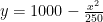
  2. A business produces an income of $x this year and $y next year, where these values can be varied according to the relation y=1000-\frac{{{x}^{2}}}{250} . Show how \left\{ \left( -\frac{dy}{dx} \right)-1 \right\} can be interpreted as the marginal rate of return over cost. Show that the value of this marginal rate is \frac{x-125}{125} when this year’s income is $x.
  3. The market demand for a good is given by p=\beta -\alpha x . The market is supplied by two duopolists with cost functions {{\pi }_{1}}={{a}_{1}}x_{1}^{2}+{{b}_{1}}{{x}_{1}}+{{c}_{1}} and {{\pi }_{2}}={{a}_{2}}x_{2}^{2}+{{b}_{2}}{{x}_{2}}+{{c}_{2}} . Assuming that the “conjectural variations” are zero, show that the reaction curves are straight lines. Deduce the equilibrium output of each duopolist.
  4. (a) A steel plan is capable of producing x tons per day of a low grade steel and y tons per day of a high grade steel, where y=\frac{40-5s}{10-x} . If the fixed market price of low grade steel is half of that of high grade steel, show that about 5½ tons of low grade steel are produced per day for maximum total revenue.
    (b) The steel producer described in Section (a) monopolizes the sale of both quality steels. If the prices of low and high grade steel are $px and $py per ton, the demands are {{p}_{x}}=20-x and {{p}_{y}}=25-2y . Find an equation giving the output x of low grade steel for maximum total revenue. Show, by a graphical method, that just under 6 tons of this steel are produced per day.

  5. Given the marginal utility equations
    {{x}_{1}}d{{y}_{1}}+{{y}_{1}}d{{x}_{1}}\ge 0 , {{x}_{2}}d{{y}_{2}}+{{y}_{2}}d{{x}_{2}}\ge 0 ,
    for which the indifference curves are the rectangular hyperbolas {{x}_{1}}{{y}_{1}}={{c}_{1}} and {{x}_{2}}{{y}_{2}}={{c}_{2}} , given initial amounts a1, b1, and a2, b2 for the individuals (1) and (2) respectively, show that the equilibrium point for a single price transaction is
    {{x}_{1}}=\frac{{{a}_{1}}+p{{b}_{1}}}{2p} , {{y}_{1}}=\frac{{{a}_{1}}+p{{b}_{1}}}{2p} , where p=\left( \frac{{{b}_{1}}+{{b}_{2}}}{{{a}_{1}}+{{a}_{2}}} \right) .
  6. The demand for tea is {{x}_{1}}=40\frac{{{p}_{2}}}{{{p}_{1}}} and for coffee {{x}_{2}}=10\frac{{{p}_{1}}}{{{p}_{2}}} thousand lbs. per week, where p1 and p2 are the respective prices of tea and coffee in pence per lb. At what relative prices of tea and coffee are the demands equal? Draw a graph to show the shifts of the demand curve for tea when the price of coffee increases from 2s to 2s 6d and to 3s per lb.
  7. The production function is x=A{{a}^{\alpha }}{{b}^{\beta }} , where A, \alpha and \beta are constants. If the factors are increased in proportion, show that the product increases in greater or less proportion according as \left( \alpha +\beta \right)  is greater or less than unity. How is this property shown on a vertical section of the production surface through 0 and a given point on the surface? What is the special property of the case \alpha =1-\beta ?
  8. Examine the utility function u=\frac{x+a}{c-\sqrt{y+b}} , where a, b and c are positive constants, and show that the indifference map is a set of parabolic arcs and of normal form for certain ranges of values of the purchases x and y.
  9. If a{{x}^{2}}+b{{y}^{2}} = constant is the transformation function for two goods X and Y, that the marginal rate of substitution of Y production for X production is \frac{ax}{by} and that the elasticity of substitution is always unity.
  10. A monopolist produces cheap razors and blades at a constant average cost of 2s per razor and 1s per dozen blades. The demand of the market per week is {{x}_{1}}=\frac{10}{{{p}_{1}}{{p}_{2}}} thousand razors and {{x}_{2}}=\frac{20}{{{p}_{1}}{{p}_{2}}} thousand dozen blades when the prices are p1 (shillings per razor) and p2 (shillings per dozen blades). Show that the monopoly prices, fixed jointly, are 4s. per razor and 2s. per dozen blades.


B

  1. (a) A radio manufacturer produces x sets per week at a total cost of \$\left( \tfrac{1}{25}{{x}^{2}}+3x+100 \right) . He is a monopolist and the demand of his market is x=75-3p , when the price is $p per set. Show that the maximum net revenue is obtained when about 30 sets are produced per week. What is the monopoly price? Illustrate by drawing an accurate graph.
    (b) In the case of Section (a), a tax of $k per set is imposed by the government. The manufacturer adds the tax to his cost and determines the monopoly output and price under the new conditions. Show that the price increases by rather less than half the tax. Find the decrease in output and monopoly revenue in terms of k.
    Express the receipts from the tax in terms of k and determine the tax for maximum return. Show that the monopoly price increases by about 33 per cent. when this particular tax is imposed.
  2. (a) If u={{x}^{\alpha }}{{y}^{\beta }} is an individual’s utility function for two goods, show that his demands for the goods are x=\frac{\alpha }{\alpha +\beta }\frac{\mu }{{{p}_{x}}} and y=\frac{\beta }{\alpha +\beta }\frac{\mu }{{{p}_{y}}} where px and py are the fixed prices and \mu the individual’s fixed income. Deduct that the elasticity of demand for either good with respect to income or to its price is equal to unity.
    (b) The incomes of an individual in two years are {{x}_{0}} and and {{y}_{0}} his utility function for incomes is u={{x}^{\alpha }}{{y}^{\beta }} . Show that the demand \left( x-{{x}_{0}} \right) for loans this year decreases as the given market rate of interest 100r per cent. increases. Deduce that the individual will not borrow this year at any (positive) rate of interest if {{y}_{0}}<\frac{\beta }{\alpha }{{x}_{0}} .
  3. Discuss this quotation from Chamberlin: “We must conclude that the problems of proportion [among the factors] and of size cannot ordinarily be separated. The goal of the entrepreneur is not to discover the most efficient proportions and then to reproduce these continuously until the most efficient size is secured.”
  4. Discuss this quotation from Douglas: “Since the demand curves for labor and capital tend to approximate and to conform to the respective marginal productivity curves, it follows that an increase of 1 per cent in the quantity of labor would, other things being equal, normally tend to be followed by a decrease of ¼ per cent in the rate of wages.”
    [He uses a production function P=1.01\,\,{{L}^{{\scriptstyle{}^{3}\!\!\diagup\!\!{}_{4}\;}}}{{C}^{{\scriptstyle{}^{1}\!\!\diagup\!\!{}_{4}\;}}} ]
  5. Discuss this quotation from Broster: “Secondly, the chief concern of the railways is the maximization not of gross but of net revenue the maximum values of which are not the simultaneous product of the same level of fares. As is well known, the fare that attracts the former is that which corresponds to unit elasticity. It is perhaps not so well known—especially amongst the managers of sales departments—that except where the total cost remains constant for different rates of output of services, the fare that attracts the maximum net revenue is necessarily higher.”
  6. Discuss this quotation from Hicks: “The elasticity of substitution of labor for capital is the same as the elasticity of substitution of capital for labor.”


Source: Duke University. David M. Rubenstein Rare Book & Manuscript Library. Lloyd Appleton Metzler Papers. Box 7. [Harvard University], Division of History, Government and Economics. Division Examinations for the Degree of A.B., 1938-39.


Categories
Columbia Economists

Columbia. Richmond Mayo-Smith. Life and Death, 1854-1901

Material from Richmond Mayo-Smith’s course at Columbia, Historical and Practical Political Economy (1891-92),  was posted earlier. Below some biographical information from his entry to a four volume collection of portraits and biographical sketches of distinguished university graduates published between 1898-1900 which is followed by the report of his death and funeral ceremony in the Columbia University newspaper, The Columbia Spectator.

The circumstances certainly point to suicide. According to the Encyclopedia of World Biography (2004), “Following a crippling boating accident, Mayo-Smith sustained a nervous breakdown and committed suicide a few months later in New York City.”

Here a link to his colleague E.R. Seligman’s 1919 tribute to Mayo-Smith published in Vol XVII of Memoirs of the National Academy of Sciences (1924).

A few pages in the paper by David John Gow [“Quantification and Statistics in the Early Years of American Political Science, 1880-1922”, Political Methodology, Vol. 11, No. 1/2 (1985), pp. 1-18] help to put Richmond Mayo-Smith within a larger context.

Incidentally Mayo-Smith’s wife, Mabel Ford, was the daughter of Gordon Lester Ford, editor of The New York Tribune, and the great granddaughter of Noah Webster according to her New York Times obituary of 4 February, 1938.

The pioneer of applied demand analysis, Henry L. Moore, was hired in 1902 to fill Mayo-Smith’s position. “Genealogically” speaking, we could think of this year’s economics Nobel laureate, Angus Deaton, as a direct descendent in the line: Mayo-Smith to Henry L. Moore to Henry Schultz to Milton Friedman (to name only one of the numerous legitimate heirs of Henry Schultz) down to Deaton, so Richmond Mayo-Smith was Angus Deaton’s great-great grandfather as far as applied consumption DNA can tell.

_____________________________

MAYO-SMITH, Richmond, 1854-

Born in Troy, O., 1854; received his early education in the public schools and High School of Dayton; A.B., Amherst, 1875; studied in Berlin, 1875-77; and at Heidelberg during the summer term of 1878; Assistant in Political Science at Columbia, 1877-78; Adjunct Professor History and Political Science, 1878-83; Professor of Political Economy and Social Science since 1883.

RICHMOND MAYO-SMITH, M.A., Professor of Political Economy and Social Science at Columbia, was born in Troy, Ohio, February 9, 1854. Through his father Preserved Smith, he is descended from the Rev. Henry Smith, who came to this country during 1638 and took up ministerial work at Wethersfield, Connecticut. His mother was Lucy Mayo. He received his early education in the public schools of Dayton, Ohio and at the Dayton High School, entering Amherst College in 1871 and graduating in 1875. He studied abroad at the University of Berlin during the two years following, and also at Heidelberg during the summer term of 1878. He was appointed Assistant in Political Science at Columbia in 1877, and was promoted to Adjunct Professor History and Political Science in the following year. In 1883 he was elected to his present position in the Chair of Political Economy and Social Science. Professor Mayo-Smith married, June 4, 1884, Mabel Ford. They have four children: Lucy, Amabel, Richmond and Worthington Mayo-Smith. He is a member of the Century, University and Authors’ Clubs, and is not actively interested in politics.

Source: University and their Sons. History, Influence and Characteristics of American Universities with Biographical Sketches and Portraits of Alumni and Recipients of Honorary Degrees. Editor-in-chief, General Joshua L. Chamberlain, LL.D.  Boston: R. Herdon Company.  Vol. 2, 1899, pp. 582-3.

_____________________________


PROF. MAYO-SMITH

Death by Fall from Fourth Story Window of His Home
Funeral Yesterday Morning
An Appreciation by Professor Giddings.

The sad story of the sudden death of Richmond Mayo-Smith, Ph. D., Professor of Political Economy and Social Science is by this time well known. For several months he had been ill with nervous prostration and was taking his seventh year of rest from university work. At six o’clock Monday evening his wife and daughter left him resting in his study on the fourth story of his home at 305 West Seventy-seventh street. Fifteen minutes later he was found dead on the flagging in the rear of the house. It is supposed that in opening the window to air the room, which was very warm, he slipped on the hard wood floor and fell out.

Richmond Mayo-Smith had been a professor of political economy at Columbia since 1883. He was born in Ohio, and was graduated from Amherst College in 1875. After leaving Amherst College he studied for two years in Berlin University. While abroad he also was a tutor in Heidelberg University. His connection with Columbia began in 1877, when he was called to the University as a teacher of history. The year following he was made an adjunct professor, and in 1883, as stated, he was made a Professor of Political Economy and Social Science. He was an honorary fellow of the Royal Statistical Society of Great Britain and a member of the National Academy of Sciences. He was a writer on economic subjects and the author of “Emigration and Immigration,” “Sociology and Statistics,” “Statistics and Economics.” These works were published in 1890, 1895, and 1899.

Professor Mayo-Smith was a member of the Century, University, Authors’, and Barnard Clubs, and of the Amherst College Association. He was a vestryman i’ Christ Episcopal Church, Seventy-first street and Broadway, of which the Rev. Dr. Jacob S. Shipman is pastor.


On Tuesday Acting-President Butler issued the following order :

President’s Room, Nov. 12, 1901.

As a mark of respect to the memory of Professor Richmond Mayo-Smith, for twenty-four years an officer of Columbia University, and in token of the affectionate regard in which he was held by his colleagues and by the student-body, the exercises of the School of Political Science will be suspended until Friday morning, Nov15.

On Thursday, Nov. 14, the day appointed for the funeral of Professor Mayo-Smith, the exercises of Columbia College and of the Schools of Law and Philosophy, will be suspended entirely; the exercises of the Schools of Applied Science and Pure Science will be suspended until 1:30 o’clock P. M.

The Trustees of Columbia College, members of the University Council, and all officers and students of the University, are invited to attend the funeral services of Professor Mayo-Smith in a body, on Thursday morning, Nov. 14, at 10 o’clock A. M., in Christ Church, Broadway and 71st St. Officers and students of the University will assemble in the basement of the Church, entrance on 71st St., at 9:45 A. M. Professor James Chidester Egbert. Jr., is designated to act as Marshal.

Nicholas Murray Butler,

Acting President.


The funeral services were held yesterday morning in Christ Church and were conducted by Chaplain Van De Water and Dr. Shipman. President Low and Acting-President Butler followed the coffin, and members of the faculty and student-body, about 200 in number, followed in procession.


Professor Franklin H. Giddings has written the following tribute:

The death of Professor Richmond Mayo-Smith has made a gap in Columbia’s Faculty which no mere closing-up of the ranks can ever fill or conceal. Some losses are irretrievable. The place that a great man has held may be taken by another. In a nominal sense his work may be done by another; but it is never the same work. Professor Mayo-Smith was a man in whom rare gifts were in a very rare way combined. No one came under his personal influence, or into the circle of his friends, who did not recognize the accuracy of his knowledge, and the remarkable poise of his judgment; who did not soon feel the singular beauty and kindliness of his nature.

At Columbia Professor Mayo-Smith had taught history, political economy and statistics, and he had long served in the University Council. As a teacher he presented every subject with the utmost clearness. He insisted upon accuracy and thoughtfulness in all required work; but his judgment of students was marked by great considerateness and fair-mindedness. Students taking advanced work under his direction were admitted to his friendship and confidence, and he never ceased to take a deep personal interest in their success.

As a scientific investigator Professor Mayo-Smith made important contributions to both political economy and social science. His most distinguished work was in the domain of statistics, and there he stood easily first among Americans, and was recognized by Europeans as ranking with the three or four greatest names on the Continent and in England. The characteristics of his scientific work, as of his teaching, were scrupulous accuracy, perfect clearness of presentation, and that balanced judgment which is the highest mark of the scientific mind. He never attempted to make figures prove anything. With endless patience he sought to read in them their own sincere story, to discover so much of truth as he might; content always to admit that neither he nor any one else knew half the things that scientific investigators are commonly supposed to have discovered.

To all these interests of the teacher and the scholar Professor Mayo-Smith added the activities of the citizen, which he discharged in a way that was an inspiring revelation to all who knew him of his deep sense of duty. For many years a most valued member of the Central Council of the Charity Organization Society, he was also chairman of the Eighth District Committee, and he made it his business to know the exact facts about every case that came before the committee for consideration or relief. I have personally known of instance after instance in which his feeling of obligation to the suffering was discharged only by an expenditure of time and energy in visitation which I felt sure he could ill afford to give. In social life he was one of the most charming of men, whose delightful humor made him always in demand as the toastmaster or chief speaker whenever, in meetings of the many learned societies to which he belonged, relaxation and good-fellowship succeeded the more serious business of the occasion. As a friend he was unselfish to a degree, thinking always first of others, always last of himself. My own obligation to him is one which no words of tribute can ever repay.

Source:  Columbia Spectator, Vol. XLV., No. 1 (Friday, November 15, 1901), p. 1.


Categories
Columbia Exam Questions

Columbia. Exam Questions for Economics Ph.D. Candidates, 1949

After reading this examination that provides prospective candidates ample opportunity to tailor their examinations to their own course work and interests, one cannot help but conclude that the examination was not intended to test mastery of a common core nor a familiarity with a wide-range of economics. Maybe the explanation is that this is merely the reflection of a committee of individuals too polite to insist on cutting questions outside of one’s own specialization yet too stubborn to allow cuts either.

Perhaps you would like to leave in the comments the list of five questions you would choose to answer (assuming that you are eager to maximize your grade on this exam). 

I’ll go first: (5, 8, 16, 22, 26).

Your turn! (Scroll down the page to add comment)

__________________________________

EXAMINATION
for
PROSPECTIVE CANDIDATES FOR THE DEGREE OF PH.D. IN ECONOMICS

(May 7, 1949, 2:00 p.m. to 5:00 p.m.)

Questions on Specific Areas of Economic Study

Answer any FIVE but NOT MORE THAN FIVE questions.

A. Write all answers legibly in ink or on a typewriter.
B. Begin each question on a fresh sheet of paper. Write your name on all sheets used.
C. Be as specific as the question permits.
D. Be sure that your statements are relevant to the question.
E. Allow yourself time to reread your answers before handing in the sheets.

__________________________________

  1. What part do psychological and technological factors play in the propagation of business cycles?
  2. Is there a need for a separate theory of international trade, and if so, on what grounds?
  3. Some writers attribute the dollar shortage to the greater increase of productivity in the United States as compared to the rest of the world (including, particularly Western Europe). What do you think of this explanation?
  4. Discuss the origins of money (a) as means of payment, and (b) as means of exchange.
  5. Describe the present distribution of powers, among the various agencies concerned, over the American currency and commercial banking systems. In particular, who determines the volume of “money”?
  6. Describe and appraise both the theoretical and the historical arguments for the “stagnation” thesis.
  7. Discuss the main trends in Soviet foreign trade under the pre-war five-year plans.
  8. To what extent is the predominance of agriculture in the productive activities of a country correlated with a low level of income? Explain the relation between the level of income and the importance of agriculture.
  9. Explain the principal influences affecting the amount of capital in different countries.
  10. What was the role of fiscal policy in mercantilism?
  11. Give a critique of the role of marginalism in John R. Commons’ institutional economics.
  12. Discuss the place of the Most-Favored-Nation Clause in the French Commercial Policy in connection with the tariff legislation of 1892 and of 1919.
  13. Give an account of the organization of labor on the Soviet collective farm.
  14. Comment on the methods and conclusions of Seligman’s “Shifting and Incidence” in the light of recent developments in the field of economic analysis.
  15. Discuss the probably future role of “benefit taxation” in the light of prevailing trends of fiscal policy.
  16. Suppose that list prices of new automobiles had been raised by 15% above actual levels prevailing in 1946. What would have been the effect on used car prices?
  17. “There is a disposition on the part of the judiciary to emphasize the compensation of the injured person rather than the punishment of the guilty one.” Outline three major features of the workmen’s compensation laws that justify this generalization. Discuss one important exception.
  18. “The expanding commercial interests of the merchant capitalists of the New England colonies came into conflict with the great capitalistic interest of British West Indian sugar.”….”On the contrary, these two interests were not competitive but essentially complementary.” Write a careful statement of the problem raised by these two conflicting assertions.
  19. Assume that you were a capitalist in 1830 with money to invest in manufacturing either in Great Britain or in the United States. Indicate the considerations (other than patriotism) that you would have weighed in choosing between the two countries for your investment.
  20. What is the “parity” concept as it applies to agricultural prices? Discuss the implications, for economic processes at large, of the application of price parity to agricultural commodities, and give your appraisal of the parity program.
  21. Discuss the changes that have occurred in the United States since the First World War, in the volume and character of production and in productivity. What effect, if any, may these changes be expected to have on the operating characteristics of the American economy and on the problems involved in maintaining full employment?
  22. Explain how statistical evidence may be used in applying tests of significance in economic research. What is the logical justification of such tests? What constitutes “verification” or “proof” in scientific inquiry?
  23. In public utility rate making, how my one distinguish between differences in rates for various types of service that are “discriminatory,” and differences that are “non-discriminatory”?
  24. Distinguish between the capitalization (security structure) of (a) a typical manufacturing corporation, (b) a typical electrical utility company, and (c) a typical railroad company.
  25. Discuss the merits of the contention that, in the determination of the net income of a business enterprise, the allowance for depreciation should be based on the replacement cost of the depreciating asset rather than on original cost.
  26. “Wages are governed by the marginal productivity of labor.” Explain as specifically as possible what this means, in operational terms. Do you consider the statement valid?
  27. Assuming an industry consisting of a limited number of large producers selling a standardized product. Is it possible to construct a theory which will define the level to which price will naturally tend? Indicate one or more answers which have been given to this problem, and problems involved with respect to assumptions used.
  28. In what practical ways did the Wagner Act contribute to the growth of American unions since 1935?
  29. In what respect and why does the Taft Harley Act change the status of foremen in American labor law?


Source: Columbia University Library, Manuscript Collections. Albert Gailord Hart Collection. Box 62: “Teaching Materials 4. Columbia University.” Folder: Label “TEACHING Sec 4: Col Univ Ec 103/4 MICRO: EXAMS”.

Image Source: Alma mater before the old library of Columbia University from Historic Preservation Education Foundation.

Categories
Economists Harvard

Harvard. Charles F. Dunbar Obituary by Taussig, 1900

In this posting I first provide links to six successive editions of Charles F. Dunbar’s textbook on the theory and history of banking (four of which revised and expanded posthumously). 

Next, following President Eliot’s memoir from the last posting, I append here the obituary for Charles F. Dunbar written by Frank W. Taussig published February 3, 1900 in the Cambridge Tribune.  

Another memoir (written by Edward H. Hall) regarding Dunbar was published in vol. 14 (1900-01) of the Proceedings of the Massachusetts Historical Society, pp. 218-228.

__________________________________

Dunbar, Charles F. Chapters on Banking, privately printed in Cambridge, Massachusetts.

Zero edition, 1885. Eight chapters printed for the use of classes in Harvard University.

Dunbar, Charles F. Chapters on the Theory and History of Banking. New York, G. P. Putnam’s Sons, The Knickerbocker Press.

First edition, 1891. Added introductory chapter, chapter on combined reserves or the system of Clearing-House loan certificates and one on the Bank of Amsterdam.

Note: title shortened for second through fourth edition to The Theory and History of Banking.

Second edition, 1901. Enlarged and edited by O. M. W. Sprague.

Third edition, 1917. Enlarged by Oliver M. W. Sprague to include three new chapters on Foreign Exchange, Central Banks and on the Federal Reserve System.

Fourth edition, 1922. With chapters on foreign exchange and central banks by Oliver M. W. Sprague and a supplementary chapter presenting the record of the Federal Reserve System by Henry Parker Willis.

Fifth edition, 1929 With supplementary chapter presenting the record of the Federal Reserve System by Henry Parker Willis. Revised and in part rewritten with additional material by Oliver M. W. Sprague. New York: G.P. Putnam’s Sons.

__________________________________

Charles Franklin Dunbar.

Charles Franklin Dunbar, professor of Political Economy in Harvard University, died at his house, on Highland street, on the night of Monday, January 29. He had been ill for some weeks, but his friends had not thought the end would come so soon.

Professor Dunbar was born July 28, 1830, and graduated from Harvard College in 1851. Among his class-mates were Professors Goodwin and Langdell, and Dr. S. A. Green; and, among those whom death has already carried away, Professor W. F. Allen of the University of Wisconsin, General Francis W. Palfrey, and Messrs. George O. Shattuck and Augustus T. Perkins of Boston. Professor Dunbar studied law after graduation, but in a few years became connected with the Boston Advertiser. To that paper he gave some of the best years of his life. He became editor-in-chief in 1862, and so was in charge of the paper during the greater part of the civil war. While always independent in his judgments, he was a fervid supporter of the Union cause, and many of his editorials rang through New England like a trumpet blast. In 1869 the paper changed hands, and Professor Dunbar resigned as editor and disposed of his interest. He was invited shortly to accept the professorship in Harvard University, and after two years spent in travel and study in Europe, assumed the duties of the professorship, in 1871. For the rest of his life he was in active service, and a resident of Cambridge through these thirty years.

Professor Dunbar’s sagacity and tact led to his selection for important administrative offices. He was dean of the Faculty of Harvard College from 1876 to 1882, and was the first dean of the Faculty of Arts and Sciences in Harvard University when that body was organized in 1890. He remained its dean till 1895. From 1886 to 1896 he was editor of the Quarterly Journal of Economics, established by the University in the first named year.

Professor Dunbar was distinguished by solidity of learning, sanity of judgment, independence of views, and scholarly thoroughness in probing to the bottom every subject he took up. His favorite topics were banking, currency and financial administration. He was interested alike in the history of these subjects and in current problems connected with them. Probably no man was better equipped by attainments and by justness of views to give advice on the financial questions which have been before the American community for the last thirty years. His writings on them gave but fragmentary indication of his attainments. He published a compact volume on the “Theory and Practice of Banking,” [sic, correct title is “The Theory and History of Banking”] which, though brief, is the best book on this subject in the English language, and in some respects perhaps the best in any language. To the Quarterly Journal of Economics he contributed frequent articles on financial subjects, and on some questions of theory; and he had abundance of material for others which he had planned but unhappily was not able to prepare. His administrative duties absorbed a large share of his strength, and stood in the way of the execution of his literary plans.

Professor Dunbar was a member of the Massachusetts Historical society, and a Fellow of the American Academy of Arts and Sciences. He was at one time president of the American Economic association. His reputation abroad was at least as high as it was in the United States: among economists the world over he was known as a scholar of the first rank.

An easy and graceful writer, he was also a clear and attractive lecturer, with a remarkable faculty for the consecutive and systematic exposition of difficult subjects. The weakness of his voice was the only obstacle which ever stood in the way of the interest and easy comprehension of his lectures. With small classes of advanced students he was at his best, and no one who came in contact with him under such circumstances failed to cherish feelings of admiration and affection far him. Staunch in his own opinions, open-minded as to those of others, free from all vanity or ostentation, strong in his affection for those with whom he came into close association, he left a memory which will be cherished by his associates and former students.  F. W. Taussig.

Source: Cambridge Tribune, Vol. XXII, No. 48 (February 3, 1900), p. 4.

Image Source: From cover of the 1885 copy privately published Chapters of Banking.

Categories
Economists Harvard

Harvard. Biographical memoir of Charles F. Dunbar, 1900

Only a few days after Harvard’s first professor of Political Economy died on January 29, 1900, the President of Harvard himself, Charles William Eliot, read the following memoir of the life of Charles Franklin Dunbar before the Massachusetts Historical Society on February 8, 1900. The memoir was published in The Harvard Graduates’ Magazine‘s June, 1900 issue and reprinted along with biographical sketches of other “Sons of the Puritans” in 1908. Page numbers for the 1908 reprint of the memoir have been placed within square brackets below.  The account of Dunbar’s Harvard career begins on page 75.

_______________________

CHARLES FRANKLIN DUNBAR

By Charles W. Eliot

[59] Charles Franklin Dunbar, born at Abington in July, 1830, was of Scotch descent, as his sandy hair and complexion, his shrewdness, reticence, and quiet humor plainly testified. He was much interested in his family descent, and gave no little time to tracing it both in Scotland and in Massachusetts. In one of his journeys to Scotland he visited the chief seats of the Dunbar Clan in Morayshire, and found reason to believe that from and after the year 1400 Dunbar was one of the prevailing names in that region. The first Dunbar in Massachusetts was Robert Dunbar of Hingham, who said of himself, in a deposition he made in court in 1659, that he was a servant of Mr. Joshua Foote when Mr. Foote lived in Boston. By a series of careful investigations Charles Franklin Dunbar established the strong probability that this Robert Dunbar who was held to the services of Joshua Foote for a term of years as early as 1655, and possibly as early as 1652, was one of Cromwell’s Scottish prisoners taken at the battle of Dunbar in 1650, [60] or at the battle of Worcester in 1651. It is certain that some of the prisoners taken at the battle of Dunbar were sent to the Colony of Massachusetts Bay in 1650-51, after having endured frightful sufferings which killed three quarters of the prisoners originally captured. Robert Dunbar, who died in Hingham in 1693 at about sixty years of age, was therefore, in all probability, of very tough fibre.

The father of Charles Franklin Dunbar was Asaph Dunbar, who was born in 1779 and died in 1867. Charles was Asaph’s youngest child. He had three brothers, all of whom filled out a reasonable span of life, and two sisters, one of whom died in infancy and the other at the age of twenty-one. The father’s business was making boots and shoes, and Charles’s three older brothers grew up in that business in Plymouth County, but while still young went away to New Orleans to sell there the goods which their father manufactured. One of these three brothers returned to New York to establish himself there in the same business. Charles was the only one of the brothers who received a liberal education. He was sent to Phillips Academy, Exeter, — probably because he had always shown a strong desire to read and an aptitude for study. The [61] success with which he accomplished the academic course at Exeter determined his being sent to Harvard College, where he graduated with credit in 1851. The fact that he was sent to Exeter at thirteen years of age determined his subsequent career; and he always felt unbounded gratitude to that ancient academy, a gratitude which he expressed by serving it for many years as a member of the board of trustees. At Harvard College he won the respect and friendship of scores of young men, many of whom have come to the front in one way or another during the forty-eight years which have elapsed since he graduated. Some of them were associated with him in after life; and he always retained their warm regard and admiration.

After leaving college he went for a time to his brothers in New Orleans; but soon came back, first to New York and then to Boston, applying himself steadily to business. A threatening of serious trouble in the lungs obliged him to abandon this indoor occupation; whereupon he bought a farm at Lexington, and entered cheerfully on the quiet out-of-door life of a farmer, for which he developed a strong taste and aptitude. Here he soon recovered his health and strength; so that he took up the study of the law at the [62] Harvard Law School, and in the office of Ebenezer Rockwood Hoar, and was in due course admitted to the Suffolk bar in 1858. Practice coming to the young lawyer but slowly, he had ample time to write for the Boston Daily Advertiser, and, finding this occupation congenial, he became within a little more than a year editor and part owner of that influential newspaper. In this enterprise he was supported and helped by the occasional labors of a group of young men whom he had known at Exeter and in College; but he himself gave his whole time and strength to the paper. He remained in the position of editor for ten years, — all through the Civil War, and through the early years of reconstruction and gradual pacification. During the Civil War he personally wrote every editorial article in any way related to the war which appeared in that newspaper. The Advertiser became by common consent the leading paper in Boston, and no newspaper since has exercised the same influence in this community. His position brought him into contact with a large proportion of the leading men of the time in eastern Massachusetts, — with merchants, manufacturers, politicians, soldiers, lawyers, and preachers. He wrote, of course, constantly on military [63] events and prospects; but the subjects he best liked to deal with were financial, economic, or political, — such as the war loans, tariffs, and banking acts, the suspension of specie payments, and the measures taken to collect a great internal revenue. The amount and the quality of the work he did in the ten years between 1859 and 1869 were remarkable, considering that he began this work at twenty-nine and ended it at thirty-nine years of age. At thirty years of age he was wielding an influence which would now seem almost impossible of attainment at that age.

A few citations from his editorials will suffice to give an idea of the elevation of their tone, and of their moderation, judicial quality, and prophetic insight.

As early as July 4, 1861, he thus defined the objects of the war for the Union, and the spirit of the Northern people: —

“We are fighting now, as eighty-five years ago, to defend a cause in which the grandest principles of government and the highest interests of man are involved. Our people now as then have thrown aside all remembrances of old divisions, and have united in an enterprise which they believe to be just and holy. Life, fortune, and sacred honor [64] are again pledged to the support of the patriotic declarations with which the second war for liberty has been undertaken; and again has Congress assembled, prepared to forego the ordinary topics of political strife, to forget as is believed all tests save the one question of fidelity to country, and to take counsel in singleness of heart for the one great object.”

Immediately after the heavy defeat of the Union troops at the first battle of Bull Run, he wrote, July 23, 1861: —

“We said at the outset that this reverse had temporarily defeated the scheme for advancing through Virginia. Let no man to-day whisper the thought of abating a jot of our vast undertaking. Taught by one reverse the nation will rise above its misfortune, and press on in its just and holy cause. The people who have poured out their blood and treasure so freely will be kindled to new efforts. … Our present misfortune will disclose to all the true secret of our weakness, and will teach all that the advance for which some have so long clamored is not to be accomplished in a single effort. With a full knowledge on all hands of the nature of our undertaking, and with such further preparation as must now be made for this grand enterprise, we can doubt its final success as little as we can doubt the justice of the cause in which [65] it is undertaken, or the wisdom of the Providence which rules all things for our good.”

He early foresaw the fate of slavery as an institution. Writing on the last night of the year 1861 a survey of the events of the year, he made this prophetic utterance a year before the Emancipation Proclamation was issued: —

“It leaves our own people with renewed courage, united beyond all hope in support of the government in a most trying case, and fully ahve to the importance of closing the war at once. It also leaves the majority with an unshaken resolution to confine the war to its proper objects, and to sustain the President in the firm and conservative course which he has pursued through the ten months in which he has held office. At the same time, the year has demonstrated to our whole people the great fact, that in the designs of Omnipotence the South has been led through its own folly to write the doom of slavery. Heavier and heavier are the blows which descend upon that institution, and more and more significant are the proofs that the South built upon a weak foundation, when, within this very year, it announced slavery as the cornerstone of its fabric, political and social.”

Near the close of the year 1862 Secretary Chase communicated to the Committee on Ways [66] and Means the draft of a bill to provide the necessary resources for the prosecution of the war. The second section authorized the Secretary of the Treasury to borrow nine hundred million dollars in any of the modes heretofore authorized for making loans. The bill also contained the details of the national bank scheme. Mr. Dunbar’s comments on this bill are in part as follows: —

“The most important feature of this bill, so far as regards the immediate emergencies of the country, is the second section, and this it seems to us has been well conceived. . . . Should this power be granted by Congress, we trust that the secretary will use it with liberal forethought. Armed with full powers, he will be able to feed the market with such securities as are most popular, at times when prices are favorable. Unrestricted by needless trammels, he can avail himself of the most favorable proposals which may be suggested from time to time by those who have money to loan, or who can present well-considered plans for meeting the wants of the Treasury with the least cost to the nation.”

Of that very important part of the bill which related to the establishment of the national bank system he speaks as follows, in his few words [67] showing that he had a clear vision of the wide scope and far-reaching consequences of the project:—

“It has been taken for granted that this measure will provoke a violent opposition, which, nevertheless, as yet has not manifested itself in any very definite shape. It is nowhere denied that the Secretary’s plan insures several very decided advantages; it looks rather to the establishment of a sound currency for the country upon a permanent basis than to any immediate results. If it be said that it will be time enough to legislate to this end when we have got out of the war and the financial difficulties incident thereto, it may be answered with at least equal force that the necessity of reform will then be less generally apparent. ‘Why don’t you mend your roof ?’ asked a traveler of a negro in whose leaky hut he had taken refuge during the shower. ‘Cause it rains’ was the answer. ‘But why don’t you mend it at some time when there is no rain ?’ ‘Cause then it don’t leak.’ This sort of logic will hardly justify Congress in refusing a careful attention to Mr. Chase’s plan, notwithstanding the statement paraded in advance, that ‘the majority of the Ways and Means are hostile to Mr. Chase’s scheme,’ and that ‘this sentiment of disapproval cannot possibly be changed.’”

[68] After the great victories at Gettysburg and Vicksburg, July 3-5, 1863, Mr. Dunbar wrote as follows on the 8th of July: —

“We speak of these events as of extreme political importance, because they have now for the first time fairly established the ascendency of the national power over the rebellion. Hitherto the struggle has been often a drawn game, and even in our moments of success has left the military strength of the rebels so formidable as to keep their hopes alive. The handwriting is now on the wall in characters which the rudest may read, warning the rebels that henceforth theirs is a hopeless cause, and that from this time their efforts must decline. We may now, at any rate, count upon the moral effect of defeat and loss of faith in their cause, and may hope for the appearance of those discontents and divisions to which despondency gives rise, and which precede the final ruin of a cause which, like the rebellion, has no root in sound principle.”

Looking back on this statement after an interval of thirty-seven years, we are struck with its absolute accuracy.

In his review of the year 1863, on the 31st of December, his comments on the Proclamation of Emancipation illustrate the perfect balance of his judgment: —

[69] “The most distinctly marked event in the conduct of the war for the year, however, is unquestionably the Proclamation of Emancipation issued on the 1st of January, 1863. Of this measure it can now be said, that it has equally disappointed its advocates and its opponents. It has failed to effect the dissolution of the rebel power which was so confidently predicted as certain to be its instantaneous effect, and has left the actual work of emancipation to be performed by the steady advance of military operations. On the other hand, it has failed to make that disastrous division among the loyal which was predicted by many of its opponents. The mass of the people have acquiesced in it as a military measure taken in good faith. But we must remark, they have done this the more readily since on independent grounds the policy of emancipation has gained favor in the popular mind rapidly during the year.”

Speaking of the extraordinary sales of 5-20 bonds in the summer and autumn of 1863, he writes as follows: —

“Throughout the country these bonds have been eagerly sought, with the noblest demonstrations of confidence and affection towards the government in defense of which the money is contributed. The success with which the government now deals with a debt of great magnitude has inspired the country [70] with faith in its ability to cope with the future, heavy as are the burdens promised by the Secretary of the Treasury.”

How far-seeing is the following paragraph, which occurs in the same review of the year 1863: —

“The feelings of the French Emperor towards the United States had long been suspected, but were first fully appreciated by our people when his designs in Mexico were fairly unmasked, and when he announced his deliberate design of erecting a throne in that country to be occupied by a prince nominated by himself. It was immediately perceived that France had created for herself upon this continent an interest adverse to that of the United States. The occupation of the Rio Grande by our forces, however, together with the established certainty that the Emperor will for the present find enough to do in dealing with the Mexican people, who do not accede to the fiction that Maximilian is their choice, has finally quieted all fears as to the course of France for the present.”

In his review of the year 1864, Mr. Dunbar wrote as follows: —

“Never has the struggle seemed so gigantic as in this year, never have the contending forces so [71] convulsed the continent with their efforts, or so appalled the spectators of a strife as terrible and unrelenting as the of the elements. Indeed, this is an elemental strife, which we have seen approaching its climax and crisis, — a strife which, in the words of a philosophic observer who was lately among us, is waged ‘not only between Aristocracy and Democracy, between Slavery and Social Justice, but between ferocious Barbarism and high Civilization.

“It is only when we view the contest in this light that it is possible to realize completely the futility of such efforts at pacification as that which has characterized this year, and which was defeated by the will of the people a few weeks ago. These raging elements are as far beyond the reach of all such attempts to quiet their agitation as is the tempest which purifies the physical atmosphere. The forces have long been gathering, they are in the full height of their sublime power, and are not to be stayed until the mission assigned to them by Providence is accomplished. A great political party thought otherwise, and sought by months of carefully studied effort to still the contention by premature peace; and it finds itself to-day shivered to atoms, and its candidates swept aside like chaff and forgotten. The judgment of the nation and its will have risen to the height of the occasion, and have settled irrevocably the devotion of this [72] people to their grand task to the very end. In its moral aspects, then, the result of the election has been the great event of the year and of the war.”

Mr. Dunbar was often called upon to express the strongest emotions of the people under circumstances of tremendous excitement. After listening all day to the rejoicings in the streets of Boston over the surrender at Appomattox, he wrote at night an editorial in which two out of the four paragraphs are as follows: —

“Four years ago this morning we were obliged to say in this place ‘we do not seek to pierce the gloom which now seems to overspread the future.’ Four years of that future as they have enrolled themselves have shown many another crisis, or agony more acute, but none of gloom so depressing as settled on us all in that week of uncertainty. This day is the anniversary of the humiliating correspondence between General Beauregard and Major Anderson, in which he demanded the surrender of Fort Sumter as a foregone necessity. To-morrow is the anniversary of the day on which he opened his fire. These four years have called upon the nation to show its steadfast endurance. They have called for that loyalty to institutions which does not seek to pierce the gloom of the future. They have bidden the nation stand firm on the eternal principles of its government, [73] and trust God to give it victory, when for victory the time had come. Through that gloom, or the flushes of hope which at one moment or another varied it, the nation has stood firm, and at last the end has come. . . .

“Such are the moral advantages of the victory. They make a nation so strong that war in its future is wholly unnecessary, — it seems hardly possible. This nation is just, — it can be as generous as it is just. It has no entangling foreign alliances, it need have no petty foreign jealousies. God has shown it His mercy in a thousand ways, and now that He blesses it with Peace, it has His promise that Peace shall lead in every other angel of his Kingdom.”

At the close of the year 1865 he wrote as follows, prophesying a period of discussion and evolution which has not yet ended: —

“The year, we may trust, is the last in the succession of years which by striking and exciting events compete for the leading place in our annals. The period of great deeds is perhaps over; we now have remaining questions of magnitude to be debated and settled, or to be suffered to work towards their own solution by process of time, and not concentrating their fierce interest into single great transactions, of which we have known so many since 1860. The question as to the future [74] of the freedmen is not to be settled by the turn of any crisis, but by many discussions, the long-continued operation of opinions, and the progress of immigration, of industry, and of ideas. Financial questions, of which we have so many of importance, are as little to be determined by any special action, but cast their shadow far over the coming years. The foreign questions, of which the closing year leaves us a supply not trifling in importance if scanty in number, are as little likely, we may hope, to assume such form as to bring back the unhealthy excitements which have long been familiar, but will rather relapse into the ordinary course of international litigation, or be settled by causes and influences which in power are far above the counsels of emperors. In short, we now enter in public matters upon a period of discussion; and if results appropriate to this method of action are wrought out with half the skill and power which we have seen displayed in the marvelous twelvemonth now ending, we shall find our prosperity and happiness, and our development in all that ennobles a people, settled on a foundation more solid than our fathers ventured to hope for.”

During his administration the Advertiser as a property increased greatly in value; so that when in 1869 Mr. Dunbar found it necessary again to pay attention to his health, and to give [75] up work for a time, he sold his interest in the newspaper for a sum which amounted to a competency for himself and his family. This was really a value which his own mental gifts and moral character had imparted to the newspaper. There is no more satisfactory way in which a man can earn a competent support for his family before he is forty years of age. All through his life Mr. Dunbar was a careful, frugal, and successful man of business, although he gave but a very small portion of his time to that side of life.

In order to recover from the nervous exhaustion which he experienced in 1868, he made two journeys to Europe, the first alone, but the second with his family. I had come into the Presidency of Harvard College in 1869, and one of the first measures which the Corporation resolved to prosecute with vigor was the establishment of a Professorship of Political Economy, and the selection of an incumbent for the chair. Mr. Dunbar being well known to all the members of the Corporation, the appointment was offered to him in 1869, and he gave a conditional acceptance to take effect two years later. A quiet life in various parts of Europe restored his health and gave him opportunity, [76] for the prosecution of studies which prepared him further for his new function; and In 1871 he took up the work of his professorship, to which he thereafter steadily devoted himself for more than twenty-eight years.

Professor Dunbar was the first Professor of Political Economy that Harvard University ever had. That great subject had previously been one of the numerous subjects assigned to the Alford Professor of Natural Religion, Moral Philosophy, and Civil Polity. Professor Dunbar announced for the year 1871-72 a course prescribed to Juniors on Rogers’s “Political Economy” and Alden’s “Constitution of the United States,” two hours a week for half a year, and an elective course in Political Economy for the Senior Class, based on Adam Smith’s “Wealth of Nations,” Bowen’s “American Political Economy,” and J. S. Mill’s “Political Economy;” but these courses were announced under the head of Philosophy. The elective course was attended by seventy-five Seniors. The next year his elective course appears under its proper heading, — Political Science, — the description of the course being altered to the following: J. S. Mill’s “Political Economy,” McCulloch on Taxation, Subjects [77] in Banking and Currency. Professor Dunbar also conducted in 1872-73 a required course for Juniors in Political Science, two hours a week during half a year. That year he used as textbooks for the Junior’s Fawcett’s “Political Economy” and the Constitution of the United States. In 1873-74 Professor Dunbar had for the first time the assistance of an instructor, because the required course in the Elements of Political Economy was transferred from the Junior to the Sophomore year, — on its way to extinction, — so that this required course had to be given that year to two large classes. Under Professor Dunbar’s elective course, Bagehot’s “Lombard Street “appears for the first time. In the next year Professor Dunbar gave, in addition to the prescribed Political Economy, two elective courses parallel to each other, one being preferable for students of History. The rapidly increasing number of students in the department made it desirable to offer these two parallel courses, so that neither class should be too large. One hundred and thirty-one students chose these electives. In 1875-76 Professor Dunbar was conducting three progressive courses: the prescribed elementary course, a first elective course on J. S. Mill’s “Political Economy,” [78] and the Financial Legislation of the United States; and an advanced course on Cairns’s “Leading Principles of Political Economy;” and McKean’s “Condensation of Carey’s Social Science;” and the number of students attending his course was steadily increasing. In the following year Professor Dunbar became Dean of the College Faculty, an administrative position which he held for six years. The prescribed course in Political Economy for Sophomores now disappeared. The elective courses were fully maintained. Professor Dunbar had some assistance in the elementary elective course, because of the necessity of devoting a good deal of his time to the administrative work of the Dean’s office. His assistant in the year 1877-78 was Mr. Macvane, now Professor of History in Harvard University. The next year his assistant was Dr. James Laurence Laughlin, who had the title of Instructor in Political Economy. In 1880-81 another course in Political Economy was added to the two already given, Professor Dunbar working in all three courses, but being assisted in the first two by Dr. Laughlin. The most advanced elective under Professor Dunbar was based on Cairns’s “Leading Principles of Political Economy,” [79] McLeod’s “Elements of Banking,” Bastiat’s “Harmonies Economiques.” In the year 1882-83 Professor Dunbar took leave of absence in Europe. His work was carried on by Dr. Laughlin and a new instructor, Mr. Frank W. Taussig, now Professor of Political Economy in Harvard University. A new half-course was added this year, — a course on the Economic Effects of Land Tenures in England, Ireland, France, Germany, and Russia. The next year brought considerable expansion to the Department. Professor Dunbar returned to his work; Dr. Laughlin was made an assistant professor; and Dr. Taussig offered for the first time a course on the History of Tariff Legislation in the United States. The number of courses offered by the Department suddenly expanded to four courses running through the whole year, and three running through half a year. Economic History appeared for the first time as part of the instruction given by the Department, Professor Dunbar having charge of the course. It was in that year that the plans of Professor Dunbar for the development of his department in the University became apparent to the academic world. Dr. Taussig soon became an assistant professor; Dr. Laughlin was [80] promoted to a full professorship at Cornell University, whence he was subsequently transferred to the University of Chicago; and a series of young men, all selected by Professor Dunbar, were brought forward in the Department as teachers. The number of teachers and courses increased until, in 1894-95, this Department, called Economics since 1892-93, employed three full professors, one assistant professor, and three instructors, and the number of courses had risen to six full courses and seven half-courses. In 1899 the lowest elective course in Economics was opened to Freshmen; so that the Harvard student thenceforth had access to that subject in all the four years of his college course. For the present year, 1899-1900, courses were announced which gave employment to three full professors, one assistant professor, and six instructors. In the academic year 1898—99 the choices made of courses in Economics numbered 1263.

Such was the development given in twenty-eight years to a subject which certainly should be second to none in value or dignity at an American university. At every step of the process it was Professor Dunbar’s sagacity, sobriety, and fairness which commanded confidence [81] and secured success. He thus made, in the course of twenty-eight years, as it were with his own hands, a complete collegiate instrument for training young Americans in Political Economy, the first such instrument ever constructed. If it should occur to any one that this growth was made possible by the general atmosphere at Harvard, the answer would be that Professor Dunbar had much to do with determining the quality of that atmosphere.

In 1886 a timely gift of a fund of $15,000 from one of Professor Dunbar’s pupils enabled the Corporation to establish the Quarterly Journal of Economics, published for Harvard University. They took this step by the advice of Professor Dunbar, and on the condition that he should edit the Journal. He acted as editor for ten years, and in that time established the position of the Journal in this country and in Europe as a valuable medium for economic discussions and researches. The subjects of some of the articles which he wrote for this Journal will indicate the wide range of his studies: In 1886, “The Reaction in Politics;” in 1887, “Deposits and Currency,” and a note on Ricardo’s Use of Facts; in 1888, a notice of an old tract entitled “The New-Fashioned Goldsmiths,” [82] a tract which appears to have been the source of the generally accepted statement as to the origin of private banking in London in the seventeenth century. In the same year appeared “Notes on Early Banking Schemes “from his pen, and an article on “Some Precedents Followed by Alexander Hamilton.” At the end of this last paper, after a learned review of the system advocated by Hamilton, and of the sources of the measures which he recommended, Professor Dunbar said in conclusion: “No statesman could have a greater task set for him, and political science can hardly have in store any greater triumph than this application of the experience of other men and other nations.” In 1889 he wrote for the Quarterly Journal an article on the Direct Tax of 1861, the conclusion of which was, “The direct tax provided for by the Constitution has at last been discredited as a source of revenue, and it has also been too prolific of misconception and confusion to have any Influence henceforth as a practical measure of finance.” A single sentence from an essay he published in the Journal in 1891 on the academic study of political economy admirably expresses the true conception of the function of an instructor in any moral [83] science: “That the student should learn to reason truly is of far more consequence than that he should perceive and accept any particular truth, and the real success of the instructor is found, not in bringing his students to think exactly as he does, — which is unlikely to happen, and, indeed, unnatural, — but in teaching them to use their own faculties accurately and with a measure of confidence.” In another passage in the same essay, speaking of the conditions under which an instructor may or may not be silent concerning his own beliefs, he says, “There are few men whose weight of authority is such as to compel any extraordinary caution in the declaration of their minds.” Those two statements are highly characteristic of Professor Dunbar’s habitual attitude towards his own students.

One may easily trace through all the activities of Professor Dunbar as a teacher and writer the effect on his mind of his ten years’ work as the editor of a daily paper during a period of startling and far-reaching military, financial, social, and political events; but it is interesting to observe that commercial and economic questions began to engage his attention some years before the war. Thus we find in the North American Review an article by him on the Danish [84] Sound Dues written as early as 1856, when he was twenty-six years of age. His services as a university teacher grew naturally out of the studies and interests of his early manhood.

Professor Dunbar was Dean of the old College Faculty for six years, from 1876 to 1882, and the first Dean of the new Faculty of Arts and Sciences from 1890 to 1895. He therefore gave a large amount of administrative service to the University. As an administrative officer he was prompt, efficient, and wise. One peculiarity he had which was rather trying to some of the many students and parents of students with whom he came into contact, — he was sometimes too reticent and silent. He would listen patiently to a long tale in which the narrator felt great interest, and take it all in, but hardly utter a word in reply. Sometimes, however, after his interlocutor had despaired of getting an answer, he would give a concise but comprehensive reply which showed how sympathetically he had apprehended the whole subject under discussion. Ordinarily patient and cautious, he was entirely capable of quick decision and prompt action. On a reconnaissance he was circumspect and thorough; but when he once made [85] up his mind how the land lay and how the adversary was intrenched, he moved on the position, in the safest possible way, to be sure, but with energy and persistence. As a rule, his aspect was serene and mild; but on occasion his face could become set, and from his blue-gray eyes there came a steel-like gleam dangerous to his opponent. In his judgment of others he was gentle, unless he became satisfied that some man he had been observing did not play fair, or was untrustworthy at the pinch; then he became stern and unrelenting. It was these qualities which made him the successful journalist that he was at thirty years of age. The Faculty was always afraid to take a step of which he did not approve, and seldom did so, unless his occasional infirmity of silence had concealed from them his opinion. They felt in him a remarkable sagacity combined with quick insight and unwavering disinterestedness; and they found him to be uniformly just. If he now and then betrayed a prejudice, they felt sure that he had good grounds for it, and were much disposed to share it with him. Every one who has seen much of the world will perceive how rare a combination of qualities was [86] embodied in this modest and retiring man, and will understand how great a loss the University has suffered in his death.

In addition to the solid satisfactions Mr. Dunbar derived from his forty years of professional work, he had great delights in his domestic life. He married, soon after leaving college, Julia Ruggles Copeland, of Roxbury, and he survived his wife only two months. Five children were born to them between 1855 and 1862, of whom three sons and a daughter survive their father and mother.

I have already mentioned the life of the young family at Lexington. When he became editor of the Advertiser, he moved, first, to Roxbury; but finding the inevitable exposures of returning to Roxbury from his office late at night (often after the omnibuses had ceased to run) too great for his strength, he moved to a small house on River Street, at the foot of Beacon Hill. This house was comparatively sunless, and, though close to Beacon Street, had no outlook whatever. It was a great Relight to him and his wife and his growing children to establish the household in 1872 in a spacious house on the hill which rises north of Brattle Street, Cambridge, not far from Elmwood, [87] a house which commanded a charming prospect, and was surrounded by fine trees. He had earned the luxury of fine prospects, abounding sun and air, and garden grounds, as product of the work of his own brain. His tastes and habits were simple, but refined. Luxuries and superfluities had no charm for him. He was fond of driving and sailing, but needed no elaborate equipment for obtaining these pleasures. He valued these sports mainly as means of getting into contact with the beauties of nature by land and by sea. He had the natural healthy enjoyment in food and drink, but always preferred simple things to elaborate, and was displeased by extravagance or excess.

In 1886 he bought the larger part of Bear Island, off Mount Desert, the smaller part being already occupied by the United States as the site of a lighthouse; and here he built in 1893 a cottage for the summer occupation of his family. When visiting friends on the neighboring shore of Mount Desert, he had often marked the beautiful form of this island, and admired the exquisite views it commanded in several directions. In deciding upon the site of his house on this island, it was his chief care to avoid impairing the aspect of the island from [88] the neighboring shores, — a thoughtful result which he perfectly achieved. All his life he had great pleasure in carpentering. He always had a carpenter’s bench in any house he occupied, and delighted in good tools and in using them with skill. He could build with his own hands fireplaces, corner buffets, desks, tables, and other pieces of furniture. At Bear Island he built a large boat-house with chambers in its upper story, doing most of the work with his own hands, after the heavy framing had been put up. He enjoyed thinning the woods which covered the northern shore of the island, and studying the flora and fauna of his isolated kingdom. A thrifty little spruce, looking as if it could easily resist all the ice and snow, all the gales, and all the droughts of that northern clime, a single graceful birch, a mountain ash loaded with red berries, or a clump of ferns, sufficed to give him great enjoyment. With reading and writing interspersed, such pleasures filled his summer days so completely and so happily that he seldom wished to leave his island. Friends came to stay with him; but he seldom cared to go far from his cottage, unless on a sail or a drive with one of his neighbors of the main island. There was no road on his island, [89] and hardly a path, except little tracks between the hummocks and ledges; and there were no sounds, except the beat of the waves on the rocky shores, the singing of birds, and the rushing of the wind through the trees. One of the peculiarities of the climate of the Maine coast had singular charm for Professor Dunbar. On almost every summer evening near sunset, there falls a great calm and stillness. No matter how boisterous the day may have been, near sundown there comes a widespread, profound silence, unspeakably grateful to such a temperament as his. The hills of Mount Desert, in full view from his island, reminded him of the similar hills built of primary rocks which his Scottish forbears had looked on in far-away Morayshire.

Outside his family circle his intimate associates were not numerous; but his friendships were intense, and his rare and concise expressions of affection were overwhelmingly strong. As I look back on this completed life, it seems to me filled with productive labors and large services from which came deep satisfactions. Grave trials and sorrows hallowed it; but its main warp and woof were both made of innumerable threads of happiness and content.

[90] In his religious convictions he was a Unitarian, and he valued highly that simple and optimistic faith; but his mind was hospitable to all forms of theological opinion, while he was strenuously averse to ecclesiasticism and aestheticism in religion. Simplicity, cheerfulness, duty, and love were the articles of his faith, and human joy and well-being their natural fruit.


Source: Sons of the Puritans. A Group of Brief Biographies. Boston, American Unitarian Association, 1908. Sketches reprinted from The Harvard Graduates’Magazine, Vol. VIII, No. 32 (June, 1900), pp. 469-484.

Image Source: The Harvard Graduates’Magazine, Vol. VIII, No. 32 (June, 1900), Frontspiece. Colorized by Economics in the Rear-view Mirror.