Categories
Courses Curator's Favorites Exam Questions Lecture Notes M.I.T. Problem Sets Suggested Reading Syllabus Uncategorized Undergraduate

M.I.T. Principles of Macroeconomics. Slides, problems sets, exams. Krugman, 1998


One might think that putting together robust links to economics course materials found in the internet archive, Wayback Machine, would be relatively straightforward, and sometimes it is. But most of us are inconsistent with the use of folders and sometimes pages get updated by other people so that traditional archival persistence is generally required to find missing pieces to the historical puzzle. In any event, today’s post manages to pack links to course content for a principles of macroeconomics course taught at M.I.T. exactly two decades ago by Paul Krugman.

I remember that semester well, because immediately after Paul Krugman finished his teaching obligations at M.I.T. for that fall term, he came to Berlin to receive an honorary doctorate from Freie Universität Berlin. The audio recording to his lecture “The return of demand-side economics” can still be heard (beginning around minute 2:00) at a webpage maintained by the John-F.-Kennedy Institute for North American Studies of Freie Universität.

_________________

14.02 Principles of Macroeconomics
Fall 1998
Professor Paul Krugman

Course Syllabus

Text: Olivier Blanchard, Macroeconomics.

Schedule (with links to lecture slides and exams)

Note: the lecture slides may differ slightly from those presented in class.

September 14 — Chapter 2: Preliminary Concepts

Slides: Tracking the Macroeconomy: Five Key Aggregates

September 16 — Chapter 3 & 4: The Goods Market (lecture by Roberto Rigobón)

September 21 — Chapter 5: Financial Markets

Slides: Review. Multiplier Analysis

Handout by Adam B. Ashcroft on bond yields about here

September 23 — Chapter 5: More on Financial Markets

Slides: The Federal Reserve and the Money Supply

September 28 — Chapter 6: IS-LM

Slides: The IS-LM Model

September 30 — Chapter 7: Expectations

Slides: Expectations and Macroeconomics

October 5 — Chapter 8: Expectations, Consumption, and Investment

Slides: Consumer Behavior–Not that simple

October 7 — Banks and the Banking System

Slides: Banking and the Financial System

October 8
Exam 1

Exam #1 Questions
Solutions

October 13 — Chapter 9: Expectations and Financial Markets

Slides: (missing)

October 14 — Chapter 10: Expectations and Policy

Slides: Expectations and Macroeconomic Policy 

October 19 — Chapter 11: Introduction to the Open Economy

Slides: The Open Economy

October 21 — Chapter 12: The Open Economy Goods Market

Slides: Macroeconomics in the Open Economy

October 26 — Chapter 13: Interest Rates and Exchange Rates

Slides: What Determines Exchange Rates

Handout on exchange rates about here.

October 28 — Chapter 13: Exchange Rate Regimes

Slides: Fixed Exchange Rates

November 2 — Chapter 14: Expectations, Crises, and General Mayheim

Slides: (missing)

November 4 — Chapter 15: The Labor Market

Slides: Why Study the Labor Market?

November 5
Exam 2

Exam #2 review
Exam #2 questions
Solutions

November 9 — Chapter 16: General Equilibrium

Slides: Putting It All Together–AS-AD

November 16 — Chapter 17: The Phillips Curve

Slides: From Aggregate Supply to the Phillips Curve

November 18 — Chapter 18: Disinflation

Slides: Long-run Unemployment-Inflation Dynamics [note: “?” for the greek letter pi, i.e. rate of inflation]

November 23 — Chapter 19 & 21: Seigniorage and Devaluation

Slides: Inflation, Interest Rates, and Hyperinflation

November 25 — Chapter 22 & 23: Long-run Growth

Slides: Economic Growth

November 30 — Chapter 24: Technical Progress

Slides: Savings, Investment, and Growth

Handout on growth about here.

December 2 — Chapter 20: Great Depression and European Unemployment

Slides: High Unemployment and Growth Slowdowns 

December 7 — Zuckerman & Krugman Foreign Affairs articles (lecture by Roberto Rigobón)

[Paul Krugman, Debate: America the Boastful, and Mortimer B. Zuckerman, Debate: A Second American Century,  Foreign Affairs (May/June 1998)]

December 9 — Course Review

Slide: Overview Graphic [Note: graphic cut-off on right hand side]

Final Examination (December, 2018)

Final Exam Review
Pablo Garcia’s Review
Final Exam Questions 


Problem Sets

Set Number Assigned Due Returned
1 9-11 9-18 9-21
2 9-18 9-25 9-28
3 9-25 10-2 10-5
4 10-9 10-16 10-19
5 10-16 10-23 10-26
6 10-23 10-30 11-2
7 11-6 11-13 11-16
8 11-13 11-20 11-23
9 11-20 12-4 12-7


Problem Set 1
Solutions

Problem Set 2
Solutions

Problem Set 3
Solutions (missing)

Optional Problem Set 1
Solutions

Problem Set 4
Solutions

Problem Set 5
Solutions

Problem Set 6
Solutions

Problem Set 7
Solutions

Optional Set 2
Solutions

Problem Set 8
Solutions

Problem Set 9
Solutions

Optional Set 3
Solutions


Image: Photograph taken in December 1998 at Cecilienhof, Potsdam (Germany). Irwin Collier and Paul Krugman.

Categories
Harvard Teaching Undergraduate

Harvard. Memos on teaching assistants and grading in economics courses, 1911


Six memos primarily concerned with the supervision of teaching assistants in economics courses, but also other interesting incidental detail is revealed. Of the six professors listed on economics department letterhead, Taussig was able to get a memorandum from everyone except for O. M. W. Sprague.

I have provided additional information from the published course announcements, annual Presidential Reports, along with some additional information on the subsequent careers of some of the teaching assistants named.

__________________

Taussig’s Cover Letter

HARVARD UNIVERSITY
DEPARTMENT OF ECONOMICS

F. W. Taussig
T. N. Carver
W. Z. Ripley
C. J. Bullock
E. F. Gay
W. M. Cole
O. M. W. Sprague

Cambridge, Massachusetts
March 22, 1911.

Dear Mr. Blake:

You remember that you made some inquiries on the President’s behalf concerning the extent to which the work of assistants was supervised in the various courses. I enclose a batch of memoranda concerning the courses in our Department, and think they tell the whole story. If further information is desired, we shall be glad to supply it.

Very truly yours,
[signed]
F. W. Taussig

Mr. J. A. L. Blake

__________________

Frank W. Taussig and Edmund Ezra Day’s Courses

From the Course Announcements, 1910-11

[Economics] 1. Principles of Economics. Tu., Th., Sat., at 11. Professor Taussig, assisted by Drs. [Charles Phillips] Huse [Harvard Ph.D., 1907], [Edmund Ezra] Day [Harvard Ph.D., 1909],  and [Robert Franz] Foerster [Harvard Ph.D., 1909], and Messrs. Sharfman [not included in ex-post staffing report in President’s Report] and  [Alfred Burpee] Balcom [Harvard A.M. (1909), S.B. Acadia (1907), Nova Scotia].

[Economics] 182hf. Banking and Foreign Exchange. Half-course (second half-year). Mon., Wed., and (at the pleasure of the instructorFri., at 1.30. Dr. [Edmund Ezra] Day [Harvard Ph.D., 1909].

[Economics] 12 1hf. Commercial Crises and Cycles of Trade. Half-course (first half-year). Mon., Wed., Fri., at 10. Dr. [Edmund Ezra] Day [Harvard Ph.D., 1909].

*  *  *  *  *  *  *

HARVARD UNIVERSITY
DEPARTMENT OF ECONOMICS

F. W. Taussig
T. N. Carver
W. Z. Ripley
C. J. Bullock
E. F. Gay
W. M. Cole
O. M. W. Sprague

Cambridge, Massachusetts

Memorandum regarding Economics 1

The professor in charge lectures twice a week. For the third hour the men are divided into sections, conducted on the familiar plan. Every Thursday afternoon, throughout the year, I meet the section instructors and discuss the work of the week with them. Questions to be asked at the section meetings are proposed by the instructors, are approved, vetoed, or modified, by myself. Usually we come to an understanding as to the topics to be discussed in the sections after the papers have been written. Not infrequently we arrange for diagrams or figures to be used, identically in all the sections; these touching points which it is desired to make clear. Immediately after the mid-year and final examinations I always meet the instructors and we read a batch of blue books together; we compare our grades, questions by questions, and try to make sure that the same standard is applied in all cases. My experience is that there is substantial uniformity in the grading.

Some of my instructors, who have charge of large numbers in their own courses, have readers to assist them in the examination of the weekly papers. Dr. Day reports as follows concerning the weekly papers in his sections: “I always instruct the “reader” as to exactly what is expected in answer to the question assigned. Students are encouraged to refer to me any cases of grading where injustice seems to have been done and, where such cases disclose any error or inaccuracy in the grading, the matter is carefully reviewed with the reader.” I may add that Dr. Day reports that he personally grades all the papers both in Economics 12 and 8b.

__________________

Courses of Thomas Nixon Carver

From the Course Announcements, 1910-11

[Economics] 3. Principles of Sociology.—Theories of Social Progress. Mon., Wed., and (at the pleasure of the instructor) Fri., at 1.30. Professor Carver and an assistant [Lucius Moody Bristol listed in President’s Report 1910-11 as the course teaching assistant].

[Economics] 141hf. The Distribution of Wealth. Half-course (first half-year). Tu., Thu., at 1.30.Professor Carver.

[Economics] 142hf. Methods of Social Reform.—Socialism, Communism, the Single Tax, etc. Half-course (second half-year). Tu., Thu., at 1.30. Professor Carver.
Open only to those who have passed satisfactorily in Economics 14a.

Information about the teaching assistant actually named by Carver

Harvard A.M. (1911), but no Harvard Ph.D.

Philip Benjamin Kennedy received his A.M. from Harvard in 1911; A.B. Beloit (Wis.) 1905; Litt.B. Occidental (Cal.) 1906.

Source: Quinquennial catalogue of the officers and graduates of Harvard University 1636-1915.p. 574.

Additional biographical information.

*  *  *  *  *  *  *

HARVARD UNIVERSITY
DEPARTMENT OF ECONOMICS

F. W. Taussig
T. N. Carver
W. Z. Ripley
C. J. Bullock
E. F. Gay
W. M. Cole
O. M. W. Sprague

Cambridge, Massachusetts

Dear Taussig:

In Economics 3 the class is divided into two sections for Friday conferences. Mr. Kennedy, the assistant, takes one section and I take the other, but we alternate. Each section has a fifteen-minute paper on the day when Mr. Kennedy has it. There is no paper in the section meeting when I conduct it.

As to blue book reading, etc., I do not read any of the Friday papers. I read hour and final examination papers only in those cases where Mr. Kennedy gives and A or an E, where he is doubtful, and where the student is dissatisfied with his mark. Then, too, I always read the paper for any student who asks me to. Mr. Kennedy and I go over all the grades together and make up the final return.

In Economics 14a and 14b, there are no section meetings. The blue books are marked and the term averages made out in the same way as in Economics 3.

Sincerely yours,
[signed]
T. N. Carver
[initials:  O.H.]

Professor Taussig.

__________________

William Morse Cole’s Accounting Course

From the Course Announcements, 1910-11

[Economics] 18. Principles of Accounting. Mon., Wed., and (at the pleasure of the instructor) Fri., at 11. Asst. Professor Cole and an assistant [Messrs. Johnson and Platt].
Course 18 is not open to students before their last year of undergraduate work. For men completing their work at the end of the first half-year, it may be counted, with the consent of the instructor, as a half-course.

*  *  *  *  *  *  *

HARVARD UNIVERSITY
DEPARTMENT OF ECONOMICS

F. W. Taussig
T. N. Carver
W. Z. Ripley
C. J. Bullock
E. F. Gay
W. M. Cole
O. M. W. Sprague

Cambridge, Massachusetts
February 23, 1911

Dear Professor Taussig

With regard to the supervision of assistants’ work in Economics 18, I have to report as follows:

There are no section meetings in charge of assistants, though if competent assistants were available I might have such work done. The work of my chief assistant is reading short papers written in the classroom and reading outside written work and blue-books. I have attempted to keep a uniform standard where several men have been reading for me at once by having a bunch of papers read by all the readers and then by me in their presence for comparison and comment. Even then there has been some variation and I have sometimes myself reread all questions where variation seemed most likely to occur. For that reason, I have this year had all reading of short papers and blue-books done by one man, who has shown himself of unusually sound judgment. I have been over all short papers with him, and read after him a bunch of mid-year books—-after I had been through several books with him. In all cases where a few points would affect a man’s grade I have personally examined the blue-book in confirmation of my assistant’s judgment. This is his third year of work for me, and I have very great confidence in him, for after innumerable checks on his work I have never found it erring more than human frailty is bound to err.

His other work has been of two parts: assisting me occasionally in the voluntary conferences which I offer weekly for assistance to men who cannot keep the pace that I set for the class work as a whole (on the principle that the quick men should not be required to attend three meetings a week if the third is necessary only for those who do not take naturally to this sort of thing); and holding required conferences with thesis writers, and reading theses. I have not had much check on the conference work and the reading of theses, for two reasons: the theses are on reports of corporations, and since no man can be familiar with the annual reports of many score of such corporations, he can not determine omissions of facts (since there is no uniformity), but only the application of certain fundamental principles, which I know that my assistants are familiar with; the theses are written merely to give the men practice in reading between the lines of actual reports, and the result of that practice shows not only in the theses themselves but in all a man’s work, especially in the final examination, so that the reading of the thesis is done rather to determine whether a man has used the opportunity afforded him for practice, than to determine how much good he has got out of it—-for the amount of good is reflected in many ways, and to pass judgment on the correctness of the conclusions drawn in each particular thesis would require that the judge should have devoted long study to the reports with which the thesis is concerned.

The reading of theses, and the conference work in connection with them, is done by four or five assistants.

With the additional funds allowed by the contribution of the visiting committee, I shall have more short papers done in the third-hour meetings and shall make attendance required for men whose work shows that they need it.

Sincerely yours
[signed]
William Morse Cole

__________________

Economic history courses of Edwin F. Gay

From the Course Announcements, 1910-11

Economics 6a. European Industry and Commerce in the Nineteenth Century. Fall term, 1910-11 taught by Professor Edwin Francis Gay, assisted by Julius Klein.

Economics 6b. Economic and Financial History of the United States. Spring term, 1910-11 taught by Professor Edwin Francis Gay, assisted by Julius Klein.

*  *  *  *  *  *  *

HARVARD UNIVERSITY
THE GRADUATE SCHOOL OF BUSINESS ADMINISTRATION

Office of the Dean

Cambridge, Massachusetts
March 4, 1911

Dear Taussig:

I have assistance, as you know, in only one course, 6a and 6b. In this course as I have run it this year a half-hour test on reading is given every fortnight and a thesis is written. The reading of the papers for the half-hour test is left almost entirely in the hands of the Assistant. When I am breaking in a new man I usually look over some of the papers at the beginning to see that he gets the proper idea in regard to grading. He holds a series of conferences with the students in regard to their theses, referring them in cases of difficulty to me. The Assistant reads the theses but I myself make it a point to read them all in addition, since it is very difficult to grade these properly. The Assistant reads the final blue books in the course but I myself sample the final blue books and in all doubtful cases read the final blue book in addition to the thesis.

I think this answer the points raised by your question.

Very truly yours,
[signed]
Edwin F. Gay.

Professor F. W. Taussig

__________________

Public Finance Course of Charles Bullock

From the Course Announcements, 1910-11

[Economics] 7 2hf. Public Finance, considered with special reference to the Theory and Methods of Taxation. Half-course (second half-year) Mon., Wed., Fri., at 10. Professor Bullock and an assistant.

[Note: in the ex post staffing report in the President’s Report the instructor is listed as Dr. [Charles Phillips] Huse [Harvard Ph.D., 1907], assisted by Wilfred Eldred (Harvard Ph.D. 1919) and Roscoe Russell Hess (Harvard A.B. (1911) magna cum laude)]

Possible Harvard Undergraduate as a teaching assistant

Roscoe Russell Hess [I am guessing this was the teaching assistant in the public finance course]

Source: Quinquennial catalogue of the officers and graduates of Harvard University 1636-1915.p. 449.

Bowdoin Prizes for dissertations in English for undergraduates: first prize of $250, Roscoe Russell Hess ’11, of Seattle, Wash., on “The Paper Industry and Its Relation to the Conservation and the Tariff”

Source: Harvard Crimson, May 17, 1911.

*  *  *  *  *  *  *

HARVARD UNIVERSITY
DEPARTMENT OF ECONOMICS

F. W. Taussig
T. N. Carver
W. Z. Ripley
C. J. Bullock
E. F. Gay
W. M. Cole
O. M. W. Sprague

Cambridge, Massachusetts
March 7, 1911

My dear Taussig:

My arrangements with the assistants in Economics 7 are substantially as follows:

I meet with them on Wednesday at 3.30 and go over with them fully the work for the conferences on Friday and Saturday. We first select questions for the paper that we set the men at the sections, aiming of course to make the questions given the different sections a nearly as possible of equal difficulty. I also go over the subjects treated in the assigned reading for the week and indicate the points which I think the assistants would better emphasize in the oral discussion in the sections.

During the early part of the half-year I also meet the assistants each week to confer with them about the marking of the weekly papers. The method that we follow is to read together several papers in each of the divisions, discussing the proper marks to be assigned to the papers until we find that we have come to substantial agreement.

I think in general you can say that the method followed in 7 is substantially like the method followed in Economics 1.

Yours sincerely,
[signed]
C. J. Bullock
[initials: O. H.]

Professor Taussig

__________________

Labor and Transportation Courses taught by W. Z. Ripley

From the Course Announcements, 1910-11

[Economics] 5 1hf. Economics of Transportation. Half-course (first half-year). Tu., Thu., and (at the pleasure of the instructor) Sat., at 10. Professor Ripley, assisted by Mr. Whitnack.

[Economics] 91hf. Problems of Labor. Half-course (first half-year). Tu., Thu., and (at the pleasure of the instructor) Sat., at 1.30. Professor Ripley, assisted by Mr. Whitnack.

Teaching assistant Whitnack probably never awarded Ph.D. from Harvard

According to the Quinquennial catalogue, Ralph C. Whitnack did receive an A.M. from Harvard in 1911. Ralph Cahoon Whitnack, formerly Ralph Cahoon Whitenack; A.B. Brown 1906; Prof. Pol. Eco., Keio Univ. (Japan) 1914-.

Source: Quinquennial catalogue of the officers and graduates of Harvard University 1636-1915.p. 574.

Whitnack’s dissertation listed being “in progress” in 1915

Doctoral dissertation “Social stratification” in progress listed in the AER list of doctoral dissertations in progress American Economic Review, Vol. 5, No. 2 (June 1915), p. 477.

Whitnack’s death in 1919

Professor Ralph Cahoon Whitnack, formerly professor of economics at Keio University, Tokio, died April 14, 1919. At the time of his death Professor Whitnack was serving as joint revenue commissioner for the native state of Baroda, India. He had direct jurisdiction over the departments of excise and customs, agriculture and cooperative credit. During 1918 and until his death he was price controller and director of civil supplies.

Source:  Notes in American Economic Review, Vol. 9, No. 4 (December 1919), p. 946.

*  *  *  *  *  *  *

HARVARD UNIVERSITY
DEPARTMENT OF ECONOMICS

F. W. Taussig
T. N. Carver
W. Z. Ripley
C. J. Bullock
E. F. Gay
W. M. Cole
O. M. W. Sprague

Cambridge, Massachusetts
24 February 1911.

Dear Professor Taussig,–

I have pleasure, in accordance with your note of even date, and in the absence of Professor Ripley, in submitting the following memorandum concerning the relations between instructor, assistant and students in Economics 5 and 9a.

The weekly section meetings are held under the direction of the assistant, after conference in each case between the assistant and instructor as to the issues to be discussed and general methods pursued.

Conferences concerning theses are held concurrently by the instructor and assistant at advertised hours. Each student is required to confer at least once with either instructor or assistant before handing in thesis.

The instructor has three hours per week, and the assistant one or more as required, for general conference with students who seek it.

The correction of weekly papers is done by the assistant.

The correction and grading of hour examinations, theses and blue books is done by the assistant under the supervision and in conference with the instructor. In particular all grades of E, A and D are scrutinized by the instructor, who goes over the blue-books and theses and assigns finalgrades in consultation with the assistant.

Very sincerely yours,
R. C. Whitnack
Austin J. Fellow: Ec. 5 and 9a.

__________________

Source for the memoranda: 

Harvard University Archives. President Lowell’s Papers, 1909-1914. Box 15, Folder 413 “1909-14”.

Source for course listings information:

Harvard University. Announcement of the Courses of Instruction offered by the Faculty of Arts and Sciences for the Academic Year 1910-11.

Source for ex post staffing of courses:

Harvard University. Report of the President of Harvard College, 1910-1911, pp. 48ff.

Source for Harvard economics Ph.D.’s:

Economics in the Rear-view Mirror’s page “Harvard. Doctoral Dissertations in Economics, 1875-1926”.

Image Source: Harvard University #2, Cambridge, Mass, c1910. Library of Congress Prints and Photographs Division Washington, D.C. 20540 USA.


Categories
Exam Questions M.I.T. Problem Sets Syllabus Undergraduate

M.I.T. Principles of Microeconomics, course materials. 1994-2005


Today’s post takes Economics in the Rear-view Mirror on a short journey to the very recent past.  Instead of transcribing archival material and publications from the period 1870-1970, I thought I would see what trawling the 341 billion web pages in the internet archive, Wayback Machine, might yield us.

On Christmas eve of 1996 Wayback Machine first captured webpages for the principles of microeconomics course taught to undergraduates at M.I.T. (14.01). Below you will find links to the archived lecture plans, problem sets and questions/answers for midterm and final examinations that I have been able to find. Spoiler alert: there are gaps in this archival record, but still one finds plenty of useful items, now more conveniently ordered. 

But first I share a few paragraphs from my paper “Syllabi and Examinations” that suggest the method in my madness. 


_________________

On the virtual informational frontier in the history of economics

…historians of recent economics are facing information-engineering challenges of learning to harness the power from the enormous current of weblog postings, tweets, working papers, media transcripts and exploding data bases to study the processes of scientific innovation and diffusion.  The pedagogy of walk-talk-and-chalk has almost become relegated to the stuff of legend, and successive waves of duplication technologies have been forced to yield to the “pdf-ing” of lecture notes, syllabi, spreadsheets, and problem sets. Video and audio recordings of lectures, panel discussions, and interviews also contribute to a genuine curse of dimensionality confronting historians of contemporary economics.

Now we can imagine a virtual divide in our informational past that marks a frontier between the methodological problems associated with the relative scarcity of written artifacts relevant for the study of the earlier evolution of the education and training of economists and the current problems of judiciously sampling from an ever expanding big data universe.  But whether as historians we are working one side of this frontier or the other, it makes great sense to embed our specific empirical concerns within a common framework, assuming a great arc of continuity (nobody said smooth!) that connects 1918 with, say, 2018 with respect to the scope and methods of economics. Without a common framework, our respective narratives would resemble tunnel building from opposite sides of a mountain with the most likely result being two noncommunicating parallel tunnels in the end. Does anyone really think there is a parallel Harvard, Chicago, Columbia, Wisconsin, Michigan universe? Of course not, we really did get here from there.


Source:  Irwin L. Collier. Syllabi and Examinations in History of Political Economy, Vol. 50, No. 3 (September 2018), pp. 587-595.

_________________

MIT 14.01
PRINCIPLES OF MICROCONOMICS

Spring 1994
Professor Jeffrey Harris

Final Exam and Alternate Final Exam (questions)

Fall 1994
Professor Franklin Fisher

Midterm Exam 1 (questions and answers)

Final Exam & Alternate Final Exam (questions)

Spring 1995
Professor Jeffrey Harris

Problem Sets with Solutions

Midterm Exam 1 (questions and answers)

Midterm Exam 2 (questions and answers)

Final and Conflict Final Exams (questions)

Fall 1995
Professor Franklin Fisher

Problem Sets with Solutions

Midterm Exam 1 (questions and answers)

Final and Alternate Final Exams (questions)

Spring 1996
Professor Jeffrey Harris

Problem Sets with Solutions

Midterm Exam 1 (questions and answers)

Midterm Exam 2 (questions and answers)

Final and Conflict Exam (questions)

Fall 1996
Professor Jeffrey Harris

Textbook:  Earl L. Grinols, Microeconomics (Boston: Houghton-Mifflin, 1994). “The textbook differs from that assigned in recent past semesters.”

Course home page

Syllabus

Additional Course Information

Schedule

Problem sets and Solutions

Midterm 1 (with answers)

Midterm 2 (questions and answers)

Midterm 2, alternate (questions and answers)

Final and Conflict Exams (questions)

Spring 1997

No Wayback Machine captures found…yet!

Fall 1997
Professor Jeffrey Harris

Probable Textbook: Earl L. Grinols, Microeconomics (Boston: Houghton-Mifflin, 1994).

Course home page

[For some reason all the links go back to Fall 1996]

Spring 1998

No Wayback Machine captures found…yet!

Fall 1998
Professor Jeffrey Harris

Textbook: Earl L. Grinols, Microeconomics (Boston: Houghton-Mifflin, 1994).

Course home page

Syllabus

Schedule

Spring 1999
Professor Jonathan Gruber

Textbook: Jeffrey M. Perloff, Microeconomics (Addison Wesley Longman, 1999).

Course home page

Syllabus

Fall 1999
Professor Jeffrey Harris

Textbook: Jeffrey M. Perloff, Microeconomics (Addison Wesley Longman, 1999).

Syllabus

Spring 2000
Professor Jonathan Gruber

Textbook: Jeffrey M. Perloff, Microeconomics (Addison Wesley Longman, 1999).

Syllabus

Schedule

Fall 2000
Professor Jonathan Gruber

Textbook: Perloff, Jeffrey M. Microeconomics. 1st Edition. Addison-Wesley.

Course home page

Syllabus

Schedule

Spring 2001
Professor Christopher Snyder

Textbook: Pindyck and Rubinfeld, Microeconomics, 5th ed.

Course home page

Syllabus

Schedule

Fall 2001
Professor Jeffrey Harris

Textbook: Pindyck & Rubinfeld, Microeconomics, 5th Edition (Prentice Hall, 2001).

Course home page

Syllabus

Schedule

Midterm 1 with answers

Spring 2002
Professor Paul Joskow

Textbook: Pindyck & Rubinfeld, Microeconomics, 5th Edition (Prentice Hall, 2001).

Course home page

Syllabus

Schedule

Fall 2002
Professor Jonathan Gruber

Textbook: Jeff Perloff, Microeconomics, 2nd Edition (Addison Wesley Longman, 2001).

Course home page

Syllabus

Schedule

Midterm 1 with answers

Spring 2003
Professor Paul Joskow

Textbook: Pindyck and Rubinfeld, Microeconomics, 5th Edition.

Course home page

Syllabus

Schedule

Fall 2003
Professor Jonathan Gruber

Textbook: Jeffrey M. Perloff, Microeconomics, 3rd Edition.

Course home page

Syllabus

Schedule

Midterm 1 (Solutions)

Midterm 2 (Solutions)

Spring 2004
Professor Paul Joskow

Textbook: Pindyck and Rubinfeld, Microeconomics, 5th Edition.

Course home page

Syllabus

Schedule

Fall 2004
Professor Jonathan Gruber

Textbook: Jeffrey M. Perloff , Microeconomics, 3rd Edition.

Course home page

Syllabus

Midterm 1 (questions)

Spring 2005
Professor Jeffrey Harris

Textbook: Microeconomics, Robert S. Pindyck, Daniel L. Rubinfield, Prentice Hall, June 30, 2004 (6th edition).

Course home page and syllabus

Schedule


Image:  Mr. Peabody (dog) and Sherman (boy) activating the original WABAC Machine.

Categories
Exam Questions Harvard Leontief Undergraduate

Harvard. Undergraduate mathematical economics. Schumpeter, Leontief, Goodwin. 1933-1950


Joseph Schumpeter introduced a one semester undergraduate course “Introduction to the Mathematical Treatment of Economic Theory” in the first semester of the 1933-34 academic year at Harvard. Schumpeter taught the course three times and it was taught from 1935-36 through 1947-48 by Wassily Leontief. The course was then continued by Richard Goodwin in 1949-50. This post presents a grab-bag of information that includes early and a late course description, annual enrollment data, a course outline from 1945-46 and five exams. Links to all earlier posts for the course available at Economics in the Rear-view Mirror have been included as well.

Some of the backstory to this course is included in this earlier post (memo by Crum of 4 April 1933 and a list of topics to be covered).

_______________

Course Announcement, 1933-34

Economics 8a 1hfIntroduction to the Mathematical Treatment of Economic Theory

Half-course (first half-year). Mon., 4 to 6, and a third hour at the pleasure of the instructor. Professor Schumpeter, and other members of the Department.

Economics 8a is open to those who have passed Economics A, and Mathematics A, or its equivalent. The aim of this course is to acquaint such students as may wish it with the elements of the mathematical technique necessary to understand the simpler contributions to the mathematical theory of economics.

Source:  Announcement of the Courses of Instruction offered by the Faculty of Arts and Sciences 1933-34 (Second edition) in Official Register of Harvard University, Vol. XXX, No. 39 (September 20, 1933), p. 126.

*  *  *  *  *  *  *

Course Enrollment, 1933-34

[Economics] 8a 1hf. Professor Schumpeter. — Introduction to the Mathematical Treatment of Economic Theory.

15 Graduates, 3 Seniors, 5 Others. Total 23.

Source: Harvard University. Report of the President of Harvard College and Reports of Departments for 1933-1934, p. 85.

*  *  *  *  *  *  *

Exam not found for Economics 8a, 1933-34

_______________

Course Enrollment, 1934-35

[Economics] 8a 1hf. Professor Schumpeter. — Introduction to the Mathematical Treatment of Economic Theory.

2 Seniors, 1 Junior, 1 Sophomore. Total 4.

Source: Harvard University. Report of the President of Harvard College and Reports of Departments for 1934-1935, p. 81.

*  *  *  *  *  *  *

 1935 final exam questions.

_______________

Course Enrollment, 1935-36

[Economics] 8a 2hf. Asst. Professor Leontief. — Introduction to the Mathematical Treatment of Economic Theory.

4 Juniors, 2 Sophomores. Total 6.

Source: Harvard University. Report of the President of Harvard College and Reports of Departments for 1935-1936, p. 82.

*  *  *  *  *  *  *

Implicit course outline and course readings with the 1936 exam questions.

_______________

Course Enrollment, 1936-37

[Economics] 4a 2hf. Asst. Professor Leontief. — Introduction to the Mathematical Treatment of Economic Theory.

1 Graduate, 2 Seniors, 3 Juniors, 2 Sophomores, 1 Other. Total 9.

Source: Harvard University. Report of the President of Harvard College and Reports of Departments for 1936-1937, p. 92.

*  *  *  *  *  *  *

Final Examination, 1936-37
HARVARD UNIVERSITY
ECONOMICS 4a

Answer at least THREE questions: one in each group

Group I

  1. Discuss the relation between the production function of an enterprise and its cost curve.


Group II

  1. Given a cost of a single plant:
    C=\frac{1}{A+X}+BX
    where indicates the total cost, the total output, and the magnitudes of the two constants are such
    that A< 0 and B> 1/A.
    Derive the total cost curve of an enterprise which consists of two identical plants of this kind.
  2. A monopolist sells in two markets a commodity produced without costs. The total revenue, R1, obtained from the sale of qunits of this commodity in the first market is given by:
    {{R}_{1}}=A{{q}_{1}}+Bq_{1}^{2}\text{ }\left( A>0,\text{ }B<\text{ }0 \right)
    The sale of qunits in the second market nets:
    {{R}_{2}}=K{{q}_{2}}+Lq_{2}^{2}\text{ }\left( K>0,\text{ }L<\text{ }0 \right)
    Compute the prices which this monopolist would charge (a) with discrimination between the two markets; (b) without discrimination.


Group III

  1. Prove that marginal costs are increasing in the point of minimum average costs.
  2. Prove that a tax on profits cannot affect the output of an enterprise unless it induces it to suspend its operations.


Source: Harvard University Archives. Examination Papers. Finals 1937. (HUC 7000.28) Vol. 79. Faculty of Arts and Sciences. Papers Printed for Final Examinations. History, History of Religions, …, Economics, …, Military Science, Naval Science. January-June, 1937.

_______________

Course Enrollment, 1937-38

[Economics] 4a 2hf. Asst. Professor Leontief. — Introduction to the Mathematical Treatment of Economic Theory.

2 Graduates, 2 Seniors, 6 Juniors, 1 Sophomore. Total 11.

Source: Harvard University. Report of the President of Harvard College and Reports of Departments for 1937-1938, p. 85.

*  *  *  *  *  *  *

Final Examination, 1937-38
HARVARD UNIVERSITY
ECONOMICS 4a2

Answer THREE questions including question 1. Devote to discussion of question 1 about one hour and a half.

  1. Discuss fully the relation between the production function and the cost curve of an enterprise.
  2. Given:
    1. The cost curve of a monopolist:
      C= A+ BQ+ CQ2
      C indicates the total cost, the total output, A, B, C,are given constants.
    2. The demand function for his product in Market I.
      q1= a1b1p1
      qis the quantity consumed for his product in Market I at the price p1.
      a1and bare given constants
    3. The demand function for his product in Market II.
      q2= a2b2p2
      q2is the quantity taken in at the price p2;
      aand bare given constants.
      The monopolist is able to discriminate between the two markets provided the difference between the two prices is not larger than K
      Find (and express in terms of the given constants) that the value of Kwhich would maximize the sales qin the first market.
  3. Given:
    1. A, monopolist’s cost curve:
      C = A+ BQ+ CQ
    2. The demand curve for his product:
      p= a bQ
      stands for total costs, Q for total output, for the market price, A, B, C, d, and are constants.
      A subsidy at dollars is paid to the monopolist per unit of output.
      Find how large the subsidy must be in order to induce him to produce and sell twice as much as he would without the subsidy.
  4. Is it possible that the average costs of an enterprise are increasing with the output while the marginal costs are decreasing at the same time?
    Give and answer and demonstrate that it is correct.


Source: Harvard University Archives. Harvard University Final Examinations, 1853-2001. (HUC 7000.28) Box 4. Faculty of Arts and Sciences. Papers Printed for Final Examinations. History, History of Religions, …, Economics, …, Military Science, Naval Science. January-June, 1938.

_______________

Course Enrollment, 1938-39

[Economics] 4a 2hf. Asst. Professor Leontief. — Introduction to the Mathematical Treatment of Economic Theory.

2 Graduates, 2 Seniors, 2 Juniors, 1 Sophomore. Total 7.

Source: Harvard University. Report of the President of Harvard College and Reports of Departments for 1938-1939, pp. 97-98.

*  *  *  *  *  *  *

Exam not found for Economics 4a, 1938-39

_______________

Course Enrollment, 1939-40

[Economics] 4a 2hf. Associate Professor Leontief. — Introduction to the Mathematical Treatment of Economic Theory.

1 Graduate, 1 Sophomore. Total 5.

Source: Harvard University. Report of the President of Harvard College and Reports of Departments for 1939-1940, p. 98.

*  *  *  *  *  *  *

Final Examination, 1939-40
HARVARD UNIVERSITY
ECONOMICS 4a2

Answer four questions including question 1.

  1. Discuss the relation between the marginal costs of an enterprise and the marginal productivities of the factors used in production.
  2. An enterprise manufactures two commodities X and Y, using two factors of production, V and W. The production function is x(yb– 1) = vnwm.
    Given the prices px, py, pvand pwwrite down the equations which determine the most profitable outputs of X and Y and the corresponding inputs of V and W.
  3. Given:
    1. The total cost curve of a monopolist
      C = A + Kxand
    2. the market demand curve for his product
      p = B – Lx,
      p is the price and x the quantity of the commodity produced and sold. A, K, B and L are positive constants.
      An excise tax of z dollars per unit of output is being levied.
      What magnitude of z (expressed in terms of the given constants) would maximize the total tax receipts?
  4. Prove that the price of labor will exceed its marginal value productivity if
    1. labor is the only factor of production used in manufacture of a given commodity,
    2. the producer of this commodity sells his output on a purely competitive market, but is the only (“monopsonistic”) buyer of the particular kind of labor used in his plant,
    3. The supply curve of labor is negatively inclined.
  5. Discuss the problem of price discrimination by a monopolist.


Source: Harvard University Archives. Harvard University Final Examinations, 1853-2001. (HUC 7000.28) Box 5. Faculty of Arts and Sciences. Papers Printed for Final Examinations. History, History of Religions, …, Economics, …, Military Science, Naval Science. June, 1940.

_______________

Economics 4a not offered in 1940-41

_______________

Course Enrollment, 1941-42

[Economics] 4a 2hf. Associate Professor Leontief. — Introduction to the Mathematical Treatment of Economic Theory.

1 Graduate, 5 Seniors, 8 Juniors, 3 Sophomores, 1 Freshman. Total 18.

Source: Harvard University. Report of the President of Harvard College and Reports of Departments for 1941-1942, p. 62.

*  *  *  *  *  *  *

Course Outline Economics 4a 1941-42 (and 1942-43)

https://www.irwincollier.com/harvard-intro-to-mathematical-economics-schumpeter-leontief-1935-42/

*  *  *  *  *  *  *

Final Examination, 1941-42
HARVARD UNIVERSITY
ECONOMICS 4a

Answer one question in each of the following three groups:

(a) 1 or 2
(b) 3 or 4
(c) 5 or 6

  1. Describe in detail the relation between a production function and the corresponding cost function.
  2. Show that the slope of a supply curve of a single enterprise is positive.
  3. Show that a total cost curve can be of such a shape that the marginal costs are increasing but the average costs decreasing throughout its whole length. Give example.
  4. The cost curve of an enterprise is
    C = A + x + Bx2+ Kx3
    (C are the total costs, x – the output, A, B, and K – constants).
    What is the lowest competitive price at which the owner will find it profitable to operate the plant rather than to cease production entirely?
  5. An enterprise consists of two identical plants. Each has a following cost curve:
    C = A + Bx2+ x3
    (C are the total costs, x – the output, A and B are constants).
    Compute the combined cost curve of the whole enterprise.
  6. Given a production function y = f(x,z)
    (y is the amount of product, p– its price, x and z inputs of two factors, pand p– their respective prices.)
    The producer maximizes his profits under conditions of pure competition. Show that an increase of the price pof factor x will reduce the amount (x) of this factor used in the process of production.


Source: Harvard University Archives. Harvard University Final Examinations, 1853-2001. (HUC 7000.28) Box 6. Faculty of Arts and Sciences. Papers Printed for Final Examinations. History, History of Religions, …, Economics, …, Military Science, Naval Science. June, 1942.

_______________

Course Description, 1942-43

Economics 4a 1hfIntroduction to the Mathematical Treatment of Economic Theory. Half-course (first half-year). Mon.4 to 6. Associate Professor Leontief.

Economics A and Mathematics A, or their equivalents, are prerequisites for this course.
The course is intended to instruct beginners in economic theory (having had elementary mathematical training) in the application of elementary mathematical methods in economics and at the same time to enable them to understand some of the major contributions to economic theory made by such writers as Marshall, Cournot, Walras, and Edgeworth.

Source:  Official Register of Harvard University, Vol. XXXIX, No. 45 (June 30, 1942). Division of History, Government, and Economics Containing an Announcement for 1942-43. 

*  *  *  *  *  *  *

Course Enrollment, 1942-43

[Economics] 4a 1hf. Associate Professor Leontief. — Introduction to the Mathematical Treatment of Economic Theory.

1 Graduate, 2 Seniors, 4 Juniors, 2 Sophomores, 1 Public Administration. Total 10.

Source: Harvard University. Report of the President of Harvard College and Reports of Departments for 1942-1943, p. 46.

*  *  *  *  *  *  *

Exam not found for Economics 4a, 1942-43

_______________

Course Enrollment, 1943-44

[Economics] 4a. (winter term) Associate Professor Leontief. — Introduction to the Mathematical Treatment of Economic Theory.

2 Juniors in ROTC, 1 Radcliffe, 3 Seniors, 4 Navy (V-12). Total 10.

Source: Harvard University. Report of the President of Harvard College and Reports of Departments for 1943-1944, p. 56.

*  *  *  *  *  *  *

Exam not found for Economics 4a, 1943-44

_______________

Economics 4a not offered in 1944-45

_______________

Course Enrollment, 1945-46

[Economics] 4a. (fall term) Associate Professor Leontief. — Introduction to the Mathematical Treatment of Economic Theory.

1 Senior, 2 Juniors, 3 Sophomores, 2 Radcliffe. Total 8.

Source: Harvard University. Report of the President of Harvard College and Reports of Departments for 1945-1946, p. 58.

*  *  *  *  *  *  *

Course Outline, 1945-46

INTRODUCTION TO THE MATHEMATICAL TREATMENT OF ECONOMIC THEORY
Economics 4a
1945-46, Fall Term

  1. Introductory remarks.
    Profit function.
    Maximizing profits.
  2. Cost functions: Total costs, fixed costs, variable costs, average costs, marginal costs, increasing and decreasing marginal costs.
    Minimizing average total and average variable costs.
  3. Revenue function.
    Price and marginal revenue.
    Demand function
    Elasticity and flexibility.
  4. Maximizing the net revenue (profits).
    Monopolistic maximum.
    Competitive maximum.
    Supply function.
  5. Joint costs and accounting methods of cost imputation.
    Multiple plants.
    Price discrimination.
  6. Production function.
    Marginal productivity.
    Increasing and decreasing productivity.
    Homogeneous and non-homogeneous production functions.
  7. Maximizing net revenue, second method.
    Minimizing costs for a fixed output.
    Marginal costs and marginal productivity.
  8. Introduction into the theory of consumers’ behavior.
    Indifference curves and the utility function.
  9. Introduction to the theory of the market.
    Concept of market equilibrium.
    Duopoly, bilateral monopoly.
    Pure competition.
    Monopoly.
  10. Time lag and time sequences.
  11. Introduction into the theory of general equilibrium.


Reading: R. G. D. Allen, Mathematical Analysis for Economists.

Evans, Introduction into Mathematical Economics.

Antoine Cournot, Researches into the Mathematical Principles of the Theory of Wealth.

Jacob L. Mosak, General Equilibrium Theory in International Trade.

Weekly problems.

Source: Harvard University Archives. Syllabi, course outlines and reading lists in Economics, 1895-2003. HUC 8522.2.1, Box 3, Folders “1945-1946 (1 of 2)”.

*  *  *  *  *  *  *

Final Examination, 1945-46
1945-46
HARVARD UNIVERSITY
ECONOMICS 4a
Introduction to Mathematical Economics

Answer any three questions.

  1. Show the relationship between the total cost curve and the supply curve of an enterprise.
  2. Show that, at the point of optimum output, the marginal costs of an enterprise are equal to the price of any cost factor divided by its marginal productivity.
  3. A consumer has an income of qdollars in the first and of ydollars in the second year. Although the combined expenditures in the two years equal y1+ y2he can spend more than yin the first year, and correspondingly less in the second year or vice versa. In both years, he purchases one kind of consumers’ goods, its price being pdollars in the first and pdollars per unit in the second year. The utility function which the consumer maximizes is u= f(x1, x2) where is the utility level, xand xthe quantities consumed in the first and second year respectively.
    1. Derive the equations which determine the optimum magnitudes of xand x2.
    2. Show that an increase of the price p1, with p2, y1,yremaining constant, might increase x1.
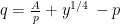
  4. The demand, q, for the product of a monopolist depends upon the price, p, of his produce and the amount of money, y, which he spends on advertising. The total production cost, c, depends upon the quantity of output, q. Given the demand function: q=\frac{A}{p}+{{y}^{{1}/{4}\;}}-p
    and the total (production) cost function = q
    where is a positive constant;
    Determine the output, the price, and the advertising outlay which would maximize the profits (total revenue minus total outlay) of this enterprise.
  5. The well-being, u, of a worker depends upon the amount, x, of consumers’ goods which he can buy with his daily wage, and the number of hours of leisure, y, which remain to him after he finishes his daily work:
    u= f(x, y)

    1. Derive the equations determining the number of hours (call it l) of daily work which he will be willing to do at the wage of dollars per hour, if the price of the consumers’ good is dollars per unit.
    2. Show that an increase of the hourly wage rate might reduce the number of hours which the worker will choose to work.


Source: Harvard University Archives. Harvard University Final Examinations, 1853-2001. (HUC 7000.28) Box 11. Faculty of Arts and Sciences. Papers Printed for Final Examinations. History, History of Religions, …, Economics, …, Military Science, Naval Science. January, 1946.

_______________

Economics 4a not offered in 1946-47

_______________

Course Enrollment, 1947-48

[Economics] 4a. Professor Leontief. — Introduction to the Mathematical Treatment of Economic Theory (Sp).

2 Graduates, 6 Seniors, 8 Juniors, 1 Sophomore, 2 Public Administration, 1 Radcliffe. Total 20.

Source: Harvard University. Report of the President of Harvard College and Reports of Departments for 1947-1948, p. 89.

*  *  *  *  *  *  *

Reading list and midterm and final examination question, 1947-48

_______________

Economics 4a not offered in 1948-49

_______________

Course Enrollment, 1949-50

[Economics] 104 (formerly Economics 4a). Assistant Professor Goodwin. — Introduction to the Mathematical Treatment of Economic Theory (Sp).

3 Graduates, 6 Seniors, 1 Junior, 2 Sophomores, 1 Public Administration, 1 Radcliffe. Total 14.

Source: Harvard University. Report of the President of Harvard College and Reports of Departments for 1949-1950, p.72.

*  *  *  *  *  *  *

Course Texts on Library Reserve, 1945-46

R.G.D. Allen. Mathematical analysis for economists

W.L. Crum. Rudimentary mathematics for economists and statisticians

P.A. Samuelson. Foundations of economic analysis.

Source: Harvard University Archives. Syllabi, course outlines and reading lists in Economics, 1895-2003. HUC 8522.2.1, Box 4, Folders “1949-1950 (1 of 3)”.

_______________

Image Sources: Schumpeter and Leontief from Harvard Class Album 1950, Goodwin from Harvard Class Album 1951.

Categories
Exam Questions Harvard Undergraduate

Harvard. Undergraduate general examination in economics, 1953


In a recent series of posts Economics in the Rear-view Mirror has provided transcriptions of undergraduate comprehensive examinations in economic for Harvard (1931), Wesleyan (1931), Princeton (1929 and 1932), and Swarthmore (1931).  The general examination for Harvard (1939) was posted even earlier.

Found in John Kenneth Galbraith’s papers with his Harvard tutorial materials is the following A.B. general examination from April 29, 1953. Students had to answer five questions, having considerable room for maneuver among and within fields.

____________________

DEPARTMENT OF ECONOMICS
GENERAL EXAMINATION

(Three hours)

Please note on the front cover of your bluebook the number of each question upon which you write, in the order followed in your book, and HONORS or NON-HONORS.

PART I
(One hour)
Economic Analysis

HONORS candidates answer ONE question taken from questions 1-4.

  1. “Depressions are caused by the exhaustion of investment opportunities and the rigidity of saving.” Discuss.
  2. “Keynes’ theory may have undermined the neo-classical theory of the price level but it has left intact the neo-classical theory of relative prices.” Discuss.
  3. “The basic criteria of anti-trust policy with respect to product markets are the same whatever the competitive structure of labor markets may be.” Discuss.
  4. “Despite all the changes that have taken place in economic theory the profit motive continues to occupy the central role which it had in Ricardo’s theory.” Discuss the role of profit in (a) Ricardo, (b) neo-classical theory, (c) Schumpeter’s theory.

NON-HONORS candidates answer ONE question taken from questions 5-8.

  1. “Future historians may well write the epitaph of our civilization as follows:

From freedom and science came rapid growth and change.
From rapid growth and change came economic instability.
From instability came demands which ended growth and change.
Ending growth and change ended science and freedom.”

Discuss this alleged conflict between economic growth and measures to secure economic stability. In your answer refer to the views of some of the great economists for examples, Schumpeter and Keynes, on this problem.

  1. In explaining business cycles most economists place crucial emphasis on fluctuations in investment or capital goods.
    Discuss the determinants of investment and the manner by which these factors operate upon investment to produce fluctuations in National Income.
  2. The basic economic questions any society must somehow answer are: (1) What consumer and capital commodities shall be produced and in what quantities? (2) How shall the goods be produced, i.e., by whom and with what resources? (3) For whom are goods to be produced, i.e., how is the national product to be distributed among individuals? Outline the way in which these questions are answered in a perfectly competitive, free enterprise economy.
  3. In addition to wages, interest, and rent, economists often talk about a fourth category of income: profit. What do economists mean by this return? What are the causes of profit and its function in a capitalist system?

PART II
(Two hours)

All students are required to choose TWO of the four fields in Part II of this examination and to answer TWO questions in each selected field. Thus a total of four questions are to be answered in Part II with an allowance of a half hour per question.

A. Economic History

  1. “The very increases in the possibilities of unrestrained competition of the past seventy-five years, through developments in transport, technology, the size and organization of firms, etc.—may in themselves partly explain some of the restraints on price competition that have appeared in this century.” Discuss both the developments and their alleged effects.
  2. “In the past 150 years the United States economy has radically altered its relationship to the world economy and at intervals has been a seriously disturbing factor.” Discuss, including references to periods in the 19th as well as the 20th.century.
  3. “In spite of the waste, apparent exploitation, and graft, the railroads more than paid for themselves in terms of American economic growth.” Discuss.
  4. Why did Hamilton favor a central banking system? What was the subsequent history in the 19th century of the issue that he poses? How satisfactory, in terms of the needs of an expanding economy, were the alternatives to a centralized banking system that existed prior to 1912.

B. Money and Finance

  1. What are the relations between a country’s balance of payments and its internal monetary and fiscal policies?
  2. From a fiscal policy standpoint, what do you consider would be the best budgetary policy for the federal government to adopt in order to combat a growing deflationary trend?
    Indicate the relative advantages and disadvantages involved in the policy you propose.
    Indicate practical as well as theoretical considerations.
  3. “Classical economists tended to view the amount of taxes paid by the private sector of the economy as measuring the amount of ‘burden’ which the government imposed on the private sector.” Do you agree with this view? If you do, what is the justification for your position? If you do not, what are some possible alternative ways of measuring the “burden” of the government on the economy, and for what purposes can they be used?
  4. “Older business cycle theories emphasized fluctuation in prices while modern ones emphasize fluctuations in income.” What is the theoretical and empirical justification for this change in emphasis?
  5. What role did the Federal Reserve System play in financing the Second World War?
    Discuss the impact of this experience upon money and banking in the United States.

C. Market Organization

  1. The spread between prices paid farmers for products used as food and prices paid for these foods at retail was 55% of the consumer’s dollar spent for food in 1910-14. It was 54% in 1952. Account for the failure of this spread to increase in spite of the great increase in processing, services, and transportation sold with the food.
  2. Although price discrimination generally is regarded as being contrary to the public interest, it is expressly sanctioned in railroad rate-setting under another name: the “value-of-service” principle. What cost and market characteristic of railroads might lead you to justify the use of discriminatory pricing in their case?
  3. Bituminous coal is a “sick” industry. What are the causes of this “sickness”? What attempts have been made to impose “healthier” conditions on the industry?
  4. Various techniques are used by oligopolistic industries in attaining stable and desirable price and production conditions. Explain at least three (3) of these techniques and discuss the possible reasons for using any one over another.

D. Labor Economics

  1. What role did the courts play in labor-management relations in the latter part of the nineteenth century? How far was this situation changed subsequent to 1930?
  2. What is collective bargaining? Is it a process of communication and education leading to agreement based upon mutually accepted and recognized goals and standards, or is it a temporary truce based upon balance of power with conflicting basic objectives?
  3. Has organized labor “distorted” the wage structure and wage level of the country at the expense of the unorganized or the weakly organized and at the expense of the recipients of other functional shares?
  4. How would you handle the problem of national emergency disputes?

April 29, 1953.


Source:  John F. Kennedy Presidential Library. John Kenneth Galbraith Personal Papers, Harvard University File, 1949-1965, Box 528, Folder “Tutorial 9/15/51-9/57”.

Image Source:  Harvard Album 1946.


Categories
Curriculum Undergraduate Washington University

Washington University. Undergraduate economics curriculum, 1897-98


In most U.S. colleges and university at the turn of the 20th century, an economics department was basically a one-man band. The courses at Washington University for the academic year 1897-98 were taught by the University of Chicago Ph.D. alumnus (1897), Henry Rand Hatfield.

___________________

Washington University
Announcement of Courses in
Economics
1897-1898

Department of Economics.
Henry Rand Hatfield, Ph.D., Instructor.


Course 1, to be followed by 2a, or 2b, is required of all taking work in the department, except of those taking Course 3, which is given independently and requires no other economic study.

The courses offered in Economics are as follows:

FIRST TERM.

COURSE 1. Elementary Economics.

A course for beginners, using Mill’s Principles of Political Economy (Laughlin’s edition) as text book. An attempt will be made to train the student in accurate economic reasoning and to show the vital connection between economic theory and the practical questions of the day. This course must be followed by either 2a or 2b.

COURSE 3. Economic History since 1763.

A course of lectures with collateral reading and reports, treating of the economic effects of the great inventions, of the American and French revolutions, of the free-trade movement in England, of the gold discoveries, of the civil war, of the crises of 1873 and 1893, etc.
No previous economic study is required for this course. Course 1 may, with advantage, be taken simultaneously.

COURSE 4. Financial History of the United States.

Lectures with collateral reading. The course will cover such topics as the management of the national debt, the use of customs duties as a revenue measure, the first and second United States Bank, the financial policy of the war of 1812 and of the civil war, the independent treasury, etc. An attempt will be made to trace the relation between the financial policy and the politics of the time, and, especially, to treat the financial history so as to throw light on the problems of today.

COURSE 6. Tariff History of the United States.

Lectures with collateral reading and study of Taussig’s Tariff History of the United States.
This course and Course 4 will be given in alternate years.


SECOND TERM.

COURSE 2a.  Advanced Economics.

This course continues the training in theory begun in Course 1, using Marshall’s Principles of Economics as the text-book with reading in Cairnes, Taussig, Hadley and Böhm-Bawerk. It should be taken by all who wish to continue the study of Economics.

COURSE 2b.  Descriptive Economics.

A practical course, designed to supplement Course 1, for those who desire only a general acquaintance with the subject. The topics discussed will be money, banking, coöperation, socialism, taxation and transportation.

COURSE 5. Money and Banking.

Discussion of the theory of money, bi-metallism, note issues and the function of bank credits. Short theses will be prepared by the students and discussed in class.

COURSE 7. Social Economics.

An examination of the economic aspects of certain social problems. The questions considered will be those relating to state interference including poor-relief, immigration, the control of monopolies, etc., and certain schemes of economic reform, such as coöperation, profit-sharing, and trades unions.
This course and Course 5 will be given in alternate years.


Source:  University of Chicago. Office of the President. Harper, Judson and Burton Administrations. Records, Box 29, Folder #8 “Chicago, University of, professional schools, School of Commerce and Administration, 1896-1924”, Special Collections Research Center, University of Chicago.

Image Source: Found in several family trees at ancestry.com without citation.


Categories
Exam Questions Undergraduate

Wesleyan. Comprehensive undergraduate economics exam, 1931


Over the past few days Economics in the Rear-view Mirror has posted comprehensive undergraduate economics exams around 1930 from Harvard, Princeton, and Swarthmore. Today I add an economics comprehensive exam from Wesleyan University to round out this cross-section.

________________

Comprehensive Examination in Economics
Wesleyan University, 1931

Part I

(Two hours)
Answer TWO of the following questions.

  1. Snowden of the British Exchequer in explaining his land value tax proposal in the House of Commons, on May 4, 1931, said:

“By this measure we assert the right of the community to ownership of the land. If private individuals continue to possess a nominal claim to land they must pay a rate to the community for the enjoyment of it. They can not be permitted to enjoy the privilege to the detriment of the community.

“Land differs from all other commodities in various respects. Land was given to us by the Creator, not for the private use of the dukes but for the equal use by all His children. Restriction of freedom in the use of land is a restriction on human liberty.

“To restrict the use of land by arbitrary will, the owner enhances its price, raises rents, hampers industry and prevents municipal development and the increase of amenities. Every increase in population, every expansion in industry, every scientific development, every improvement in transportation, every child that is born, increases the rent of land. Rent enters into the price of every article produced, into the cost of every public service.”

What economic principles are involved in the above analysis? What was the position of the classical economists with reference to the various problems involved?
To what extent do you agree with Mr. Snowden’s analysis and what are the reasons that contribute to your present conviction?

  1. Write a brief essay on the subject “Laissez Faire in Economic Theory: Its Past Significance and Its Applicability to the Present American Economic Order.”
    In your essay show how economists of the past regarded laissez faire, the reasons for their attitude, and the adequacy of this philosophy for the problems of the present.
  2. What is the basis for the assertion that we have an acquisitive society? Indicate the strong and the weak points of such a society. Outline in general terms, the nature of a so-called functional society. Present the case for and against such a social order.
    Indicate your conclusion as to the relative merits of these two types of societies as applied to past eras and as applied to the present period.
  3. (a) Enumerate and describe each of the important wage theories that has been suggested in the evolution of classical economic doctrines.
    (b) Indicate what wage theories were held by each of the authors you have studied and explain why he advocated the theory in question.
    (c) What do you regard as valid and what invalid in all these wage theories? Present and defend your own explanation for the general wage level.


Part II

(Two and one-half hours)
Answer THREE of the following questions.

  1. (a) What are the causes of the present economic depression in the United States and the rest of the world?
    (b) What agencies, if rightly directed, can contribute toward the elimination of business fluctuations? Explain in what manner and to what extent each of these agencies may be expected to assist.
  1. Contrast Russia and the United States at the present time as to the organization of economic institutions, the direction of production and the distribution of wealth.
    Give and explain your opinion as to the relative merits of the two systems.
  2. Compare the conditions of farming and industry that make for a special agricultural problem in the United States.
    Evaluate the measures that have been suggested for the solution of this problem.
  3. The Labor Government is in power in Great Britain. A collectivist system supported by the industrial wage earner exists in Russia while organized labor in the United States is relatively weak and ineffective. Discuss and explain these contrasts.
  4. (a) The late President Hadley believed that public utilities should be subjected to no more regulation than any private enterprise. Can you suggest any arguments in support of such a position? What are the arguments on the other side?
    (b) What do you consider necessary as a means of insuring adequate regulation of public utilities and how would you proceed to the attainment of this objective.
    Outline in detail some of the things that you would prescribe.

(Each student will be examined orally as per schedule already announced.)

  1. [The consumer pays $10 for a given goods. Four of the $10 go to the manufacturer. What important economic problems are suggested by this situation? Indicate and defend a program for meeting these problems.]


[Note: question 6 of part II of this exam was not included followed by the note “Question presented elsewhere”. In the list of 65 selected questions for review in the cited source below, there was a single optional 50 minute question. I have included that question in square brackets above, but this represents only an educated guess on my part.]


Source:  Edward S. Jones. Comprehensive Examinations in the Social Sciences, Supplement to the December, 1933 Bulletin of the Association of American Colleges,pp. 36-38.

Image Source: Olin Memorial Library at Wesleyan University, built in 1925-27 and dedicated in 1928. From Wikipedia entry “Wesleyan University”.

Categories
Exam Questions Swarthmore Undergraduate

Swarthmore. Senior comprehensive economics exam, 1931


The two previous posts provided undergraduate comprehensive examinations for Harvard and Princeton from the early 1930s that were published in the Bulletin of the Association of American Colleges (December, 1933). The cross-section of comprehensive economics exams is now expanded with this post to include Swarthmore College’s economics department.

A decade later Swarthmore College brought in external examiners (many of whom recruited from Wolfgang Stolper’s network of Harvard graduate buddies), e.g.

_________________

Senior Comprehensive Examination in Economics

Swarthmore College, 1931

  1. a. Why have railroads been subject to an unusual amount of regulation?
    b. Appraise reproduction cost as a basis for the valuation of public utilities.
    c. Explain the operation of the principle of joint costs in the determination of rates for specific services.
  2. Discuss:
    a. “One of the unions’ chief errors is restriction of output, which is always against the social interest and even fruitless for the workers.”
    b. “To the extent that employee representation seems to the worker to be just an employer’s weapon against trade unionism, it will be still less popular in the future than today and even its good points will be ignored.”
  3. Is it necessary to make goods in order to make money? Give the answers of T. N. Carver, S. & B. Webb, F. M. Taylor, T. Veblen, Adam Smith, R. H. Tawney, and Alfred Marshall. Why have these scholars come to such contrary conclusions after examining the facts? Is it possible that both groups are right; that neither one is right? How so? If not, which group is right and why?
  4. a. Since it is understood that all kinds of money in this country are to be maintained at a parity of value with standard money, would not inconvertible paper money issued by our government be quite as acceptable and useful as any kind? Explain.
    b. In the United States there are many kinds of money. What are they, and what is the security behind each one? Does Gresham’s Law operate? Why, or why not.
  5. a. It is said that the United States is evolving into a commission form of government; that the government set up by the Constitution is gradually delegating its duties to “expert commissions.” Bearing in mind the frailty of commissioners and their staffs, do you believe this is a wise movement? Why? Be specific.
    b. Giving generous reference to the history of governmental regulation in the United States, what do you believe will be the position of the government as a regulator of business twenty-five years hence?
  6. According to present estimates, the federal government will complete this fiscal year, June 30, 1931, with a deficit of nearly one billion dollars. Outline, in detail, the causes of this deficit. Suggest, with reasons, the fiscal program which the government should adopt, for the coming year, in view of this deficit.
  7. Philip Snowden, British Chancellor of the Exchequer, has proposed the imposition of a tax on the site value of land as a means of balancing the British budget. It is argued that such a tax would have less of a repressive effect upon industry than any other type of tax which might be imposed. Give in detail the reasoning which supports this position.
  8. Give an historical account of the currency agitation and legislation from the end of the Civil War to the end of the last century. What issues were involved and how did they arise? On the whole, do you think that our currency history of this period refutes or verifies the quantity theory of money?
  9. a. Imagine yourself a Congressman in the year of 1828 and make a brief argument for the high tariff policy adopted in that year. Would you argue in the same way today? If not, why not? Is your supposed speech that of a representative from South Carolina or Pennsylvania? Give reasons.
    b. Briefly comment upon what you regard as three important causes or factors in the present industrial depression.
  10. a. How important for price theory and for practical life are differences in the elasticity of demand for commodities? Illustrate, using diagrams.
    b. Translate, and if necessary, correct the following popular statements into the more exact language of economic theory:

(1) “We produce too much coal and people freeze to death; we raise too much cotton and people go naked.”
(2) “Great Britain’s foreign trade is in a bad way; she has an extremely unfavorable balance.”
(3) “The price of corn is low because you can buy good corn land so cheaply.”
(4) “Depressions are due to over-production, and by this I mean that more goods are produced than can be sold, for two reasons; rich people save too much, and the workers do not get high enough wages.”

(Answer five questions. Use the first half-hour to study and select your questions. Then devote about thirty minutes to answering each question.)


Source:  Edward S. Jones. Comprehensive Examinations in the Social Sciences, Supplement to the December, 1933 Bulletin of the Association of American Colleges, pp. 41-43.

Image Source: Parrish Hall, Swarthmore College  .


Categories
Exam Questions Princeton Undergraduate

Princeton. Two undergraduate comprehensive exams in economics, 1929 and 1932


Another catch in my trawling for exams, we have below two undergraduate comprehensive examinations from Princeton (1929 and 1932).  These exams were selected and published in a supplement to the Bulletin of the Association of American Colleges dedicated to the subject of comprehensive exams. The style of the questions is rather different from those seen for Harvard from 1931 that were transcribed for the previous post.

__________________________

Senior Comprehensive Examination
Princeton University, 1932

Part I
Use a separate book for each question

I
(20%)

  1. Contrasting the England of 1700 with the England of the Middle Ages, R. H. Tawney states: ” Opinion ceased to regard social institutions and economic activity as amenable, like personal conduct to moral criteria.”
    How far was this true (1) of price; (2) of the money reward for human labor? Give the reasons.
  2. Compare Henry George’s theory of rent with Ricardo’s theory of rent.

II
(40%)

  1. What was the Marxian theory of “surplus value”? Discuss the present price and wages policy in Russia in the light of the Marxian theory.
  2. “Socialization will proceed, step by step, from one industry to another, according as circumstances in each country may permit. Objectionable as private profit-making enterprise is to Socialists, they will refrain from destroying it in any industry until they are in a position to replace it by a more efficient form of organization.” (From a resolution of the Labor and Socialist International.)
    What is the “more efficient form of organization” proposed for the “nationalized industries,” as illustrated in the Webb Constitution for the Socialist Commonwealth of Great Britain? Would it be more efficient than “private profit-making enterprise” in these industries? Give your reasons.

III
(40%)

Answer one of the three following questions: A, B, or C.

A

Discuss the Interstate Commerce Commission in its present status as a regulator of interstate commerce. Is it lacking any powers which it should possess? Should it be deprived of any powers that it now has? Are there any powers it should retain which could be made more effective by legislation? Give reasons for your answers.

B

At the time of the Napoleonic Wars the following statement was made as to the ability of Great Britain to make remittances to the continent to support her armies and subsidize her allies:

“A favorable balance of trade is a very probable consequence of large drafts on Government for foreign expenditure; an augmentation of exports, and a diminution of imports, being promoted and even enforced by the means of such drafts.”

A few weeks ago, in a discussion of the payments of inter-allied debts, it was stated:

“The essential fact about war debt payments is that they are foreign payments. Many people seem to think that the French Government may tax its citizens, deposit the money in the Bank of France, and then either draw a check upon the Bank of France to pay the United States on war debts, or use the same money for armament expenditures. The essential difference is that a check drawn in francs by the French Government upon the Bank of France to the credit of the American Treasury is of no value to us until it is transferred into dollars.”

On the basis of these statements, discuss critically the topic, “Divergent Views on the Payment of International Obligations,” laying particular emphasis on the economic principles which are involved. Where possible, use historical illustrations in your discussion.

C

A certain industrial corporation has outstanding common stock of par value of $10,000,000; also a first mortgage bond issue, amply secured by the plant, of $2,000,000.

Below is a list of five possible methods of voluntarily revising the capital structure of this company.

  1. The issuance of convertible bonds,
  2. The declaration of a stock dividend,
  3. The declaration of a privileged stock subscription,
  4. The purchase of the company’s own stock in the open market,
  5. The formal reduction of the corporation’s capital by amendment of the certificate of incorporation.

Discuss thoughtfully four of these five methods.

While it is not desirable to lay down any rigid plan to be adhered to in discussing all of these methods, your answer should explain (1) what is involved in the use of the method in question, (2) the objective or objectives ordinarily sought to be attained by its use, (3) what conditions other than those stated in the first paragraph should prevail in order to justify the use of the method, and (4) any special disadvantage which might be suffered.

__________________________

Senior Comprehensive Examination
Princeton University, 1929

Examination in Special Field I

I

Case A

During the latter part of the period of inconvertible paper currency in this country (1862-1879) trade dollars (a silver coin somewhat heavier than the standard silver dollar and possessing at that time the right of free coinage) began to appear in circulation alongside the greenbacks, although the trade dollar was intended for use only in foreign trade.

Case B

In Russia, the chervonetz, a paper monetary unit issued in 1923, kept at a high value by relative limitation of quantity and backed by a considerable gold reserve, quickly drove the Soviet paper rouble, an enormously depreciated paper monetary unit, out of circulation.

Case C

In Germany, in 1923, foreign gold standard currencies appeared in considerable volume in ordinary commercial transactions, which up to that time had for years been carried on almost entirely with highly depreciated paper marks.

In all these cases “bad” money not only did not drive out good but the reverse was more nearly true. Explain each case and state Gresham’s Law so as to make it universally applicable.

II

Suppose that the United States in 1893 had abandoned the gold standard, taken from gold the legal tender quality and made all paper currency redeemable in silver dollars which were no longer freely coined.

(a) What would have been the upper and lower limits on the exchange rates of the dollar against gold standard currencies?

(b) What influences would have affected the gold value of the dollar?

(c) How, if at all, would the gold price of silver have been affected?

(d) Could the rise in prices, which took place after 1896, have been prevented under the monetary system outlined above? Reasons.

III

Compare the check and deposit system of banking, such as prevails in Anglo-Saxon countries, with the French system where checks are little used and practically the whole of the circulating medium is issued by the Bank of France which shares its profits with the government of the republic.

Your answer should attempt to assess, from the point of view of the general interest, the relative virtues and vices of the two types of banking, showing specifically and precisely in what manner advantages or disadvantages accrue under the one or the other system.

IV

Assume that in any given country:

(a) central bank reserves are very high;

(b) exports are increasing relative to imports;

(c) stock speculation has been and continues rampant and stock prices have risen greatly;

(d) commodity prices are stable.

What policy do you think the central bank should pursue, and why?

V

Spain is now on an inconvertible paper monetary standard. Suppose that political disturbances lead to a sharp decline in confidence with regard to Spain’s economic prospects, that present foreign lenders to Spain seek to withdraw their capital and that further loans are refused. Trace through the resulting movement of exchange rates the probable course of trade and industry in Spain up to the point of restoration of a stable economic equilibrium. Assume no further inflation of the Spanish currency.

VI

  1. Give a brief description of the Dawes Plan of reparations payments, criticizing adversely where such criticism seems to you to be warranted.
  2. Compare the economic effects on both paying and receiving countries of reparations in cash and reparations in kind.


Source:  Edward S. Jones. Comprehensive Examinations in the Social Sciences, Supplement to the December, 1933 Bulletin of the Association of American Colleges, pp. 38-41.

Image Source:John E. Sheridan, Princeton Poster, c. 1901  . Library of Congress Prints and Photographs Division Washington, D.C. 20540 USA.


Categories
Exam Questions Harvard Undergraduate

Harvard. Three economics subject exams from divisional comprehensives, 1931


Being a scavenger for old economics exams, I just had to transcribe the following three comprehensive subject examinations from the Harvard Division of History, Government, and Economics battery of comprehensive exams from 1931.  These exams were selected and published in a supplement to the Bulletin of the Association of American Colleges dedicated to the subject of comprehensive exams. The subjects examined were History of Economic Thought, Public Finance, and Labor Problems.

For some strange reason two of the questions were omitted, with a note that the questions were presented “elsewhere”. I have identified what I think to be the likely missing questions from a list of 65 questions discussed earlier in the monograph. These two questions are placed in square brackets in the public finance and labor problems examinations.

__________________________

History of Economic Thought

Harvard University, 1931
(Three hours)

Answer either FOUR or FIVE questions, including TWO from each group. If you answer FOUR questions, write about an hour on one of them and mark your answer “Essay.” This question will be given double weight.

A

Use a separate blue book for the questions in this part.

  1. Discuss the economic policies of one of the following in the light of theory and contemporary conditions: Colbert, Hamilton, Turgot, Bismarck, Andrew Jackson, Gladstone, Cromwell.
  2. Compare the part played by economic theories in the French Revolution and the Russian Revolution.
  3. In what ways do you think the economic thought of the Greeks reflects the social, intellectual, and political conditions of the period?
  4. Discuss the influence of economic fallacies upon public policy during the past hundred years.
  5. To what extent do you think the social and economic organization of medieval towns is reflected in the economic views of medieval thinkers?
  6. “Mercantilism is, in substance, the sum of all efforts to bring about a self-sufficient empire.” Discuss.
  7. How did contemporary writers explain the price revolution of the sixteenth century? Were these new or already accepted doctrines?
  8. Discuss the importance of economic theory for an understanding of British colonial policy during the period from 1783 to 1867.

B

Use a separate blue book for the questions in this part.

  1. What were some of the more widely held theories of wages during the nineteenth century?
  2. Discuss one of the following topics: The Medieval Doctrine of Just Price; The “Dismal Science”; Economic Stages.
  3. “Though the real problem of Distribution was sometimes approached by the Classical Economists, it was never properly presented, nor was an attempt made at its solution.” Discuss.
  4. What were the chief contributions to economic thought of one of the following writers: Senior, J. B. Clark, Walker, Cantillon?
  5. Explain the meaning of three of the following terms and tell with what writer or group they are chiefly associated: produit net, lucrum cessans, preventive check, productive forces, non-competing groups.
  6. ” There are no terms in economics which bear about them more palpable traces of the conflicts through which they have gone than ‘production’ and ‘productive.'” Discuss.
  7. What were the principal doctrines of the Austrian school of economics?
  8. Discuss the relation between the work of one of the following writers and the work of earlier thinkers: Smith, J. S. Mill, Marshall.

__________________________

Public Finance

Harvard University, 1931
(Three hours)

Part I
(About one hour)

  1. White an essay on one of the following topics:

(a) The general property tax,
(b) British budget principles since 1860,
(c) The sales tax,
(d) Postal rate problems in the United States,
(e) Financial problems of highway construction and maintenance.

Part II
(About one hour)

Answer TWO questions only.

  1. Do you think it wise for a government to exempt its own bonds and notes from taxation? Why, or why not?
  2. Indicate the nature and significance of the “grant in aid” in British public finance.
  3. Discuss recent tendencies in state and municipal expenditure.
  4. Discuss the fiscal aspects of a system of protective tariff duties.
  5. [In what ways do the problems of government finance affect currency systems and the control of currency?]

Part III
(About one hour)

Discuss THREE of the following quotations.

  1. “Modern taxation or tax making in its most characteristic aspect is a group contest in which powerful interests vigorously endeavor to rid themselves of present or proposed tax burdens.”
  2. “Though differential rents of land have complete ability to bear taxation directly imposed upon them, and cannot shift such taxation, they cannot be reached by a tax imposed upon their produce.”
  3. “To tax investment income at a higher rate would seem to be trebly unjust; for ‘savings’ are first taxed as ‘earned income’; the income derived from them is then taxed as ‘investment income’; and, thirdly, a portion of the invested capital, is confiscated by the ‘death duties’—a triple penalty upon thrift.”
  4. “It must not be supposed that a government’s safe borrowing power is anything like its national wealth, for the wealth belongs to the people and can be taken from them only by law and the laws are made by the people indirectly and eventually.”
  5. “Taxes should fall proportionately to the wealth of the taxed, that is, the sacrifice should be equally felt by all. This rule is easy to keep when taxation is light; but when taxation must be heavy, the rule is difficult to keep.”

[Note: Part II, Question 6 has been identified from a list of 65 questions as likely. It was appears to be the better “fit” of  two optional, 20-minute public finance questions.]

__________________________

Labor Problems

Harvard University, 1931

Part I
(About one hour)

  1. Write an essay on one of the following topics:

(a) the legal status of trade unions in Great Britain,
(b) unemployment and the business cycle,
(c) standard wage rates,
(d) the family allowance system,
(e) the policy of organized labor towards new machinery.

Part II
(About one hour)

Answer TWO questions only.

  1. To what extent does welfare work contribute to the solution of the labor problem?
  2. What is a sweated industry? What are the best correctives for this abuse?
  3. Compare the policies of the trade unionists in any two of the following countries:

(a) United States,
(b) France,
(c) Germany,
(d) Australia.

  1. Discuss the policy and objectives of the British Labor Party.
  2. Discuss the tendencies of judicial interpretations of “liberty of contract” in labor cases in the United States.

Part III
(About one hour)

Discuss THREE of the following questions.

  1. “Only the most formal conception of the idea of equality and the most unrealistic attitude toward groups in our community could think of the ordinary forms of labor legislation as class legislation.”
  2. “If no general fund exists which can be diverted from some other form of surplus income into wages, trade unionism becomes a mere device for adding to certain well organized groups of workers a scarcity wage paid by less favorably placed workers.”
  3. “Wages are more of a question for business than they are for labor. Low wages will break business far more quickly than they will labor.”
  4. “Scientific management, properly applied, normally functioning, should it become universal, would spell the doom of effective unionism as it exists today.”
  5. [“As long as there is liberty there will be strikes, for a strike is nothing more or less than liberty to stop work and to wait for a bargain.”]


[Note: Part III, Question 11 has been identified from a list of 65 questions as an optional optional labor question for about 20 minutes and that fits the discuss the quotation format]


Source:  Edward S. Jones. Comprehensive Examinations in the Social Sciences, Supplement to the December, 1933 Bulletin of the Association of American Colleges, pp. 33-36.